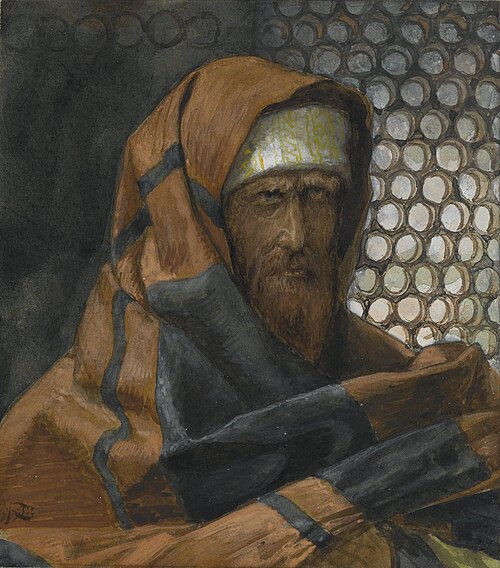
Righteous
Nicodemus
Disciple of the Lord
A Pharisee and member of the Sanhedrin who came to Jesus by night and helped bury Him.
- Feast
- August 2old style August 15
- Reposed
- 1001st century
- Place
- Judaea
- Order
- The Righteous
Life
Saint Nicodemus the Righteous was a Pharisee and a member of the Sanhedrin, a teacher of Israel, who came by night to the Lord Jesus Christ and who, after the Crucifixion, brought spices for His burial. The Gospels name him only in the Gospel of John. The Orthodox Church honours him as a disciple of the Lord on the Sunday of the Myrrh-Bearers, the third Sunday of Pascha, and on 2 August, the day of the finding of his relics.
John shows him three times. First, Nicodemus comes to Jesus by night, perhaps from fear of others, perhaps so that he might talk undisturbed, and says to Him, "Rabbi, we know that you are a teacher come from God." The Lord speaks to him about being born again, of water and the Spirit, without which no one can enter the Kingdom of God, and says the words, "For God so loved the world that he gave his only Son" (John 3:1-21). Nicodemus is puzzled, and Jesus answers that he, a teacher of Israel, should understand these things. The Gospel does not say how the meeting ended.
The second time is during the feast of Booths, when the chief priests and Pharisees were angry that the guards had not arrested Jesus. Nicodemus spoke in the Sanhedrin: "Does our law judge a man without first giving him a hearing and learning what he does?" His colleagues mocked him, saying that no prophet comes from Galilee (John 7:50-52).
The third time is after the death of the Lord on the cross. Nicodemus came with Joseph of Arimathea, took part in taking the body down, and brought a mixture of myrrh and aloes of about a hundred Roman pounds, roughly thirty-three kilograms, a quantity fit for a king. They wrapped the body in linen cloths with the spices, as the Jews bury, and laid it in a new tomb in the garden near the place of crucifixion (John 19:38-42). The disciples were hiding in fear, and what these two men did took courage.
According to tradition, Nicodemus was baptized after the Resurrection by the Apostles Peter and John. For his faith he was expelled from the Sanhedrin, deprived of his property and driven out of Jerusalem. He found shelter in the house of his kinsman Gamaliel, the teacher of the Law mentioned in the Acts of the Apostles (5:34-39), who also became a Christian, together with his son Abibas. After their death they were buried near Saint Stephen the first martyr.
In the year 415, the priest Lucian of Kafar-Gamala, near Jerusalem, had visions in which Gamaliel showed him the place where the bodies of Stephen, Nicodemus, Gamaliel and Abibas lay. They dug and found the tombs, a fragrance came out of them, and many healings followed. The relics of Stephen were taken to Jerusalem, and the others were placed in the church at that place. Lucian wrote an account of the finding. The Church commemorates it on 2 August (15 August by the civil calendar for the Churches that keep the old calendar). The Roman Church marks the translation on 3 August, and keeps Nicodemus with Joseph of Arimathea on 31 August.
Under his name a writing has come down, the Gospel of Nicodemus, also called the Acts of Pilate, from the fourth or fifth century. It is not Scripture, and the Church does not use it as such. Some modern scholars have wondered whether the Gospel Nicodemus is the Nicodemus ben Gurion known from the Talmud, but others reject this, because that man lived some forty years later.
Commemorated the same day August 2
 Stephen I of RomeHieromartyr · Bishop of RomeAug 2
 GamalielRighteous · Teacher of the Apostle PaulAug 2
 Basil the BlessedFool-for-Christ · Fool for Christ of MoscowAug 2
 Maximus of PaduaSaint · Bishop of PaduaAug 2
- Theodore of the DardanellesNew Martyr · New Martyr of the DardanellesAug 2
- Abibas of JerusalemRighteousAug 2
- Aelfthryth of CrowlandSaintAug 2
- AlfredaVenerableAug 2
- Athanasius ZhulanovMartyrAug 2
- Auspicius of AptSaint · Bishop of AptAug 2
- BasilMartyrAug 2
- Basil of VologdaFool-for-ChristAug 2