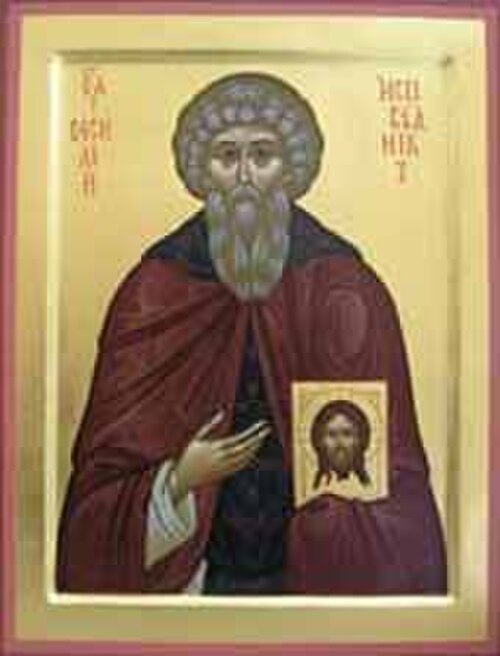
Venerable
Basil the Confessor
Byzantine monk
Byzantine monk venerated as a confessor of the faith, who died around the year 750.
- Feast
- February 28old style March 13
- Reposed
- 7508th century
- Order
- Venerables
Life
Venerable Basil the Confessor (also called Basil the Decapolite) was a Byzantine monk, disciple and companion in struggle of Venerable Procopius the Decapolite, and died around 750. He is commemorated on 28 February (by the new calendar, 13 March by the old; according to the Serbian source, also on 12 April). Our sources mix this monk with another Basil the Confessor, bishop of Parium, so we tell of each separately.
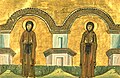
He was a monk in Constantinople, in one of the monasteries. In the time of the iconoclast persecution of the emperor Leo the Isaurian, he was subjected together with Procopius to many torments and put in prison, where both monks remained until the emperor's death, in 741. After the emperor's death Basil lived nearly ten years more, returned to his monastery and died a natural death, in 750 (the Serbian source gives the year 747). In the Menologion of Basil II (end of the tenth century), under 27 February, there is a short common life of Procopius and Basil, in which both are called confessors. In the Synaxarion of the Church of Constantinople (tenth century) the life of Procopius is under 27 February, and that of Basil under 28 February. In the Menologion the image of the two venerable ones is painted. In Russian calendars Basil is called the Decapolite, but in the Greek ones this name is missing.
The other Basil the Confessor was a monk and was elected bishop of Parium, in Asia Minor. In February 754 the emperor Constantine V convened the synod of Hieria to condemn the veneration of icons. Basil refused to sign the decision to destroy icons and then avoided any dealings with the iconoclasts. For this he suffered much persecution, hunger and deprivation. He is commemorated on 12 April. The Serbian source considers that they are one and the same person and says that he was bishop at Parium, refused to sign the decision against the veneration of icons and was tormented, then returned with Procopius to their monastery. The two accounts do not agree.
Commemorated the same day February 28
 Romanus of CondatVenerable · Hermit of the JuraFeb 28
 Nestor of MagydosHieromartyr · Bishop of MagydosFeb 28
 Kyranna of ThessalonicaNew Martyr · Martyr of ThessalonicaFeb 28
 Nicholas Salos of PskovFool-for-Christ · Fool for Christ of PskovFeb 28
 Marina and CyraHoly Venerables · Nuns of SyriaFeb 28
- NymphasApostle · One of the SeventyFeb 28
- Leo of CappadociaVenerable · Ascetic of CappadociaFeb 28
- AvrikiosMartyrFeb 28
- BarsusSaint · Bishop of DamascusFeb 28
- Cairalius, Pupulius, Gaius and SerapionHoly MartyrsFeb 28
 Cyra of BeroeaVenerableFeb 28
- Diochuill of Airiudh MuiltSaintFeb 28