Fool-for-Christ
Nicholas Salos of Pskov
Fool for Christ of Pskov
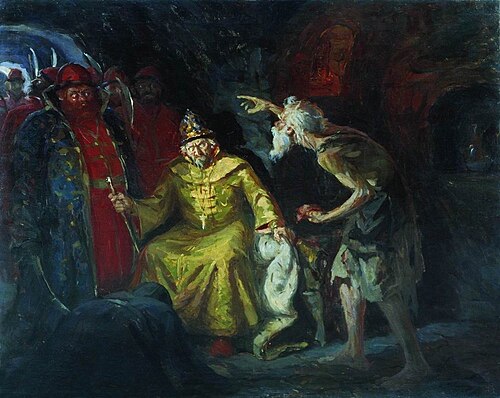
Fool for Christ of Pskov who in 1570 stood in the way of Tsar Ivan the Terrible's wrath against the city.
- Feast
- February 28old style March 13
- Reposed
- 157616th century
- Place
- Pskov
- Order
- Fools-for-Christ
Life
Nicholas Salos of Pskov was a fool for Christ who, according to tradition, in February 1570 went out to meet Tsar Ivan the Terrible and rebuked him for cruelty, thus stopping the killing of the people of Pskov. He is venerated as a local saint of Pskov; the Russian source numbers him among the locally venerated saints, not among those venerated by the whole Church. He is commemorated on 28 February (in a leap year, on 29 February), Old Style. The years of life given in our record (1501 to 1576) are not confirmed by the Russian sources, which give neither the date of birth nor of death.
The tradition
In February 1570, after the devastating campaign against Novgorod, Tsar Ivan IV, suspecting the inhabitants of treason, marched on Pskov with his oprichniki. The tradition says the people of Pskov met him with bread and salt, and from the crowd Nicholas came out and held out a piece of raw meat, on a fast day, as a pointer to the sinfulness of his deeds. By his harsh speech the tsar was halted, ordered the killings to cease and then left for Alexandrov, sparing the city. He was buried under the cathedral of the Holy Trinity at Pskov. The record of his miracles, which existed in the eighteenth century, has been lost.
What the sources say
Of Nicholas we have no news in the chronicles, though the tsar's visit to Pskov is mentioned in the Short Pskov Chronicle. The oldest testimony is that of the English merchant Jerome Horsey, who calls him "Mickula Sweat" (Mikula the Holy) and tells how a sorcerer or deceiver, held by the people to be a prophet, met the tsar with curses and threats, calling him a blood-drinker, and warned that a cloud of fire hung above his head. The tsar shuddered and asked him to pray for forgiveness of his cruel thoughts. Horsey says he saw him himself, a wretched figure, naked summer and winter. The English diplomat Giles Fletcher, who was at Moscow in 1588, mentions the event in a favourable light and tells the legend of the raw meat offered to the tsar on a fast day. Karamzin names him beside the voivode Tokmakov, who was then at Pskov, but in general repeats Fletcher's account; the account is found again in Metropolitan Macarius (Bulgakov) and in P. V. Znamensky.
The historian I. U. Budovnits, who studied widely the old Russian and foreign sources, judged that the story of Nicholas and Tsar Ivan has a purely legendary character. All the sources give Nicholas the role of saviour of Pskov from the tsar's wrath, but tell differently how he rebuked him. The name "Salos" comes from the Greek for "fool"; the Brockhaus and Efron dictionary explains it, citing Karamzin, as "simple, foolish", and ties it to the nickname of a fool of Novgorod. For us there remains the figure of a man of God who dared to speak the truth before power.
Commemorated the same day February 28
 Romanus of CondatVenerable · Hermit of the JuraFeb 28
 Nestor of MagydosHieromartyr · Bishop of MagydosFeb 28
 Kyranna of ThessalonicaNew Martyr · Martyr of ThessalonicaFeb 28
 Basil the ConfessorVenerable · Byzantine monkFeb 28
 Marina and CyraHoly Venerables · Nuns of SyriaFeb 28
- NymphasApostle · One of the SeventyFeb 28
- Leo of CappadociaVenerable · Ascetic of CappadociaFeb 28
- AvrikiosMartyrFeb 28
- BarsusSaint · Bishop of DamascusFeb 28
- Cairalius, Pupulius, Gaius and SerapionHoly MartyrsFeb 28
 Cyra of BeroeaVenerableFeb 28
- Diochuill of Airiudh MuiltSaintFeb 28