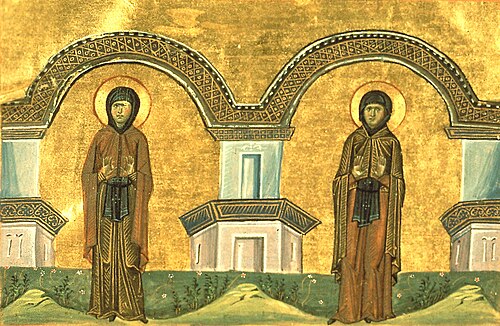
Holy Venerables
Marina and Cyra
Nuns of Syria
Two ascetics of Syria, nuns of the 4th and 5th centuries, whose struggles Theodoret of Cyrrhus describes.
- Feast
- February 28old style March 13
- Era
- unknown
- Order
- Venerables
Life
Venerable Marina and Cyra (or Marana and Cyra) were Syrian ascetics, nuns of the fourth and fifth centuries. Theodoret of Cyrrhus, who knew them personally, tells of them in chapter twenty-nine of the History of the Lovers of God. The Church commemorates them on 28 February.
They were born in the city of Beroea. They were of noble family and were brought up as befitted it. Leaving wealth and luxury, they fenced off for themselves a small place under the open sky outside the city, shut themselves in and blocked the door with earth and stones. For their maidservants, who wished to share their labours, Marina and Cyra built a small house beside their enclosure. Through a small opening in the wall Marina and Cyra watched over their fellow-strugglers and urged them to prayer. In place of a door they had a small window, through which they received necessary food. Through this window they spoke with the women who came to them, at one appointed time, Pentecost; at all other times they kept silence. Only Marina spoke with the women who came, and Cyra's voice was never heard by anyone.
Marina and Cyra constantly wore very heavy chains on their bodies. Cyra, who was weaker in body, bent to the ground under their weight and could not straighten herself. Their clothing consisted of large veils, which at the back fell to the ground and covered their feet entirely, and in front reached the waist and covered the face, neck, chest and hands. Theodoret saw them several times. Out of respect for Theodoret's episcopal rank, Marina and Cyra ordered the maidservants to open the door and let him inside. Theodoret saw very heavy chains on the bodies of these weak women and with difficulty persuaded them to take them off, but after he left they put them on again, at the neck, waist, hands and feet. Enduring all changes of weather, rain, snow and the burning rays of the sun, the ascetics were not downcast and did not grieve, but through their faith and prayer to God they knew how to draw joyful comfort from these visible hardships. By the time the History of the Lovers of God was written, in 444 or 445, Marina and Cyra had lived within their enclosure, in fasting and prayer, for forty-two years.
Imitating the prophets, Marina and Cyra took upon themselves various fasts: imitating Moses, three times they remained without food for forty days and then took a little nourishment; likewise, imitating Daniel, three times they fasted for three weeks and then took a little. Theodoret tells of two pilgrimages made by Marina and Cyra. The first was to Aelia (Jerusalem), at least twenty days' journey, to the place of the sufferings of Jesus Christ; on the way they took no food, and only after arriving in the city and venerating the holy places did they take some, and on the way back they kept the same strict fast. The second was to Isauria, to the city of Sis, to the tomb of the first martyr among women, Thekla. The two ascetics made the journey there and back without taking food.
Commemorated the same day February 28
 Romanus of CondatVenerable · Hermit of the JuraFeb 28
 Nestor of MagydosHieromartyr · Bishop of MagydosFeb 28
 Kyranna of ThessalonicaNew Martyr · Martyr of ThessalonicaFeb 28
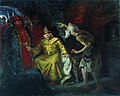 Nicholas Salos of PskovFool-for-Christ · Fool for Christ of PskovFeb 28
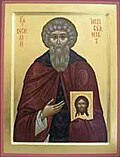 Basil the ConfessorVenerable · Byzantine monkFeb 28
- NymphasApostle · One of the SeventyFeb 28
- Leo of CappadociaVenerable · Ascetic of CappadociaFeb 28
- AvrikiosMartyrFeb 28
- BarsusSaint · Bishop of DamascusFeb 28
- Cairalius, Pupulius, Gaius and SerapionHoly MartyrsFeb 28
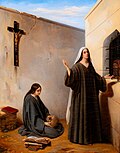 Cyra of BeroeaVenerableFeb 28
- Diochuill of Airiudh MuiltSaintFeb 28