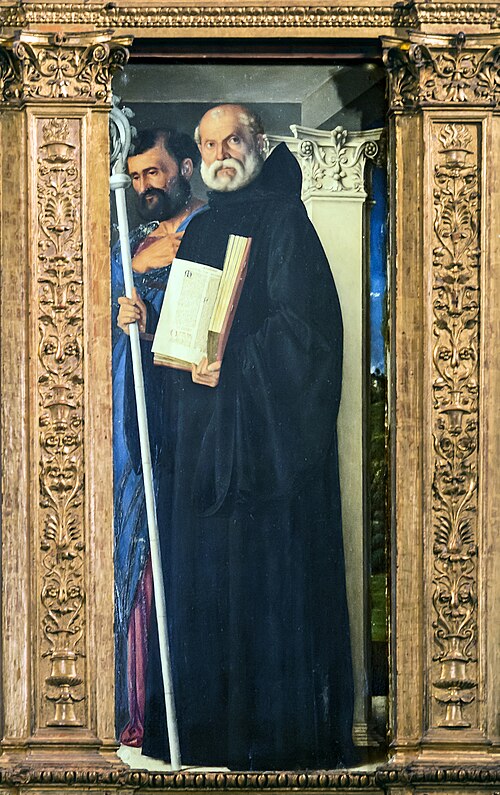
Venerable
Benedict of Nursia
Founder of Monte Cassino
Father of Western monasticism, author of a monastic Rule and founder of Monte Cassino.
- Feast
- March 14old style March 27
- Reposed
- 5476th century
- Place
- Abbey of Monte Cassino
- Order
- Venerables
Life
Saint Benedict of Nursia, the venerable father, is regarded as the father of Western monasticism. He lived in Italy at the end of the fifth and in the first half of the sixth century, founded the monastery of Monte Cassino, and wrote a monastic Rule that guided the monasteries of the West for centuries. His life is known chiefly from the Dialogues of Saint Gregory the Dialogist, whose second book is devoted to him.
Youth and the wilderness
He was born around 480 at Nursia in Umbria, to noble Roman parents, who sent him to study at Rome. Troubled by the way of life of the city, he left the schools. He first settled at Enfide, near the church of the holy Apostle Peter, and then, going deeper into the mountains, met a hermit named Romanus, who clothed him in the monastic habit and directed him to a lonely cave at Subiaco. Romanus brought him food from time to time. For three years Benedict fought a hard battle with temptations there. Tradition also remembers his sister Scholastica, honoured as a saint, whom Saint Bede takes to have been his twin.
Disciples
His reputation made him known. The monks of a nearby monastery, left without an abbot, asked him to lead them, and he consented, though he knew their ways were different from his. His strict order did not please them and, according to Saint Gregory, they tried to poison him. The saint made the sign of the cross over the cup, and it broke. He returned to his cave at Subiaco.
Many disciples then gathered around him, and he divided them into twelve communities, each with an abbot chosen from his tested disciples. At Subiaco a neighbouring priest, Florentius, moved by envy, sent him a poisoned loaf. According to the Dialogues, a raven carried the bread away after the saint blessed it. Because of further temptations, around 530 Benedict left Subiaco.
Monte Cassino and the Rule
He settled in Campania, on Monte Cassino, midway between Rome and Naples, and built a monastery on the site of a pagan temple of Apollo. The monastery remained for a long time a centre of theological learning for the Western Church and had a notable library.
The Rule, in seventy-three chapters, was written from the experience of the Eastern desert fathers and the teaching of Saint John Cassian the Roman; Wikipedia names other rules that influenced it, among them those of Saint Pachomius and Saint Basil the Great. It requires the renunciation of personal property, obedience and constant work. Each new monk spent a year as a novice. The elders taught the young and copied ancient manuscripts, which preserved many writings from the first Christian centuries. The abbot decides, but takes counsel with the experienced brethren. Through its moderation and balance the Rule became the foundation of countless monastic communities of the Middle Ages.
Repose
Sources differ on the year. According to tradition, Saint Benedict died of a fever at Monte Cassino on 21 March, in 547 according to English Wikipedia and in 543 according to the Romanian. He was buried in the same tomb as his sister Scholastica, who had died shortly before him.
Veneration
The saint is honoured by the Orthodox Church, the Roman Catholic Church and other communions. The Orthodox Church commemorates him on 14 March, while the Roman Catholic Church keeps 11 July, according to Wikipedia the day of the translation of his relics to Fleury in France. Pope Paul VI declared him patron of Europe in 1964, and in 1980 Pope John Paul II named him co-patron of Europe with Saints Cyril and Methodius.
Commemorated the same day March 14
 Matilda of RingelheimRight-Believing · Queen of GermanyMar 14
 Rostislav I of KievRight-Believing · Grand Prince of KievMar 14
 Theognostus of MoscowSaint · Metropolitan of Kiev and all RusMar 14
 Lazarus of MilanSaint · Archbishop of MilanMar 14
- Euschemon of LampsacusConfessor · Bishop of LampsacusMar 14
- Andrew of RafailovVenerable · Abbot of Rafailov MonasteryMar 14
- AphrodisiusMartyrMar 14
- BasilMartyrMar 14
- Boniface CuritanSaint · Bishop of RossMar 14
- CaemhanSaintMar 14
- CuimnechSaintMar 14
- Dativa of NicomediaSaintMar 14