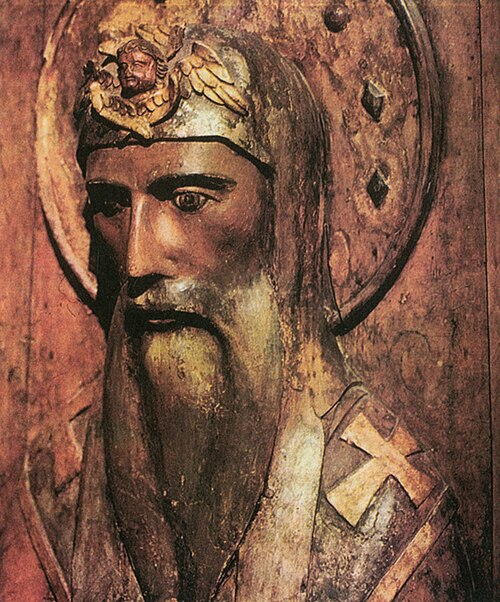
Saint
Theognostus of Moscow
Metropolitan of Kiev and all Rus
Metropolitan of Kiev and all Rus, appointed by the Patriarch of Constantinople, who died in 1353.
Life
Saint Theognostus was metropolitan of Kiev and all Rus, a Greek by birth, successor of Saint Metropolitan Peter, from 1328 until his repose on 11 March 1353, at Moscow. His shepherding coincided with the reigns of the grand princes Ivan Kalita and Simeon the Proud. He is venerated as a saint by the whole Russian Church. His feast is on 14 March.
Beginnings
No news has been kept of his birth and youth; he is held to have been from Constantinople. Consecrated by Patriarch Isaias in 1328, he arrived in Rus the same year. Immediately after his arrival he visited the Russian dioceses, which, at the request of the princes of Halych and Lithuania, had been separated into distinct metropolias (the metropolia of Halych and the metropolia of Lithuania). He secured in good time the patriarch's support for restoring a single metropolia of all Rus and in May 1328 gathered in Volhynia a council of the bishops of the abolished metropolia and, with them, consecrated Athanasius, bishop of Volodymyr-Volynskyi, and Theodore, bishop of Halych. Then he went to Moscow, which he chose as his permanent seat.
Moscow and its churches
From his first days in Moscow he cared for the appearance of the city, urging the grand prince too. He completed the building of the Dormition cathedral, begun by his predecessor Peter. In 1329 two stone churches were raised, of the holy Apostle Peter and of Saint John Climacus, the latter of the type called under the bells. On 20 September 1333 the new cathedral of the Archangel was consecrated, built by Ivan Kalita from a vow, in thanksgiving for the deliverance of Rus from the famine caused by the rye that had given no grain. In 1330 he took part in founding the first monastery of the grand prince, Saviour-Transfiguration, blessing the transfer of some of the monks from Danilov monastery to the Kremlin, under an archimandrite, John, to whom Theognostus gave the first archimandrity in Moscow. Through his efforts, in July 1333 the relics of Metropolitan Peter were glorified and he was numbered among the saints (in some sources, in 1339). In 1339-1340 the Siya Gospel was written at Moscow, now in the Library of the Russian Academy of Sciences.
Shepherding and efforts for unity
To strengthen the unity of the Church he travelled through the metropolia and went even to Constantinople; he ordained bishops, among them Tryphon of Lutsk (1331) and Paul of Chernigov (1332). He succeeded in closing the metropolia of Lithuania, opened for a time, and the metropolia of Halych, reopened in 1337-1338 and existing until 1347. He sided with the prince of Moscow, easing his plans; in 1329, for instance, he placed under excommunication the people of Pskov, who had received the disgraced prince of Tver, Alexander Mikhailovich; the prince left Pskov and went to Lithuania, and the excommunication was lifted. He was the first to succeed in wholly subjecting the Novgorodians, although complaints to Constantinople were not lacking: in 1331 he set as archbishop of Novgorod his own candidate, Vasily Kalika, in place of an Arsenius chosen by the bishops of Halych-Volhynia; he mediated in 1336 the peace between Ivan Kalita and Novgorod, from which the prince received the tribute due.
At the Horde
He went twice to the Golden Horde, in 1332 and in 1342. The second time, in the time of Simeon the Proud, he had great troubles: someone told Khan Jani Beg that the metropolitan gathered great revenues from the clergy and had much money, and the khan demanded payment from all the clergy. According to the Serbian account, the metropolitan answered that Christ our God redeemed his Church from the pagans with his precious Blood, so why should he pay tribute to pagans? He endured in the Horde every sort of torment, gave away up to 600 roubles to men of power, and insisted that the khan confirm to the Church, by a new yarlyk, all its former privileges. He succeeded in saving all the treasures of the Russian churches and gave up all his own property. After a great fire at Moscow he began to restore the churches.
Repose and veneration
When he felt his end approaching, he insisted that no one be set as successor except one who had gone through a long monastic apprenticeship, and recommended Alexis, bishop of Vladimir. He died on 11 March 1353, of plague, and was buried in the sanctuary of the Dormition cathedral in the Kremlin. His relics were found incorrupt in 1471, but rest underground. Local veneration was appointed in the nineteenth century, and today he is a saint of the whole Church.
Commemorated the same day March 14
 Benedict of NursiaVenerable · Founder of Monte CassinoMar 14
 Matilda of RingelheimRight-Believing · Queen of GermanyMar 14
 Rostislav I of KievRight-Believing · Grand Prince of KievMar 14
 Lazarus of MilanSaint · Archbishop of MilanMar 14
- Euschemon of LampsacusConfessor · Bishop of LampsacusMar 14
- Andrew of RafailovVenerable · Abbot of Rafailov MonasteryMar 14
- AphrodisiusMartyrMar 14
- BasilMartyrMar 14
- Boniface CuritanSaint · Bishop of RossMar 14
- CaemhanSaintMar 14
- CuimnechSaintMar 14
- Dativa of NicomediaSaintMar 14