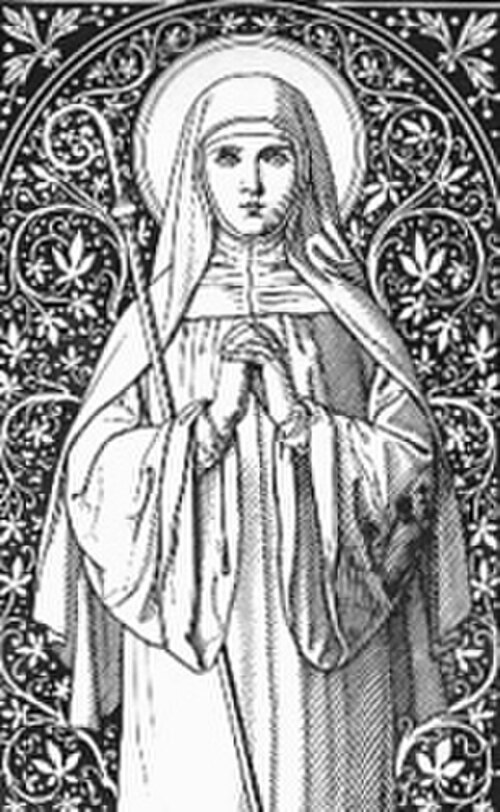
Right-Believing
Matilda of Ringelheim
Queen of Germany
Queen of Germany, wife of Henry the Fowler and mother of Emperor Otto the Great, known for her almsgiving.
- Feast
- March 14old style March 27
- Reposed
- 96810th century
- Place
- Quedlinburg
Life
Saint Matilda of Ringelheim was queen of Germany, wife of Henry the Fowler, the first king of the Ottonian dynasty, and mother of Emperor Otto the Great. She is known for her piety, justice and almsgiving and for the convents she founded. She is commemorated on 14 March.
Family and marriage
She was born around 895, daughter of Count Dietrich and Reinhild, in a Saxon family from which Duke Widukind was also descended. She was raised in Herford Abbey by her grandmother, also Matilda. She had three sisters and a brother, Beuve, bishop of Châlons. At seventeen, in 909, she married Henry, then duke of Saxony, later king of Germany from 919; his first marriage had been annulled. They had five children: Hadwig (mother of Hugh Capet), Otto I the Great, Gerberga, Henry I of Bavaria and Bruno the Great, archbishop of Cologne. In 929 she received from Henry her dower, with lands at Quedlinburg, Pöhlde, Nordhausen, Grona and Duderstadt. As queen she took an interest in women’s monasteries; it is said that her influence on Henry’s reign was above all her strong sense of justice. Serbian and other sources tell that, in her husband’s absences, she governed as regent and built many churches.
The widow
Henry died in 936, at Memleben, and was buried at Quedlinburg. In the same year Queen Matilda founded a convent there, where she lived in the following years, taking care of the family’s legacy. Quedlinburg became the most important centre of prayer of the kingdom and a place of commemoration of the royal dead, as well as of education for the daughters of nobles, some of whom became abbesses. Among them was her granddaughter Matilda, daughter of Otto I, to whom the queen passed, in 966, after thirty years of leadership, the care of the convent; she was the first abbess of Quedlinburg. With her other resources she founded more convents: Enger in 947 and, the last, Nordhausen in 961.
Between 936 and 946 her son Otto questioned how she managed her dower and claimed her goods; for this reason she withdrew into exile, according to some sources to Enger, after the accusation by Otto’s counsellors that she was squandering the treasury. Otto’s wife, Queen Edith, brought about reconciliation: Matilda left her wealth, and Otto was forgiven. This quarrel is still controversial today. Before her death Matilda obtained papal privileges for all the monasteries of eastern Saxony, which were overridden after her death, when the dower passed to Theophanu, wife of her grandson Otto II.
Death and veneration
She died in the convent of Quedlinburg on 14 March 968, after a long illness, and was buried in the abbey there, beside her husband. Throughout her life she was dedicated to charity and her church foundations, as the two lives of her show. Her veneration was very widespread in medieval Germany. She is patron of the church of Saint Matilda in Quedlinburg and in Laatzen, of the Melkite church in Aleppo and of the Matilda Hospital in Herford.
Commemorated the same day March 14
 Benedict of NursiaVenerable · Founder of Monte CassinoMar 14
 Rostislav I of KievRight-Believing · Grand Prince of KievMar 14
 Theognostus of MoscowSaint · Metropolitan of Kiev and all RusMar 14
 Lazarus of MilanSaint · Archbishop of MilanMar 14
- Euschemon of LampsacusConfessor · Bishop of LampsacusMar 14
- Andrew of RafailovVenerable · Abbot of Rafailov MonasteryMar 14
- AphrodisiusMartyrMar 14
- BasilMartyrMar 14
- Boniface CuritanSaint · Bishop of RossMar 14
- CaemhanSaintMar 14
- CuimnechSaintMar 14
- Dativa of NicomediaSaintMar 14