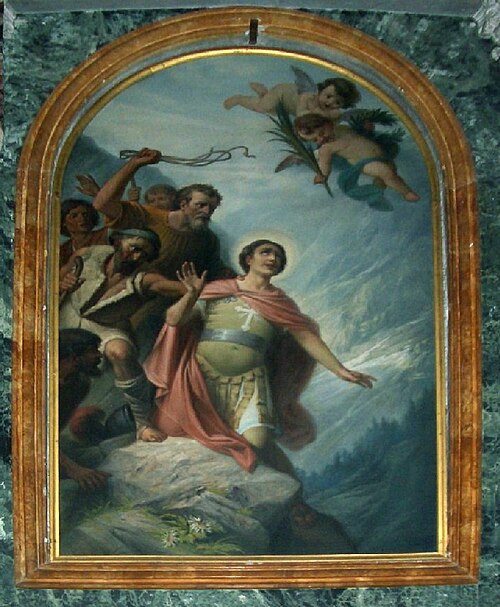
Martyr
Bessus
Of the Theban Legion
Venerated as a member of the legendary Theban Legion led by Maurice, martyred for the faith in the 3rd century.
- Feast
- December 1old style December 14
- Reposed
- 3003rd century
- Order
- Martyrs
Life
Saint Bessus (Besse) is venerated as one of the soldiers of the legendary Theban Legion, led by Maurice, put to death for the Christian faith in the third century. It is a Western cult (north-western Italy), and the sources at our disposal show no Orthodox act concerning him; the reports of his existence are confused and uncertain, so what follows is local tradition, not secure history. His days are 10 August and 1 December, both celebrated at Ivrea.
The legend
The evidence for Bessus' existence is confused and uncertain: his name is in fact identified with two different, semi-legendary saints of the same name: one was a martyred bishop of Ivrea who lived in the eighth century, the other a hermit of the same name who lived in an Alpine sanctuary near Campiglia, in the Cogne valley. It is said that the cult of Bessus might be the Christianization of the cult of the Egyptian god Bes, also invoked for fertility; according to Fabio Arduino, Bes and Bessus are both linked, in iconography, with an ostrich feather.
According to tradition, Bessus survived the decimation of his legion and fled to the valleys of Aosta and Cogne, where he devoted himself to converting the shepherds of the region to Christianity. Many legends were linked with him. A breviary of 1473 says that Bessus was martyred thus: he was invited to a banquet by some Piedmontese who had stolen the cattle now served as the meal. When Bessus discovered this, he rebuked the cattle thieves. Angered, the thieves chased him and forced him to jump from the cliffs of Monte Fantino. Bessus survived, but was then killed by the Roman legionaries who had slaughtered the Theban Legion at Agaunum. The cliff preserves an imprint linked with the saint. According to local tradition, the sanctuary dedicated to the saint was built on the place of his martyrdom and is to this day a place of pilgrimage. Another version of the tale says that Bessus hid in the Cogne valley before being killed by Roman soldiers.
In 1912 Robert Hertz, a French historian and anthropologist, found at Cogne another version of Bessus' death, from the oral tradition handed down from generation to generation. According to it, Bessus was not a soldier of the Theban Legion at all, but a local shepherd, so pious that God rewarded him with a flourishing, fat and healthy flock. Out of envy of his prosperity, some shepherds killed him, throwing him off a cliff.
Veneration
Apart from the cult of Saint Maurice, veneration of Bessus enjoyed a wider popularity than that of other saints of the Theban Legion and remains alive today. According to a local tradition, his relics were stolen in the ninth century and taken to Ozegna, to the chapel now occupied by the sanctuary Beata Vergine del Convento e del Bosco. Then, during the reign of Arduin of Italy, the relics were moved to the cathedral of Ivrea, where they were placed in a Roman sarcophagus. Today the relics rest in a side altar, with those of other martyr saints. Bessus is depicted in an altarpiece by Claudio Francesco Beaumont. He was regarded as a great miracle-worker and protector of soldiers in the dangers of war; he was also invoked for fertility. On 10 August an annual festival and pilgrimage is held in the mountains of the Gran Paradiso National Park, in the Val Soana: the saint's statue is carried to the cliff linked with his martyrdom. The honor of carrying the statue was once a cause of dispute between the towns of Cogne and Campiglia, which had been under different dioceses, until in the thirteenth century both became part of the diocese of Ivrea.
Commemorated the same day December 1
 NahumProphet · The ProphetDec 1
 Simon of CyreneSaint · Bearer of the CrossDec 1
 Castritian of MilanSaint · Bishop of MilanDec 1
 Philaretos the MercifulRighteous · Merciful nobleman of PaphlagoniaDec 1
 Ansanus of SienaMartyr · Patron of SienaDec 1
- Ursicinus of BresciaSaint · Bishop of BresciaDec 1
- Anastasia ȘagunaSaint · Mother of St Andrei ȘagunaDec 1
- Agericus of VerdunSaint · Bishop of VerdunDec 1
- Ananias of ArbelaMartyrDec 1
- Ananias of PersiaMartyrDec 1
- Anthony the NewVenerableDec 1
- Antony the YoungerVenerableDec 1