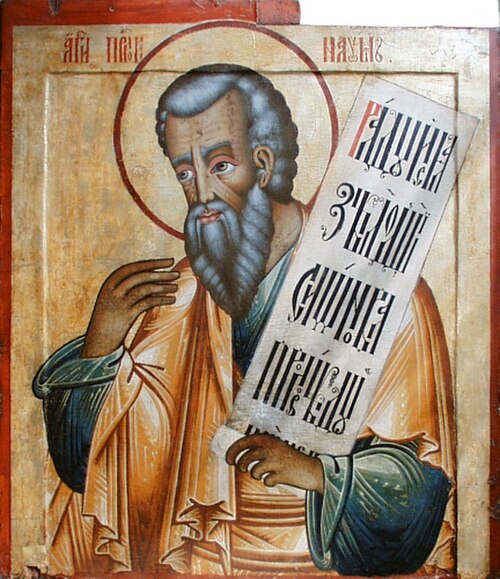
Prophet
Nahum
The Prophet
One of the twelve minor prophets, who foretold the fall of Nineveh.
- Feast
- December 1old style December 14
- Reposed
- 700 BC7th century BC
- Place
- Alqosh
- Order
- Prophets
Life
Saint Nahum the Prophet is the seventh of the twelve minor prophets of the Old Testament. His name means "comfort" or "God consoles." His short book, of three chapters, announces the fall of Nineveh, the capital of Assyria. The Orthodox Church commemorates him on 1 December.
Very little is known about his life. His book calls him the Elkoshite, a man of Elkosh, but the place cannot be identified with certainty. Saint Jerome placed it in Galilee, and this has led some to think that Capernaum, "the village of Nahum," took its name from him. Another tradition links Elkosh with Alqosh in northern Mesopotamia, where a tomb of Nahum was shown in a synagogue until modern times, though other places in the Holy Land also claim it. The Orthodox synaxarion says he lived in the seventh century before Christ, died at the age of forty-five, and was buried in his native region.
His time can be reasoned from the book. Nahum speaks of the fall of the Egyptian city of Thebes, taken by the Assyrians in 663 before Christ, as an event already past, and he announces the fall of Nineveh as near. Nineveh fell in 612 before Christ to the Babylonians and the Medes. The prophecy therefore belongs to the years when Assyria, after the death of King Ashurbanipal, was weakening. Some older writers placed Nahum earlier, in the days of King Jotham of Judah.
The book opens with a hymn to the Lord, who is slow to anger and does not leave the guilty unpunished, and who is good, a stronghold in the day of trouble to those who trust in Him. Then comes a vivid description of the siege and capture of the city: the clash of arms, the chariots in the streets, the gates of the rivers opened, the palace melting away. Nineveh is called a "bloody city," full of lies and plunder. Unlike Jonah, who was sent to call the city to repentance, Nahum does not call Nineveh to repent. He speaks of it as already judged. The synaxarion adds that he also speaks of the blasphemy of King Sennacherib.
For Judah the news is good: "Behold, upon the mountains, the feet of him who brings good tidings, who publishes peace" (Nahum 1:15). The Church reads this word, which Saint Paul also takes up (Romans 10:15), as the announcement of the Gospel and of the peace that Christ brings.
In Orthodox usage the Prophet Nahum is commemorated on 1 December, with a hymn in his honour, and in some places he is invoked with Saint Nahum of Ohrid, commemorated on 23 December, for people with mental illness. The two should not be confused: the second was a disciple of Saints Cyril and Methodius, more than fifteen centuries later.
Commemorated the same day December 1
 Simon of CyreneSaint · Bearer of the CrossDec 1
 Castritian of MilanSaint · Bishop of MilanDec 1
 Philaretos the MercifulRighteous · Merciful nobleman of PaphlagoniaDec 1
 Ansanus of SienaMartyr · Patron of SienaDec 1
 BessusMartyr · Of the Theban LegionDec 1
- Ursicinus of BresciaSaint · Bishop of BresciaDec 1
- Anastasia ȘagunaSaint · Mother of St Andrei ȘagunaDec 1
- Agericus of VerdunSaint · Bishop of VerdunDec 1
- Ananias of ArbelaMartyrDec 1
- Ananias of PersiaMartyrDec 1
- Anthony the NewVenerableDec 1
- Antony the YoungerVenerableDec 1