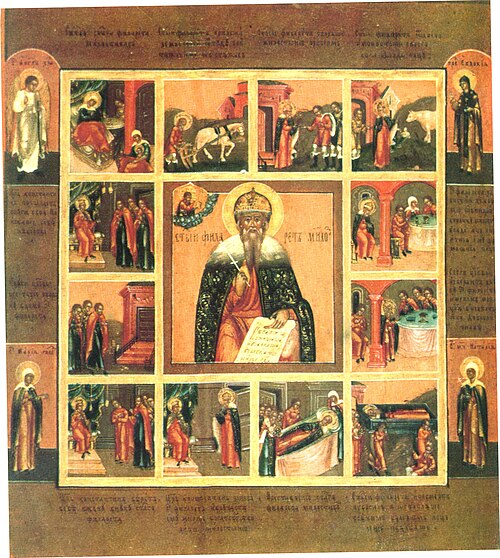
Righteous
Philaretos the Merciful
Merciful nobleman of Paphlagonia
Great landowner of Paphlagonia known for his mercy to the poor; his life was written by his grandson Niketas.
- Feast
- December 1old style December 14
- Reposed
- 7928th century
- Place
- Constantinople
- Order
- The Righteous
Life
Saint Philaretos the Merciful was a great landowner of Paphlagonia, known for his mercy toward the poor and counted among the fools for Christ. His life was written by his grandson, Niketas. He is remembered on 1 December.
He lived, according to tradition, between 702 and 792, in the village of Amnia in Paphlagonia, in Asia Minor. He was the son of Georgios and Anna, Christians who raised him in piety. He married a wealthy woman of noble family, Theoseba, and they had three children: John, Hypatia and Evanthia. He was rich himself, but he remembered the exhortations of Scripture about almsgiving, among them the words in Matthew 25:40 about “the least of these.” In an Arab-Byzantine war his house was plundered; only two oxen, a cow with her calf, a beehive and a donkey remained to him, which he willingly gave to the needy. His wife and children were upset, but he answered that he had hidden riches and treasure, so much that it would be enough for them to feed and clothe themselves even if they lived a hundred years without working.
His gifts gained a reputation for multiplying in the hands of those who received them, so a man asked for Philaretos' calf to build a herd. His wife, discontented, told him: “You have no pity on us, you merciless man, but don't you feel sorry for the cow? You have separated her from her calf.” Philaretos agreed, and summoned the man who had taken the calf and gave him the cow as well. During a famine, he asked his wife to give wheat to a man who had asked for it, and she demanded: “First you must give a bushel to each of us in the family, then you can give away the rest as you choose.” Philaretos gave the man two bushels, and his wife said sarcastically: “Give him half the load so you can share it.” He did so, until he gave him all the wheat and the donkey, and the family wept over the loss. The life tells that the Lord rewarded him when a friend, a tax collector, sent him forty bushels of wheat, and the people of the surrounding villages gave him rams.
In the time when the Empress Irene was seeking a wife for her son, Constantine VI, the envoys came to Amnia as well. Philaretos and Theoseba gave a feast, and the imperial family was impressed with them and chose his granddaughter Maria for marriage, in 788. So Philaretos had still more to help the poor, even giving feasts for them. Once he filled three bags with gold, silver and copper and distributed the contents to the poor, making no distinction between the bags: from the first those who were very poor received, from the second those who had lost their goods. He refused to wear costly clothing or to receive any titles. Near the end of his life, at ninety, he asked the abbess of the Rhodolphia monastery in Constantinople to be buried there, gave her some gold and told her that he would pass away in ten days. He fell asleep in 792, in his home, beside his family, charging them to give alms as he had given. Theoseba worked on the restoration of churches and monasteries for the rest of her life.
The life is also valuable for history: the lands of Paphlagonia are described as raided by the “Ishmaelites,” which attests to the success of Arab raids into Byzantine territory. Some historians think that Niketas wrote it to lend prestige to the family, after Constantine VI divorced Maria. In the nineteenth century Anna Chertkova made a retelling of the life, which Leo Tolstoy praised. A church on the Mount of Olives in Jerusalem and several churches and chapels in Russia bear his name.
Commemorated the same day December 1
 NahumProphet · The ProphetDec 1
 Simon of CyreneSaint · Bearer of the CrossDec 1
 Castritian of MilanSaint · Bishop of MilanDec 1
 Ansanus of SienaMartyr · Patron of SienaDec 1
 BessusMartyr · Of the Theban LegionDec 1
- Ursicinus of BresciaSaint · Bishop of BresciaDec 1
- Anastasia ȘagunaSaint · Mother of St Andrei ȘagunaDec 1
- Agericus of VerdunSaint · Bishop of VerdunDec 1
- Ananias of ArbelaMartyrDec 1
- Ananias of PersiaMartyrDec 1
- Anthony the NewVenerableDec 1
- Antony the YoungerVenerableDec 1