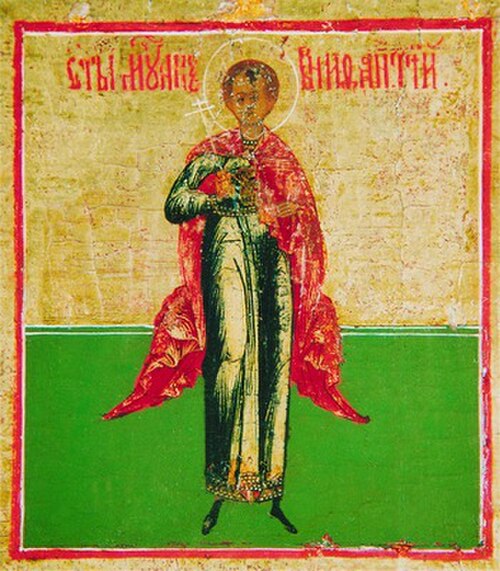
Martyr
Boniface of Tarsus
Roman sent to Tarsus for the relics of martyrs, who was martyred there in 307, according to legend.
- Feast
- December 19old style January 1
- Reposed
- 2903rd century
- Place
- Tarsus
- Order
- Martyrs
Life
The Holy Martyr Boniface of Tarsus was, according to the traditional account, a Roman killed for the Christian faith at Tarsus in Cilicia at the beginning of the fourth century (in some sources in 307), where he had gone from Rome to bring to his mistress Aglaida relics of martyrs. The story is largely legendary.
Boniface was a servant, the steward of the household of the wealthy Roman Aglaida. Both were pagans and lived in debauchery; some accounts say they were lovers. Yet he was generous to the poor, hospitable to strangers and compassionate to those in misfortune. Hearing of miracles worked through the relics of martyrs, Aglaida decided to send him to the East for relics. Boniface set out with slaves and much gold, and at parting said jokingly: But if I find no martyr's body and you receive mine, tortured for Christ, will you receive it with honour? Aglaida reproved him, saying it was no time for jests, but for reverence. At Tarsus he came to the square where Christians were being tortured; he saw twenty saints in torments and, seized with repentance, threw himself at their feet, kissed their chains and openly confessed himself a Christian, refusing to sacrifice to idols. The judge ordered sharp needles driven under his nails, then molten tin poured into his mouth; in other accounts he was thrown into a cauldron of pitch, but an angel cooled him and the flames burned some of the pagans. At last he was beheaded. His servants searched for him three days, learned of his death and ransomed his body and head for five hundred gold coins, anointed the remains with perfumes and carried them to Rome.
His body was the relic that reached Aglaida, who became a Christian. She built in his memory a church, today Santi Bonifacio e Alessio, on the Aventine hill; then she gave her wealth to the poor and lived in a monastery for fifteen or eighteen years and, it seems, received the gift of driving out evil spirits. In 972 Pope Benedict VII gave the church to the Greek metropolitan Sergius of Damascus, and the monastery there became famous for its Latin and Greek community; the relics were moved in the seventh century to the basilica of Sant'Alessio. He is invoked against drunkenness. The Orthodox Church commemorates him with the righteous Aglaida on 19 December; in the West he was commemorated on 14 May, until in 1969 the Roman calendar dropped his name because of the legendary character of the story. Because of the date, he was one of the three so-called Ice Saints.
Commemorated the same day December 19
 Anastasius I of RomeSaint · Bishop of RomeDec 19
 Gregentius of HimyarSaint · Archbishop of the HimyaritesDec 19
 Fausta of SirmiumMartyr · Mother of Saint AnastasiaDec 19
 Elijah of MuromVenerable · Monk of the Kiev CavesDec 19
- Avitus of MicyVenerable · Abbot of MicyDec 19
- Darius of NicaeaSaintDec 19
- Eulogia of SamurcășeștiVenerable Martyr · Nun of Samurcășești-CiorogârlaDec 19
- George the Scribe and Saba of KakhuliVenerableDec 19
 MonireSaint · Bishop in ScotlandDec 19
- Adjutus of OrléansVenerableDec 19
- Aedh of LemhchoillSaintDec 19
- AglaiaVenerableDec 19