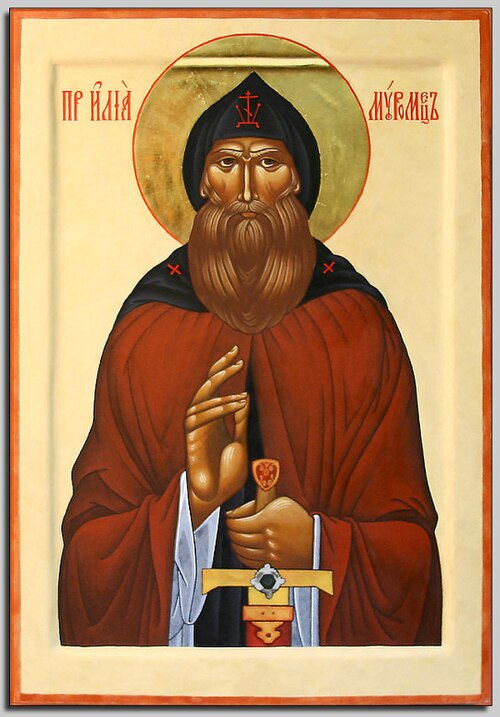
Venerable
Elijah of Murom
Monk of the Kiev Caves
Monk of the Kiev Caves from Murom, considered a possible prototype of the epic hero Ilya Muromets.
- Feast
- December 19old style January 1
- Reposed
- 120413th century
- Place
- Murom
- Order
- Venerables
Life
Venerable Elijah of the Caves, also called Elijah of Murom, was a monk of the Kyiv Caves Lavra in the twelfth century. According to tradition, before becoming a monk he was a strong warrior, called Chobotok, from the village of Karacharovo, near the town of Murom. Some scholars regard him as a possible prototype of the epic hero Ilya Muromets of the Russian bylinas. Very little is known of his life, but his relics, kept in the Near Caves at Kyiv, have been scientifically examined and show a man of great stature, with signs of illness and a mortal wound. The Church commemorates him on 19 December and in the Synaxis of the Venerable Fathers of the Near Caves.
What is known
Few certain facts about Venerable Elijah's life have been preserved. The fact that the Kyiv Caves Paterikon has no life of him shows that he spent little time in monasticism. It is supposed that his tonsure took place in the time of the abbacy of Venerable Polycarp of the Caves (1164 to 1182) and that he fell asleep about 1188. A more recent tradition says that before tonsure he was a warrior in the retinue of Prince Vladimir Monomakh, famed for feats of arms and unusual strength, which he used only against the enemies of the Fatherland, to defend people and restore justice. After a grave wound received in a battle with the Cumans, obeying the call of his soul, he became a monk at the Caves Lavra and vowed never again to take weapon in hand. But when the monastery was threatened by invaders, he broke his vow, took up the sword to defend the monastery and the brothers, and received a mortal wound in the chest. The venerable one, with an incurable wound, fell asleep in the monastery, in the caves of Saint Anthony.
The first written mention of him is from the 1630s. In the work "Teraturgima" of the church historian Athanasius Kalnofoysky, printed in Polish at the Lavra press in 1638, a hero named Chobotko is mentioned, whose relics were kept in the cave of Saint Anthony, and that this monk, called Elijah Muromets, had lived in the monastery 450 years earlier, that is, in 1188. In 1594 the ambassador of the German emperor, Erich Lassota, wrote in his notes about the tomb and relics. The early Orthodox tradition places his life in the twelfth century, and scholars date the burial to the eleventh and twelfth centuries. In the Orthodox Theological Encyclopedia he is called "Elijah Chobotok". He was canonized in 1643 together with sixty-nine other saints of the Caves Lavra.
The hero of the byliny or the saint of the Lavra?
Descriptions of the life of the monk of the Caves are in many places interwoven, knowingly or not, with those of the hero of the byliny of the same name. The nickname "Muromets" led some historians to say he came from Murom or from Morovisk. It may be that the nickname was given him later, because of the same name as the epic hero. Certain features of the worldly hero were attributed to Venerable Elijah. Some nineteenth-century historians suggested that his homeland might have been Karachev or Morovsk. According to legend, Chobotok was a hero and bore the nickname from the day he once defended himself from enemies with a "chobot", that is, a boot.
At Murom there are many tales about Elijah. His descendants are said to be the Gushchin family of Murom, who hereditarily have great strength, and one of them, who lived at the end of the nineteenth century, was even forbidden to take part in fist fights. Elijah's hut is thought to have stood at that place in Karacharovo (now part of Murom) where the house of one of the Gushchins now stands. Beside it is the church of the Holy Trinity, which Elijah, according to tradition, built himself, hauling oak trunks from the river.
The relics
In 1988 an interdepartmental commission of the Health Ministry of the Ukrainian SSR examined the relics of Venerable Elijah. The examination, carried out with the help of several departments of the Kyiv Medical Institute and of the Institute of Geology, lasted three years. The remains were dated to the twelfth century. They show a tall man, about 177 cm, a great height for the Middle Ages, of sturdy build, with very developed muscles and unusual physical strength, who died at 40 to 45. X-rays showed signs of acromegaly and of a rare disease of the spine that can hinder walking, which may give a real basis to the tale of thirty-three years spent on the stove. The bones of the skull are unusually thick, the wrists and collarbones much larger than in ordinary people, and the bones show traces of several fractures.
The cause of death, according to the researchers, was a large, deep wound in the region of the heart, probably made by a two-handed axe or a spear. Besides the wound on the left side of the chest, the body has a deep round wound on the left arm, as if the monk had covered his chest with his hand and the blow went through it to the heart. The date of death could not be fixed but is in the second half of the twelfth century. So the view that Elijah served Vladimir Monomakh, who died in 1125, does not stand. The researchers suppose he received the mortal wound in January 1203, when Kyiv and the Lavra were plundered by the Russo-Cuman host of Prince Rurik Rostislavich, with the Olgovichi.
The venerable one's relics lie in the position of prayer, with the fingers of the right hand joined in the sign of the cross with two fingers. For opponents of Nikon's reforms this was an argument for the old two-finger sign of the cross. The priest John Lukyanov, passing through Kyiv on the way to Jerusalem in 1711, wrote that he saw in the cave of Saint Anthony the saints in incorrupt bodies, as if alive, and saw "the brave warrior Elijah Muromets", incorrupt, under a cover of gold, his left hand pierced by a spear, the wound visible, and his right hand in the sign of the cross. A part of the relics, the middle finger of the left hand, is in the Transfiguration monastery in Murom. The rest of the relics are in the Near Caves of the Lavra.
Veneration
Local veneration began at the end of the seventeenth century, when Archimandrite Varlaam (Yasinsky) of the Caves established the celebration of the Synaxis of the Venerable Fathers of the Near Caves. Veneration throughout the Church began after the permission of the Holy Synod, in the second half of the eighteenth century, to enter the names of several Kyivan saints in the general calendars. Each year, on the day of commemoration, 19 December, a service is held early in the morning beside his relics, in which the shrine is opened and the faithful may touch the saint's right hand, which, tradition says, is always warm. Venerable Elijah is regarded as patron of the Strategic Missile Forces and the Border Service of Russia. Several churches have been consecrated in his honour, among them one in the settlement of Vlasikha near Moscow and one in Dnipro, Ukraine. In 2018 a monument was raised to him at Rubtsovsk.
Commemorated the same day December 19
 Anastasius I of RomeSaint · Bishop of RomeDec 19
 Boniface of TarsusMartyrDec 19
 Gregentius of HimyarSaint · Archbishop of the HimyaritesDec 19
 Fausta of SirmiumMartyr · Mother of Saint AnastasiaDec 19
- Avitus of MicyVenerable · Abbot of MicyDec 19
- Darius of NicaeaSaintDec 19
- Eulogia of SamurcășeștiVenerable Martyr · Nun of Samurcășești-CiorogârlaDec 19
- George the Scribe and Saba of KakhuliVenerableDec 19
 MonireSaint · Bishop in ScotlandDec 19
- Adjutus of OrléansVenerableDec 19
- Aedh of LemhchoillSaintDec 19
- AglaiaVenerableDec 19