Saint
Gregentius of Himyar
Archbishop of the Himyarites
Archbishop of Zafar, capital of Himyar, in the 6th century, according to a life compiled in the 10th.
- Feast
- December 19old style January 1
- Reposed
- 5526th century
- Order
- Hierarchs
Life
Saint Gregentius, called Gregory in the Slavonic tradition, was archbishop of the Himyarites, a people of southern Arabia whose kingdom is known today as Himyar, in the sixth century. According to his Life, he was sent by the Patriarch of Alexandria to Zafar, the capital of that kingdom, after the Christian king of Ethiopia had ended the persecution of the Christians there. The Church honours him as a wonderworker and as the enlightener of the Himyarites, who built churches, ordained priests, and brought Jews and pagans to the faith.
The Life and history
What is known about Saint Gregentius comes from a collection of Greek writings put together no later than the tenth century and preserved also in a Slavonic translation. It contains the saint's Life, a collection of laws attributed to him called the "Laws of the Himyarites", and a debate with a Jewish scholar named Herban. Scholars regard much of this material as legendary, but the last part of the Life draws on better historical sources.
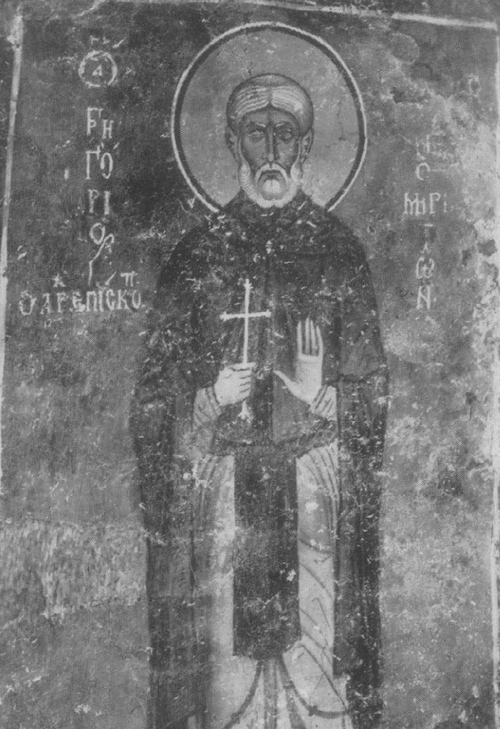
The name Gregentius is unknown outside these texts. The Life says that he received it from a holy man of his homeland. Later copyists, unfamiliar with the name, often changed it to Gregory, the form found in all the Slavonic versions and on the fresco of him in the monastery of Koutsovendis in Cyprus, painted between 1110 and 1118. Some scholars connect the name with that of Saint Gregory of Agrigento, whose Life was a major source for the author.
Birth and childhood
According to his Life, Gregentius was born on 6 December toward the end of the fifth century, by some reckonings around 481. His birthplace was the town of Lyplianes in the land of the Avars, which scholars identify with present-day Ljubljana. Greek and Serbian tradition, however, make him a native of Mediolanum, that is, Milan. His father was named Agapius, and his mother, according to some sources Theodotia, according to others Eusebia.
At his baptism he was given the name of a sage who lived on a nearby mountain. From childhood, tradition says, he was filled with the grace of God and had the gift of healing. He began school at seven, and at ten he fell into a river and was miraculously saved from drowning. He then withdrew to the wilderness, where a holy man taught him and foretold what was to come.
After his mother's death he was entrusted to the priest who had baptised him, a married man without children. When barbarians attacked the town, the people took refuge in the fortress of Korada, and Gregentius, who was in the vineyards, managed to slip into the fortress during the siege. After the invaders withdrew, an elder named Niketas interpreted a dream of his foster mother, saying that the boy would one day bring a fourfold people to the faith.
Travels in Italy and Africa
With the holy man from the wilderness, Gregentius then set out on a long journey. The Life takes him through Murano and Padua, where Bishop Eulogius made him a reader and deacon, and on to Agrigento in Sicily, where the priest Stephen hosted him by the church of the Mother of God outside the walls. There a woman foretold that he would go to Egypt and to the Himyarites. Scholars point out that the order and timing of these journeys do not fit real geography.
In Milan he venerated the tomb of Saint Ambrose and began to read his writings. There he took as a disciple a fourteen-year-old boy, Leo, who later became an official and was murdered. In Carthage he met a woman who pretended to be mute to escape a man who sought to seduce her, and before him she spoke clearly. There too he gave spiritual counsel to a young Thracian, Pothetos, and urged him to return to his wife.
In Rome
In Rome he freed a servant woman, Elizabeth, from the torment of an unclean spirit. The Life says that the Apostle Peter appeared to him, having been absent from his tomb to comfort the persecuted Christians of Najran, and that at the tomb of the Apostle Paul he saw in ecstasy the apostle bringing him the episcopal omophorion. Russian tradition says that the Apostles Peter and Paul placed the omophorion on his shoulders as a sign of the ministry that awaited him.
He prayed in the church of the Martyr Boniface, with whom he would come to share his feast, and at the tomb of Saints Boniface and Aglais. A hermit named Artados, who lived on a mountain, foretold in detail his future in Egypt and among the Himyarites, where he would convert four peoples: pagans, Jews, Himyarites, and Moors. The Life says that in Rome he also met Pope Felix IV.
In Alexandria
Setting out from Augustopolis, Gregentius and the holy man sailed to Alexandria. There a servant woman greeted him by name and foretold that the patriarch would call him to be an archbishop. He visited a monastery led by the abbot Epiphanius and by his prayers drove away an evil spirit that was throwing stones at a monk named Cosmas. Greek tradition says that he had come to Egypt in the reign of Justinian to live as an ascetic.
The persecution at Najran
At that time the king of Himyar, Dunaan, known to history as Dhu Nuwas, had embraced Judaism, and in 523 he cruelly put to death the Christians of Najran, among them their leader, Saint Arethas. Emperor Justin I asked the Christian king of Ethiopia, Elesbaan, also known as Kaleb, to march against him. Elesbaan defeated Dunaan, conquered the kingdom, and restored Christianity there.
Because the Jews had destroyed the entire church hierarchy, Elesbaan asked the Patriarch of Alexandria for a bishop and clergy for the churches of the land. The Life says that the patriarch, after praying, saw in a dream the Apostle Mark, who pointed him to the deacon Gregentius. The patriarch summoned him, ordained him priest and then archbishop, and Serbian tradition says that at his consecration his face shone like fire and the church was filled with fragrance.
Archbishop in Arabia
After his consecration Gregentius set out with the Ethiopian envoys. He stayed for a time in the Ethiopian capital, Aksum, then crossed the sea and came to Zafar and to Najran, where he met the king. He consecrated the churches the king had built and appointed priests to them at Najran, Zafar, Aden, and other towns. Together with Elesbaan he adorned the tombs of the martyrs slain by Dunaan and raised a church in honour of Saint Arethas.
After reigning there for thirty-six months, Elesbaan had to return to Ethiopia, where, according to the Life, he later withdrew to a monastery. Before leaving he gave Gregentius authority to choose a king from among the nobles of the land. Through the hierarch's prayer Abraham was chosen, known to historians as Abraha, whom Gregentius anointed king and whom he served as counsellor. On his advice Abraham appointed bishops in every city.
The Life says that an order was then given that all unbaptised Jews must receive baptism under threat of death. Their leaders met in secret, and one of them, the scholar Herban, proposed asking for a public debate to show which faith was true. The king was angered, but Gregentius rejoiced, saying that it was better for people to accept the faith freely than under compulsion.
The debate with Herban
After forty days of preparation the debate was held in the city of Atara, before a great crowd of Jews and Christians. Herban accused the bishop of believing in three gods, and Gregentius answered that Christians believe in one Godhead in three Persons. They spoke of Noah's ark, the rod of Moses, and many other passages of Scripture, and the hierarch based his arguments on the Old Testament alone. The fiercest part of the debate concerned icons, which Herban called idols.
The debate lasted several days. Herban admitted that Gregentius was a wise man, and before the last day he confessed to his own people that he had seen in a dream Moses bowing down before Jesus Christ. Yet he continued to resist and at the end demanded that the bishop show him his God.
Gregentius prayed aloud, calling on the power of the Holy Cross. The Life says that the earth shook, the heavens opened in the east, and the Lord Jesus Christ appeared in a bright cloud, while a voice declared that, for the bishop's prayer, the One crucified by their fathers would heal them. The Jews were blinded by the heavenly light and begged the hierarch to heal them. They received baptism and recovered their sight, and Herban was given the name Leo at his baptism.
The Laws of the Himyarites
Tradition also ascribes to Saint Gregentius a collection of laws for the city of Najran. They deal with morals and the family, slavery, labour, social life, rents, officials, sorcery, perjury, theft, and the right of asylum in churches. The penalties are very harsh, but the laws forbid wife-beating and cruelty to animals, something unusual in Byzantine law.
Scholars disagree about their age. Some consider them a later composition, others, such as Nina Pigulevskaya and Irfan Shahîd, have defended a sixth-century origin, and still others believe they preserve at least some authentic memories of pre-Islamic Arabia. The debate with Herban was the most widely read part of the writings about Saint Gregentius and circulated on its own into modern times.
Repose and veneration
Saint Gregentius shepherded the Church of the Himyarites for thirty years, helping King Abraham to build churches. Shortly after Abraham's death and the accession of his son, Gregentius departed to the Lord on 19 December, according to tradition in the year 552. He was buried in the great church of the city.
Saint Gregentius is commemorated on 19 December (1 January New Style), a day also recorded in the Synaxarion of the Church of Constantinople. The writings about him were preserved and read in the monasteries of Mount Athos, and in the nineteenth century two Athonite monks, one of Vatopedi and one of the Skete of Saint Anne, bore his name.
Commemorated the same day December 19
 Anastasius I of RomeSaint · Bishop of RomeDec 19
 Boniface of TarsusMartyrDec 19
 Fausta of SirmiumMartyr · Mother of Saint AnastasiaDec 19
 Elijah of MuromVenerable · Monk of the Kiev CavesDec 19
- Avitus of MicyVenerable · Abbot of MicyDec 19
- Darius of NicaeaSaintDec 19
- Eulogia of SamurcășeștiVenerable Martyr · Nun of Samurcășești-CiorogârlaDec 19
- George the Scribe and Saba of KakhuliVenerableDec 19
 MonireSaint · Bishop in ScotlandDec 19
- Adjutus of OrléansVenerableDec 19
- Aedh of LemhchoillSaintDec 19
- AglaiaVenerableDec 19