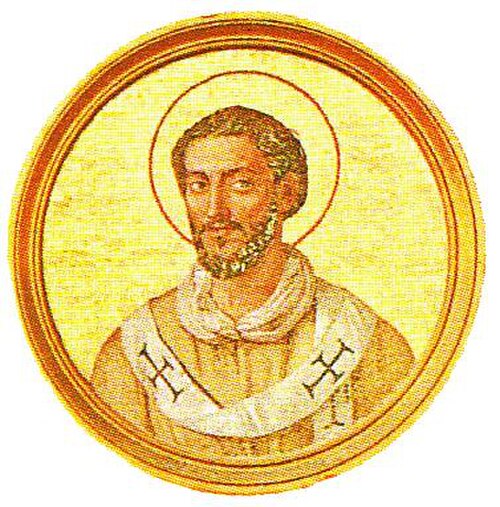
Saint
Caius of Rome
Bishop of Rome
Bishop of Rome from 283 to 296, of whom few reliable details are preserved.
Life
Caius of Rome, also called Gaius, was bishop of Rome from 17 December 283 until his death on 22 April 296. He guided the Church in the years of calm before the great persecution of Diocletian, and little reliable information about him has survived. He is venerated as a saint in the Roman Catholic Church, which keeps his memory on 22 April together with Pope Soter. A Russian source says that he is also commemorated in Orthodoxy on 24 August, but we could not confirm this in the Orthodox calendars we consulted.
What is known
According to Christian tradition he was a native of Salona in Dalmatia, the son of a man also named Caius, of a noble family said to be related to Emperor Diocletian. Almost all that is told of him comes from the Book of the Pontiffs, which in turn relies on a legendary account of the martyrdom of Saint Susanna of Rome. Historians today consider several of its statements to be inexact, among them that he lived for eight years in the catacombs and that he settled for good the lower orders of the clergy.
The tradition adds that before someone could become a bishop he had to pass through the offices of porter, reader, exorcist, acolyte, subdeacon, deacon and priest, and that Caius divided the districts of Rome among the deacons. During his time the hostility toward Christians grew, though new churches were built and cemeteries enlarged. The domus ecclesiae on the site of the later church of Santa Susanna, in Rome, belonged to the brothers Caius and Gabinus. Gabinus was the father of Susanna, so the sources call Caius her uncle, although it is not certain that the owner of the house was the pope.
Death and burial
Later accounts say that he hid from the persecution with Saints Polycarp, Sebastian, Tranquillinus, Tiburtius, Nicostratus and Zoe, and died a martyr, often said to have been beheaded. Historians doubt this, since Diocletian's persecution began only in 303, and the Calendar of 354 does not list Caius among the martyrs but among the bishops of Rome who died in peace. It records his burial in the cemetery of Callixtus on 22 April.
His tomb with the original epitaph, and a ring with which he sealed his letters, were found in the catacomb of Callixtus. His relics were later moved to a church, and when that was demolished in 1880 they were carried to the chapel of the Barberini family. He is venerated especially in Dalmatia and Venice, and in art he is shown in the papal tiara beside Saint Nereus.
Commemorated the same day April 22
 SoterSaint · Bishop of RomeApr 22
 Theodore of SykeonVenerable · Byzantine asceticApr 22
 Leonides of AlexandriaMartyr · Father of OrigenApr 22
 Vitalis of GazaVenerable · Hermit of GazaApr 22
 Nathanael of CanaApostle · Disciple from Cana of GalileeApr 22
 Opportuna of MontreuilVenerable · Abbess of MontreuilApr 22
 Platon of Banja LukaHieromartyr · Bishop of Banja LukaApr 22
 EpipodiusMartyr · Martyr of LyonApr 22
- Eustathius MalakhovskyNew Martyr · Priest in TurkestanApr 22
- Abdiesus and AzadanHoly MartyrsApr 22
- AcepsimasHieromartyr · Bishop of HnaitaApr 22
 Altfrid of MünsterSaint · Bishop of MünsterApr 22