
Hieromartyr
Platon of Banja Luka
Bishop of Banja Luka
Bishop of Banja Luka in 1940-1941, abducted, tortured and killed by the Ustaše in May 1941.
Life
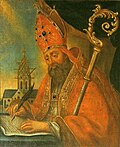
Saint Platon, born Milivoje Jovanović, was bishop of Banja Luka in the Serbian Orthodox Church. He shepherded the diocese from 1940 until May 1941, when he was abducted, tortured and killed by the Ustaše of the Axis-occupied Croatian state because he would not abandon his flock. The Serbian Church proclaimed him a hieromartyr in 1998 and canonized him two years later, and his feast falls on 22 April (5 May on the new calendar), the day of his death.
Childhood and studies
He was born in Belgrade on 29 September 1874, to Ilija, a career officer born in Trebinje, and Jelka, from Foča. His parents had settled in Belgrade as refugees from Herzegovina, and the child was baptized in the church of the Ascension. He did his primary schooling at Vranje and secondary school at Niš, and in 1892 entered the seminary in Belgrade. In 1895 he took monastic vows and received the name Platon. He graduated in 1896 and was ordained deacon and then presbyter.
In 1896 he went to Russia and from 1897 studied at the Moscow Theological Academy, where he was the first Serb to receive the Ivan Aksakov Scholarship. He completed his studies in 1901.
Service in the Church
On his return he was assigned to the monastery of Rajinovac near Belgrade. In 1902 he led a group of Serbian monks to Visoki Dečani, then under Ottoman rule. He then taught theology at Aleksinac between 1903 and 1906, and for a few months at Jagodina. He was raised to the ranks of syncellus, protosyncellus and, in 1909, archimandrite, and from 1908 he edited the Gazette of the Serbian Patriarchate.
In the Balkan Wars of 1912–1913 he served as a military chaplain in the Morava Brigade, and at the beginning of the First World War he served again as a chaplain to the army. After the defeat of Serbia he did not leave with the army for the island of Corfu but stayed in the country. During the occupation he was arrested and narrowly escaped execution by Bulgarian forces. He cared for those struck by misfortune, especially orphans and widows, and for a short time administered the diocese of Ohrid.
After the war, in 1919, his opponents in the Bishops' Council forced him into retirement, and for a time he worked as an apprentice in a carpentry shop and then in a printing house. He directed the monastic school and monastery of Rakovica, where he built a printing house, and issued religious publications. After the election of Patriarch Varnava he ran the monastery press at Sremski Karlovci and edited the Gazette of the Patriarchate from 1932 to 1938. There he also started the children's paper "Mali Bogoljub". From 1934 to 1936 he was abbot of Krušedol monastery.
Bishop
On 4 October 1936 he was consecrated at Sremski Karlovci as bishop of Moravica, vicar of the Patriarch. In 1938 he was elected bishop of Ohrid and Bitola, but was removed from the see after criticizing his predecessor and accusing him of sowing discord in the diocese. Later he was chosen bishop of Banja Luka and took up the diocese in October 1940.
Martyrdom
After Yugoslavia was invaded in April 1941, Banja Luka became part of the Independent State of Croatia, ruled by the Ustaše. The authorities told him to leave his diocese, since he was a Serb born in Serbia, and the commissioner Viktor Gutić decreed that all citizens born in Serbia or Montenegro must leave the city within five days. Platon refused. He answered that he had been appointed bishop according to the canons, that before God, the Church and the people he was bound to care for his flock, and that he would stay with it as a good shepherd who lays down his life for his sheep.
On the night of 4 to 5 May 1941 he was arrested by the Ustaše together with the priest Dušan Subotić. The following night they were taken from their cell and driven to the outskirts of the city, where they were tortured and killed, and their mutilated bodies were thrown into the river Vrbas.
Veneration
The saint's body was found on the bank of the Vrbas at Kumsale on 23 May and was buried the next day in an unmarked grave. He was one of several hundred Serbian Orthodox clergy killed in that state during the war. In 1973 his remains were exhumed and moved to the crypt of the Church of the Holy Trinity in Banja Luka. In 1998 the Bishops' Council of the Serbian Orthodox Church numbered him among the hieromartyrs, and in May 2000, at the Church of Saint Sava on Vračar in Belgrade, Patriarch Pavle celebrated the solemn canonization of the new martyrs of the Serbian Church killed by the Ustaše.
Commemorated the same day April 22
 SoterSaint · Bishop of RomeApr 22
 Caius of RomeSaint · Bishop of RomeApr 22
 Theodore of SykeonVenerable · Byzantine asceticApr 22
 Leonides of AlexandriaMartyr · Father of OrigenApr 22
 Vitalis of GazaVenerable · Hermit of GazaApr 22
 Nathanael of CanaApostle · Disciple from Cana of GalileeApr 22
 Opportuna of MontreuilVenerable · Abbess of MontreuilApr 22
 EpipodiusMartyr · Martyr of LyonApr 22
- Eustathius MalakhovskyNew Martyr · Priest in TurkestanApr 22
- Abdiesus and AzadanHoly MartyrsApr 22
- AcepsimasHieromartyr · Bishop of HnaitaApr 22
 Altfrid of MünsterSaint · Bishop of MünsterApr 22