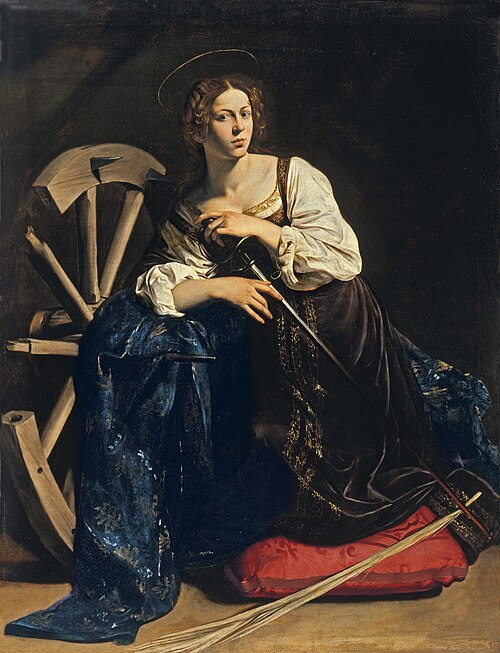
Great Martyr
Catherine of Alexandria
of Alexandria
Learned maiden of Alexandria who confessed Christ before the emperor and was killed in the fourth century.
- Feast
- November 25old style December 8
- Reposed
- 3054th century
- Place
- Alexandria
- Order
- Great Martyrs
Life
The Holy Great Martyr Catherine of Alexandria was, according to tradition, a Christian virgin of noble birth and great learning, who confessed Christ before the emperor and received the crown of martyrdom at the beginning of the fourth century, around 305. She is one of the most honoured women martyrs of the Church, commemorated on 24 or 25 November.
Youth and calling
According to tradition, Catherine was born around 287 at Alexandria, the daughter of Constus, governor of Egypt in the time of Emperor Maximian, and of Sabinella. Of Greek and Egyptian descent, she received an excellent education, reading the philosophers and scholars of her day, and knew rhetoric, medicine and several languages. Many rich and noble suitors asked for her hand, but she rejected them all, wishing to marry only one who would surpass her in glory, wealth, beauty and wisdom.
Her mother, a secret Christian, took her to a hermit, who spoke to her of the heavenly Bridegroom, Christ, gave her an icon of the Mother of God with the Child and baptized her. According to tradition, the Mother of God and the Child then appeared to her, and Christ gave her a ring, a sign of spiritual betrothal. She is said to have been about fourteen at the time. Many people came to faith through her words.
Her confession before the emperor
When persecutions began, the emperor came to Alexandria for pagan festivals, at which sacrifices were offered to the gods and Christians were forced to worship. Catherine appeared before him and rebuked him for his cruelty. The emperor summoned fifty of the wisest pagan philosophers and orators, hoping they would overthrow her arguments, but Catherine won. Many of her opponents, won over by her words, declared themselves Christians and were condemned to death, and she encouraged them before the end.
Torments and martyrdom
The emperor ordered her to be subjected to terrible tortures and then thrown into prison, and afterward commanded that she be killed on a wheel set with spikes, but the wheel broke. According to tradition, many of those who had come to watch believed in Christ. In the end Catherine was beheaded with the sword, at about the age of eighteen. According to tradition, milk flowed from her wound instead of blood.
Relics and veneration
Her relics, according to tradition, were carried by angels to Mount Sinai, and in the eighth century they were discovered by Egyptian Christians and placed in the monastery there, which drew many pilgrims. The first life of the saint was written in Greek, not earlier than the sixth or seventh century, and her veneration spread first in the East and then in the West. Scholars today have linked her story with Saint Dorothea of Alexandria and with the philosopher Hypatia, but they do not doubt that the saint existed.
Her symbol is the spiked wheel, called the Catherine wheel. In the West she is counted among the Fourteen Holy Helpers, and Joan of Arc said that Catherine was among the saints who appeared to her.
Commemorated the same day November 25
 Peter of AlexandriaHieromartyr · Patriarch of AlexandriaNov 25
 Seraphim OstroumovHieromartyr · Bishop of SmolenskNov 25
- 150 OratorsSaintNov 25
- 670 MartyrsMartyrNov 25
- Alanus of LavaurVenerableNov 25
- Alexander VershinskyHieromartyrNov 25
- Andrew ShershnevHieromartyrNov 25
- Barlaam PopovHieromartyrNov 25
- Basil PariyskyHieromartyrNov 25
- BasilissaSaintNov 25
- Bernold of OttobeurenSaintNov 25
- Cosmas KorotkikhHieromartyrNov 25