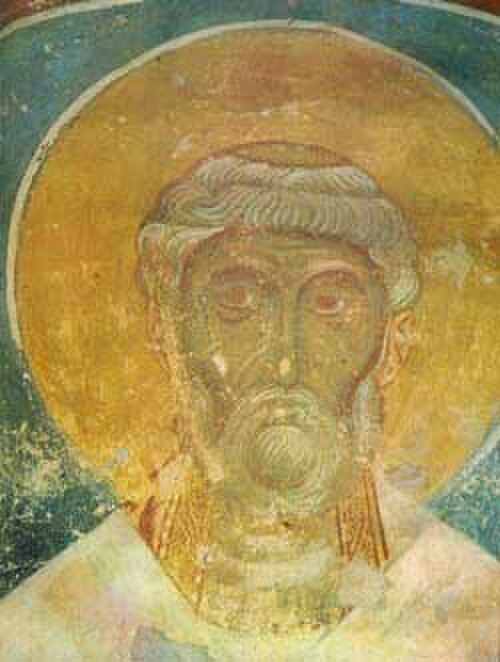
Hieromartyr
Peter of Alexandria
Patriarch of Alexandria
Patriarch of Alexandria from 300 to 311, killed in the persecution at the start of the fourth century.
- Feast
- November 25old style December 8
- Reposed
- 3114th century
- Place
- Alexandria
- Order
- Martyrs
Life
The Holy Hieromartyr Peter of Alexandria was the seventeenth pope and patriarch of Alexandria, from 300 to 311, disciple and successor of Theonas. He received martyrdom in the last great persecution, on 25 November 311. He is honoured by the Orthodox, the Coptic and the Catholic Churches.
Life
He was born and raised in Alexandria. According to Coptic tradition, his parents gave him to Theonas to be raised for the priesthood, like Samuel. He was reader, deacon and priest, and, a very learned man, headed for five years, from 295, the theological school of Alexandria. At the beginning of 300 Theonas, on his deathbed, advised the leaders of the Church to choose Peter; so he was chosen. His shepherding included the great persecution of Diocletian, begun in 303. Forced to leave the city, he travelled through many lands, strengthening his flock by letters, then returned to guide it again, in secret, visiting those in prison, helping widows and orphans and holding services in hiding. In 306 he wrote the “Discourse on Repentance”, to Christians who, for fear of torments, had denied the faith or sought various evasions. It was divided into fourteen canons, which entered the canons of the Church, among them the fifteenth, on the fast of Wednesday and Friday, taken from his Paschal sermon.
According to some sources, he was for a time in prison with Bishop Meletius of Lycopolis, and the two quarrelled over the treatment of the lapsed, who had sacrificed to idols or handed over the Scriptures to the authorities. Peter was lenient; Meletius demanded the rebaptism of those who had denied the faith. The quarrel grew heated, and Peter hung a curtain between himself and Meletius. A priest of Meletius was Arius. It is said that Arius tried in vain to receive the patriarch’s absolution before his death, and Peter, before dying, anathematized him as a heretic and excommunicated him. The synaxarion says that in prison Christ appeared to him, as a child, on the holy altar, in a torn garment, saying that Arius had torn it. According to some, in 306 he held a synod at Lycopolis that condemned Meletius.
Martyrdom
Peter was seized and imprisoned; learning of it, the emperor ordered his head cut off. The crowd of Christians gathered at the prison, ready to die for their patriarch, made the soldiers delay the execution, so as not to cause a massacre or a riot. Peter, fearing for the people’s lives, advised the soldiers to break a hole in the back wall of the prison, to bring him out that way and kill him. According to Dimitry of Rostov, the tribune and soldiers, amazed at the saint’s courage, brought him to the place where the Holy Apostle Mark was killed and cut off his head. A virgin, enclosed near Saint Mark’s tomb, heard that night a voice from heaven: “Peter, the beginning of the apostles; Peter, the end of the martyrs of Alexandria.” His body was taken by Christians and brought to the church, placed, for the funeral, on the seat on which, out of humility, he had not dared to sit in life.
Severus of Ashmunein says that after the martyr took off his omophorion and bared his neck, the soldiers, frightened, looked at one another and none dared to cut off his head, until they agreed that whoever did it would receive five denarii from each of the others. One soldier did it on 29 Hatur (today 25 November in the old calendar), in the year 311. Of his writings only titles and fragments remain; he also wrote the book “On the Godhead”, cited at the Third and Fourth Ecumenical Councils.
Commemorated the same day November 25
 Catherine of AlexandriaGreat Martyr · of AlexandriaNov 25
 Seraphim OstroumovHieromartyr · Bishop of SmolenskNov 25
- 150 OratorsSaintNov 25
- 670 MartyrsMartyrNov 25
- Alanus of LavaurVenerableNov 25
- Alexander VershinskyHieromartyrNov 25
- Andrew ShershnevHieromartyrNov 25
- Barlaam PopovHieromartyrNov 25
- Basil PariyskyHieromartyrNov 25
- BasilissaSaintNov 25
- Bernold of OttobeurenSaintNov 25
- Cosmas KorotkikhHieromartyrNov 25