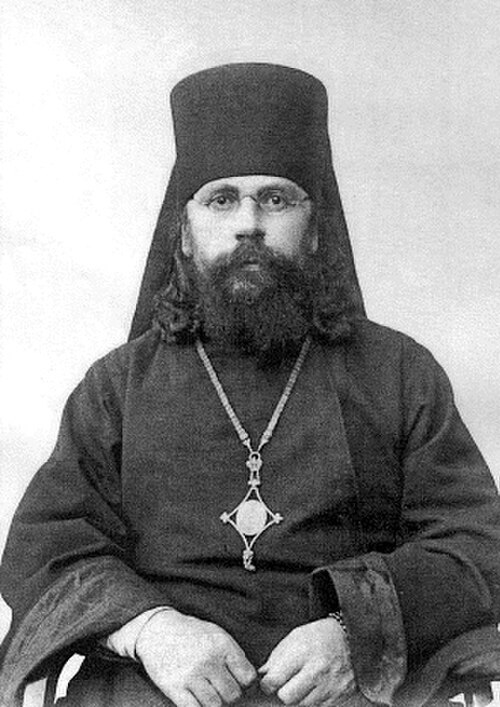
Hieromartyr
Seraphim Ostroumov
Bishop of Smolensk
Son of a psalmist and graduate of the Moscow Theological Academy, Bishop of Smolensk, killed in the Katyn forest in 1937.
- Feast
- November 25old style December 8
- Reposed
- 193720th century
- Place
- Katyn
- Order
- Martyrs
Life
Saint Seraphim (Ostroumov), Hieromartyr and Archbishop of Smolensk, was a bishop of the Russian Orthodox Church who served first among the Orthodox of the Chełm land, in present-day Poland, and then in Oryol and Smolensk. After years of imprisonment and persecution he was shot in 1937 in the Katyn forest. The Church honours him among the New Martyrs of Russia, and today he is also venerated in the Polish Orthodox Church, where he served a century ago.
Childhood and studies
In the world he was Mikhail Mitrofanovich Ostroumov, born on 6 November 1880 in Moscow into the family of Mitrofan Ostroumov, psalmist at the Church of the Prophet Elijah on Vorontsovo Pole. He studied at the theological school of the Zaikonospassky Monastery, then at the Moscow Theological Seminary, completed in 1900, and at the Moscow Theological Academy, from which he graduated in 1904 as a candidate of theology and was retained as a scholar preparing for a professorship.
On 14 September 1904 he was tonsured a monk with the name Seraphim by Bishop Tryphon (Turkestanov) at the Epiphany Monastery in Moscow. That same month he was ordained hierodeacon and then hieromonk. Immediately after his ordination he went to Optina, where he worked in the monastery kitchen and served as canonarch.
On 28 October 1904 he was appointed acting lecturer in the department of the theory and history of preaching at the Moscow Academy. The appointment was made by Metropolitan Vladimir (Bogoyavlensky), who wished to increase the number of conservative monastic teachers. The academy's council, however, refused to approve it, and Hieromonk Seraphim was unable to lecture. In 1906, under pressure from the liberal part of the faculty and the students, he was forced to leave the academy together with Archimandrite Joseph (Petrovykh).
At the Monastery of Jabłeczna
In 1905 he travelled with the theology professor Mikhail Tareyev to the monasteries of Wirów and Leśna Podlaska and through the Chełm land. What he saw moved him so deeply that he decided to give up an academic career and devote himself to pastoral work in that region. In 1906, at his own request, he joined the Monastery of Saint Onuphrius at Jabłeczna, where from September he served as deputy to the abbot, Archimandrite Joseph (Petrovykh).
The diocese of Chełm had been separated from that of Warsaw in 1905, and the Holy Synod wanted the monastery to become a strong centre of Orthodoxy and of Russian influence in the region. After Tsar Nicholas II's edict of toleration, up to 200,000 former Uniates of the Chełm land had passed to the Roman Catholic Church. Together with the abbot, Hieromonk Seraphim worked to strengthen the monastery's finances and to broaden its charitable and educational work.
In October 1907 he became head of the two-grade parish school at the monastery and of new courses for teachers, which trained staff for church schools. At their opening he said that the region needed local teachers who knew its ways, because outsiders often misunderstood it. He found benefactors for the monastery's restoration, above all the Moscow priest Nikolai Kopiev, with whose help the main Church of Saint Onuphrius was rebuilt under his supervision.
In November 1907 Archimandrite Joseph was transferred to the diocese of Novgorod. On 1 December Seraphim became acting abbot, and two weeks later the brotherhood elected him abbot, the first such election in decades, since abbots were usually appointed by the Synod. The Synod confirmed the election on 18 January 1908, and on 2 February 1908 he was raised to the rank of archimandrite and made dean of the monasteries of the Chełm diocese.
Work as abbot
As abbot he built the Dormition chapel near the monastery (consecrated in August 1907) and completed the skete of Saints Sergius and Herman of Valaam on the shore of the White Lake, opened in 1909, both with the help of Father Kopiev. Across the river Bug he raised the chapel of the Meeting of the Lord, built from the gifts of the faithful and consecrated in 1912. That same year he opened a second dependency of the monastery in the forest of Dratów, 85 kilometres away, dedicated to the Prophet Elijah, with a church and a school. He obtained funds from the Synod for a new bell tower, but the work was halted by the war. He also helped build the Church of the Protection of the Mother of God at Sławatycze between 1910 and 1912.
The monastery adopted the rule of Saint Basil the Great, with common life and a common table. In winter the monks had lessons deepening their knowledge of the sacraments, the services, Church history and the ascetic life. Many of them were sent to preach in the parishes of the diocese or in Austrian Galicia.
The monastery had a guesthouse and a tea room for pilgrims, a pharmacy and a clinic, and the poor were given lunch free of charge. Besides the parish school there were a two-grade school in the village of Otoki with 62 children, a one-grade school in Jabłeczna with 60 pupils, a trade school with a boarding house and, from 1911, an agricultural school where children learned gardening, orcharding, forestry, animal husbandry, dairy work and beekeeping. In 1914 more than 400 pupils were studying in the monastery's schools. Jabłeczna once again became a great place of pilgrimage.
On 31 August 1909 he was appointed missionary preacher of the diocese, but on 8 December the appointment was cancelled and he returned to the monastery. He also worked on a history of the monastery, whose manuscript was probably lost during the war.
Rector at Chełm
On 28 January 1914 he was appointed rector of the Chełm Theological Seminary. He chaired the diocesan school council, was a member of the Brotherhood of the Mother of God and edited the diocese's publications, the journal “Chełm Church Life” and the “People's Paper”. In 1915, before the Russian army withdrew from Chełm, the seminary was evacuated to Moscow. There Archimandrite Seraphim cared for the refugees from the Chełm land and worked to ease their life in exile.
Bishop in Oryol
On 24 February 1916 he was named Bishop of Biała Podlaska, vicar of the diocese of Chełm, and was consecrated on 3 April 1916 in the Cathedral of Christ the Saviour in Moscow by Metropolitan Macarius (Nevsky) of Moscow with other bishops. On 21 April he was entrusted with the temporary administration of the diocese of Chełm.
From 27 May 1917 he temporarily administered the diocese of Oryol, and on 18 August 1917, elected by the faithful, he became Bishop of Oryol and Sevsk. He cared for the seminary, the schools, the publications and the monasteries; he was an honorary member of the Oryol Church Historical Society and compiled photograph albums of the region. He was a delegate to the All-Russian Congress of Clergy and Laity and an ex officio member of the Local Council of 1917-1918, working in several of its departments. When the Soviet authorities banned church schools, he organised secret religious classes, preached and led processions.
In 1918 he was twice placed under house arrest: on 14 March, without the right of correspondence, when he was interrogated twice, and on 6 July, when the Cheka broke up a diocesan meeting at his residence and searched the house. In these years in Oryol a little boy served him in the altar who would later become the renowned elder John Krestiankin.
In 1922 he was arrested for allegedly resisting the confiscation of church valuables and, on fabricated charges, was sentenced to seven years in prison in total isolation. The sentence was reduced to a year and a half, and after one year and ten months he was released and returned to Oryol. On 29 May 1924 he was raised to the rank of archbishop. He fought firmly against Renovationism, the so-called Living Church. In December 1926 he was arrested again and banished from his diocese.
Archbishop of Smolensk
On 1 November 1927 he became Archbishop of Smolensk and Dorogobuzh. He could not serve in the Dormition Cathedral, which had been handed over to the Renovationists. The cathedral was for a time the Church of Saint Nicholas, closed in 1929 along with more than ten other parishes, and then the Church of Saints Peter and Paul, until 1936, when it was seized and turned into an archive. The authorities tightened their grip on the Church: in 1931 the liturgical vestments of the Smolensk parishes were confiscated, and in 1935 the bells. The archbishop tried to resist but had no means to do so.
Martyrdom
On 11 November 1936 he was arrested with other clergy and accused of anti-Soviet propaganda and of leading a “counter-revolutionary group of churchmen”. He was charged with foretelling the fall of communism in his sermons and with encouraging the clergy to reopen closed churches. Neither he nor the others admitted guilt. They were sentenced to five years in the Karaganda camps.
In November 1937, half a year after his arrival in the camp, the case was reopened. The archbishop was brought to Smolensk, and the NKVD troika of the region sentenced him to death. He was shot on 8 December 1937 (25 November in the Old Style) in the Katyn forest near Smolensk and received the crown of martyrdom.
Veneration
On 21 November 1958 he was rehabilitated by the Smolensk regional court, a decision confirmed by the prosecutor's office on 21 July 1989. On 17 July 2001 the Holy Synod of the Russian Orthodox Church numbered him among the Synaxis of the New Martyrs and Confessors of Russia, with his commemoration on the day of his martyrdom.
In the crypt of the memorial Church of the Resurrection at Katyn, consecrated in 2012, there is an exhibition devoted to him. On 7 December 2013 a moleben in his honour was served at the cross on the Russian side of the Katyn memorial, and in 2014, at the initiative of Patriarch Kirill, a monument to him was unveiled there in the presence of Russian, Polish and Belarusian Orthodox clergy. In 2017, on the eightieth anniversary of his death, Bishop Seraphim (Amelchenkov) published a book on his ministry in Poland and Russia.
At the beginning of the twenty-first century his veneration also began in the diocese of Lublin and Chełm of the Polish Orthodox Church, where he had served a century before. In 2014 Archbishop Abel (Popławski) established a parish in his honour at Biała Podlaska.
A sad episode shows how well known his name was. In 1939, after the archbishop's death, a certain Mikhail Pozdeyev began to pass himself off as Bishop Seraphim Ostroumov, after a village priest mistook him for him; he was arrested in 1940 and sentenced.
Commemorated the same day November 25
 Catherine of AlexandriaGreat Martyr · of AlexandriaNov 25
 Peter of AlexandriaHieromartyr · Patriarch of AlexandriaNov 25
- 150 OratorsSaintNov 25
- 670 MartyrsMartyrNov 25
- Alanus of LavaurVenerableNov 25
- Alexander VershinskyHieromartyrNov 25
- Andrew ShershnevHieromartyrNov 25
- Barlaam PopovHieromartyrNov 25
- Basil PariyskyHieromartyrNov 25
- BasilissaSaintNov 25
- Bernold of OttobeurenSaintNov 25
- Cosmas KorotkikhHieromartyrNov 25