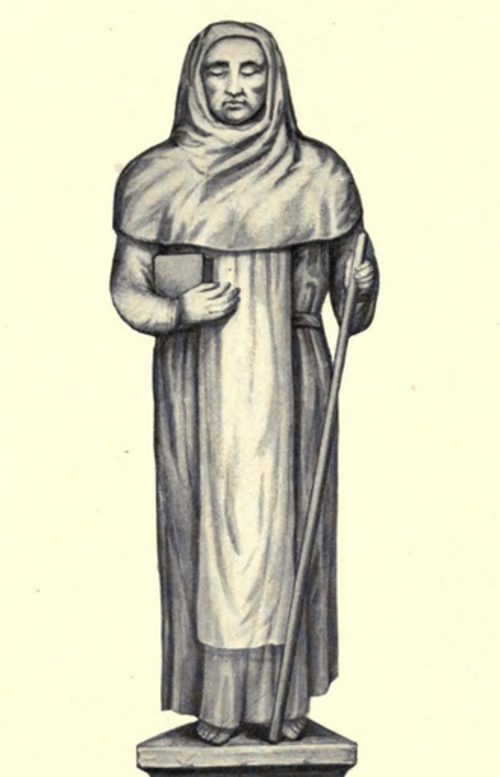
Venerable
Cenydd
A Welsh holy monk, a hermit on the Gower peninsula.
- Feast
- August 1old style August 14
- Era
- 6th century
- Order
- Venerables
Life
Saint Cenydd (Cennydd, Kinède, in English Kenneth, Kined) was a Christian hermit of the sixth century on the Gower peninsula in Wales, credited with the foundation of the church at Llangennith (Llangenydd). Liturgical calendars and place-name evidence suggest his historical existence; his legend, however, is too late and too obviously derivative to be relied upon.
According to Welsh sources collected in the fifteenth century by Capgrave in the Nova Legenda Angliae, Cenydd was a Breton prince, the son of King Dihoc (presumably Deroch II of Domnonée) by an incestuous relationship with his own daughter. A cripple, he was placed in a cradle of osiers and cast into the estuary of the River Loughor and landed on Worm's Head. Seagulls and angels with a miraculous breast-shaped bell ensured that he survived and was educated as a Christian. He became a hermit, his only companion an untrustworthy servant whose dishonesty was revealed when he stole a spear from a group of robbers who had been hospitably received. In 545 Saint David cured Cenydd while traveling to the Synod of Brefi, but he preferred to remain as he was born and prayed that his infirmity be restored. An incised stone monument with images of the legend, the "Kenneth Stone", was found at Saint Mungo's Church at Dearham in Cumbria. On Burry Holms, an island at the northern end of Rhossili Bay, are the remains of a pre-Norman hermitage associated with him. In Brittany his name appears, in variants such as Kihoet or Quidic, in several churches and localities. He is commemorated on 1 August as a saint of the undivided Church, by the New Calendar.
Commemorated the same day August 1
 The Maccabean MartyrsHoly MartyrsAug 1
 Æthelwold of WinchesterSaint · Bishop of WinchesterAug 1
 Exuperius of BayeuxSaint · First Bishop of BayeuxAug 1
 Leo of MontefeltroSaint · First bishop of MontefeltroAug 1
 Bono of RomeHieromartyr · Roman priestAug 1
- Arcadius of BourgesSaint · Bishop of BourgesAug 1
 Dmitry PavskyHieromartyr · ArchpriestAug 1
- Alexander of PergeMartyr · FarmerAug 1
- Alim the MaccabeeMartyrAug 1
 AlmedhaMartyrAug 1
- Anthony the NewVenerable · the WonderworkerAug 1
- Antoninus the MaccabeeMartyrAug 1