Right-Believing
Ceolwulf of Northumbria
King of Northumbria
King of Northumbria from 729 to 737, to whom Bede dedicated his Ecclesiastical History; he died a monk at Lindisfarne.
- Feast
- January 15old style January 28
- Reposed
- 7658th century
- Place
- Lindisfarne
Life
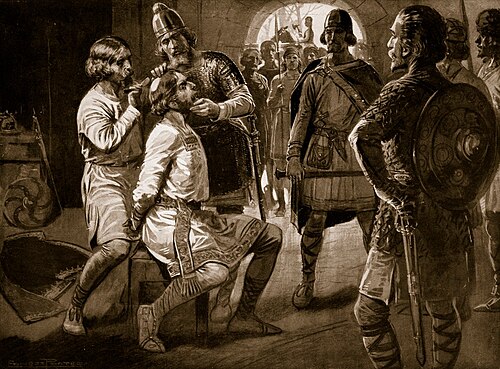
Saint Ceolwulf the right-believing was king of Northumbria from 729 to 737, the "most glorious king" to whom Saint Bede the Venerable dedicated his Ecclesiastical History of the English People. In 737 he gave up the throne and became a monk at Lindisfarne, where he lived until his repose, on 15 January 765. The Church remembers him on 15 January.
He was born around 695, in one of the branches of the dynasty of the Idings, son of Cuthwin of the line of Ocga and brother of Coenred, who had taken the throne in 716. Osric, the last of the branch of Æthelric, reigned ten years, and in 729, shortly before his death, named Ceolwulf his successor. He was a man of deep monastic interests and, it seems, little suited to affairs of state. He sought Bede's advice in important matters, and Bede, praising his piety, had doubts about his ability to rule. Bede dedicated the Ecclesiastical History to him in 731. The start of his reign was disturbed by factions and rebellion. In autumn 731 he was seized by his enemies and forced to receive the monastic tonsure, was deposed for a time, but quickly restored. The details of the coup are unclear. Bishop Acca of Hexham is said to have been deprived of his see, which suggests he supported the king's enemies. In 732 or 734 he named his cousin Ecgbert to the see of York. It is thought he may have spent time in Ireland, perhaps in spiritual study.
As king he endowed Lindisfarne monastery with many gifts. He obtained for the monks a dispensation allowing beer and wine, against the Celtic custom, which limited drink to water and milk. In 737 he gave up the throne to his first cousin Eadberht and withdrew to Lindisfarne, where he spent the rest of his life, falling asleep in the winter of 764 to 765. He was buried beside Saint Cuthbert, and after prayers at his grave miracles took place and he was regarded as a saint. According to some sources, in 830 his relics were moved with Saint Cuthbert's from Lindisfarne to Durham, while according to others Bishop Ecgred moved them to the church of Saints Peter, Cuthbert and Ceolwulf, rebuilt at Norham.
Commemorated the same day January 15
 RachelRighteous · The MatriarchJan 15
 Paul of ThebesVenerable · The First HermitJan 15
 Remigius of ReimsSaint · Archbishop of ReimsJan 15
 Remigius of RouenSaint · Archbishop of RouenJan 15
 John the Hut-dwellerVenerable · Hermit of ConstantinopleJan 15
- EugippiusVenerable · Abbot of LucullanumJan 15
 Gabriel of LesnovoVenerable · Hermit of LesnovoJan 15
 Ephysius of CagliariMartyr · Patron of CagliariJan 15
 Viator of BergamoSaint · Bishop of BergamoJan 15
 Nektary TelyashinSaint · Archbishop of Siberia and TobolskJan 15
- Salome of UjarmaRight-Believing · Queen of IberiaJan 15
 Pansophius of AlexandriaMartyrJan 15