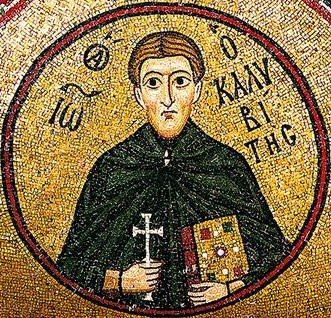
Venerable
John the Hut-dweller
Hermit of Constantinople
Monk who, after years in Jerusalem, lived in humility in a hut at the gate of his parents' house.
- Feast
- January 15old style January 28
- Reposed
- 5005th century
- Place
- Constantinople
- Order
- Venerables
Life
Saint John the Hut-dweller (John Calybite, John Kalyvitis), a venerable father, was a monk and hermit of Constantinople in the fifth century, in the time of the emperor Leo I (457-474). His feast is on 15 January.
Childhood
He was the son of a rich and noble family of Constantinople; his father, Eutropius, was a general in the Byzantine army, and his mother was named Theodora (according to a Serbian source, he was an only child). He received an excellent education, learning Christian theology and the secular sciences (philosophy and rhetoric). He loved reading spiritual books. Seeing his love for the Church, his parents gave him, at the age of twelve, a gospel "bound in gold." Understanding the vanity of worldly life, he longed to lead a monastic life and left home secretly for a monastery in Bithynia (according to the Serbian source, with a monk, to a monastery in Asia Minor), where he took the monastic vows.
His struggle
He lived six years in the monastery, amazing the brethren by his unceasing prayer, humble obedience, severe self-restraint and patience in carrying out his duties. But consumed with longing for his parents (in the Serbian source, tempted by the devil), he asked the abbot's blessing to return to Constantinople. He settled there, unknown to anyone, in a hut near his parents' house, to see his loved ones daily. He lived in poverty, dressed as a beggar, receiving food from his parents' table; they did not recognize him, because he had grown thin from long fasting. He kept the gospel received in childhood as all his property; for three years (according to the Serbian source) he lived in prayer, asking God for the salvation of the souls of his father and mother, enduring many insults.
His repose
Feeling that his end was near, he called his mother and revealed his identity; his parents recognized him by the gospel given him in childhood. He died surrounded by his parents, young, probably around 450 (according to the sources, he was not more than twenty-five), and was buried in the beggar's rags in the very place of his hut. His parents built a church over the tomb, beside which a hospice for the poor was made. During the Crusades the head of Saint John was taken to Besancon, in France, and the rest of the relics to Rome. His Life, composed by Symeon Metaphrastes, is printed in Migne's Patrology.
Commemorated the same day January 15
 RachelRighteous · The MatriarchJan 15
 Paul of ThebesVenerable · The First HermitJan 15
 Remigius of ReimsSaint · Archbishop of ReimsJan 15
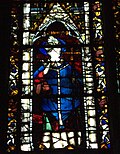 Remigius of RouenSaint · Archbishop of RouenJan 15
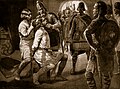 Ceolwulf of NorthumbriaRight-Believing · King of NorthumbriaJan 15
- EugippiusVenerable · Abbot of LucullanumJan 15
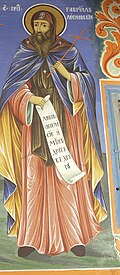 Gabriel of LesnovoVenerable · Hermit of LesnovoJan 15
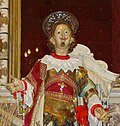 Ephysius of CagliariMartyr · Patron of CagliariJan 15
 Viator of BergamoSaint · Bishop of BergamoJan 15
 Nektary TelyashinSaint · Archbishop of Siberia and TobolskJan 15
- Salome of UjarmaRight-Believing · Queen of IberiaJan 15
 Pansophius of AlexandriaMartyrJan 15