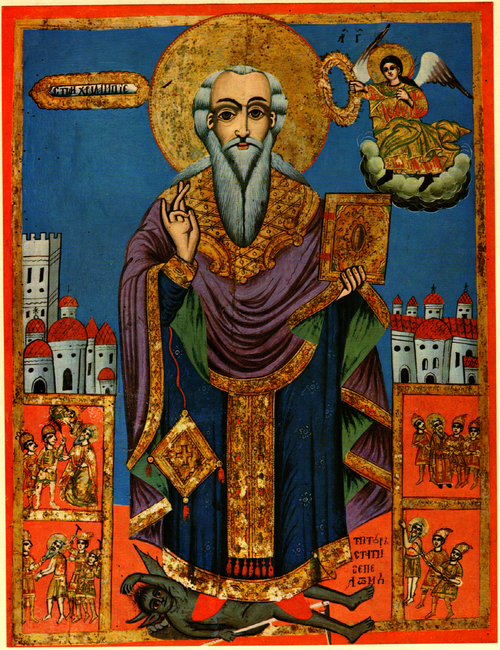
Hieromartyr
Charalampus
Presbyter of Magnesia
Priest of Magnesia on the Maeander in Asia Minor, who died a martyr around 202.
- Feast
- February 10old style February 23
- Reposed
- 2023rd century
- Place
- Antioch of Pisidia
- Order
- Martyrs
Life
Saint Charalampus, hieromartyr, was a priest or, according to other sources, a bishop in Magnesia in Asia Minor, and received the crown of martyrdom around 202, in the time of Emperor Septimius Severus. He is said to have been one hundred and thirteen years old, which is why he is counted the oldest of the martyrs. The Church commemorates him on 10 February, and his name in Greek means one made radiant with joy.
Life and suffering Charalampus lived in Magnesia on the Maeander in Asia Minor. He preached the Gospel and strengthened Christians in time of persecution, and through his labours the community grew. When news of his preaching reached the proconsul Lucian and the military commander Lucius, he was arrested. Before the court he confessed Christ and refused to sacrifice to idols.
Despite his great age he was mercilessly tortured: they tore his body with iron hooks and flayed his skin. The saint had only one word for his tormentors: “Thank you, brothers, for scraping my old body and renewing my soul for new and eternal life.”
According to his Life, two soldiers, Porphyrius and Baptus, seeing his patience, openly confessed faith in Christ and were killed with the sword. Three women who watched his sufferings also began to glorify Christ and were put to death. According to tradition, Lucius, enraged, took up the instruments of torture and began to torment him himself, but his arms were suddenly cut off as though by a sword. The proconsul Lucian spat in the saint's face and at once his head was turned backward. A voice was heard from a cloud, saying that the saint's prayers were received and that his word would be healing for the sick. The two officials begged forgiveness, were healed by the saint and became Christians. Some texts add that nails were driven into his body and that he was dragged to the emperor with his beard tied in a rope.
The end After further tortures Charalampus was brought before Septimius Severus himself, who condemned him to death. On the way to the place of execution he prayed that in the place where his relics would rest there should be neither famine nor disease. After the prayer he gave up his soul to God even before the executioner's sword touched his neck. According to tradition the emperor's daughter Galina, moved by his death, became a Christian and buried him herself. Some sources say he died at Antioch of Pisidia.
Veneration The saint's skull is kept at the Monastery of Saint Stephen at Meteora, and fragments of his relics are found in many places in Greece and elsewhere. Many miracles are told through them, and the saint is very dear to the Greek and Bulgarian peoples. In Bulgaria he is honoured above all as a helper of the sick and protector of beekeepers, and on his feast honey is blessed in many churches. In Russia he is invoked against death without repentance and for the protection of animals and crops.
Icons show him as an old man in episcopal or priestly vestments, with a blessing hand. Greek tradition depicts him as a priest, Russian as a bishop. He is commemorated on 10 February.
Commemorated the same day February 10
 ScholasticaVenerable · Sister of BenedictFeb 10
 Anna of NovgorodRight-Believing · Wife of Yaroslav the WiseFeb 10
 Austrebertha of PavillyVenerable · Abbess of PavillyFeb 10
 Joachim of KorsunSaint · First Bishop of NovgorodFeb 10
 Prochorus of the Kiev CavesVenerable · Monk of the Kiev CavesFeb 10
 German of NovgorodSaint · Bishop of NovgorodFeb 10
 Longinus of KoryazhmaVenerable · Founder of Saint Nicholas MonasteryFeb 10
- GalinaRighteousFeb 10
 Peter GrudinskyHieromartyr · PriestFeb 10
- ValentinaMartyrFeb 10
- Airennan of TamhlachtSaintFeb 10
- Amantius of RomeMartyrFeb 10