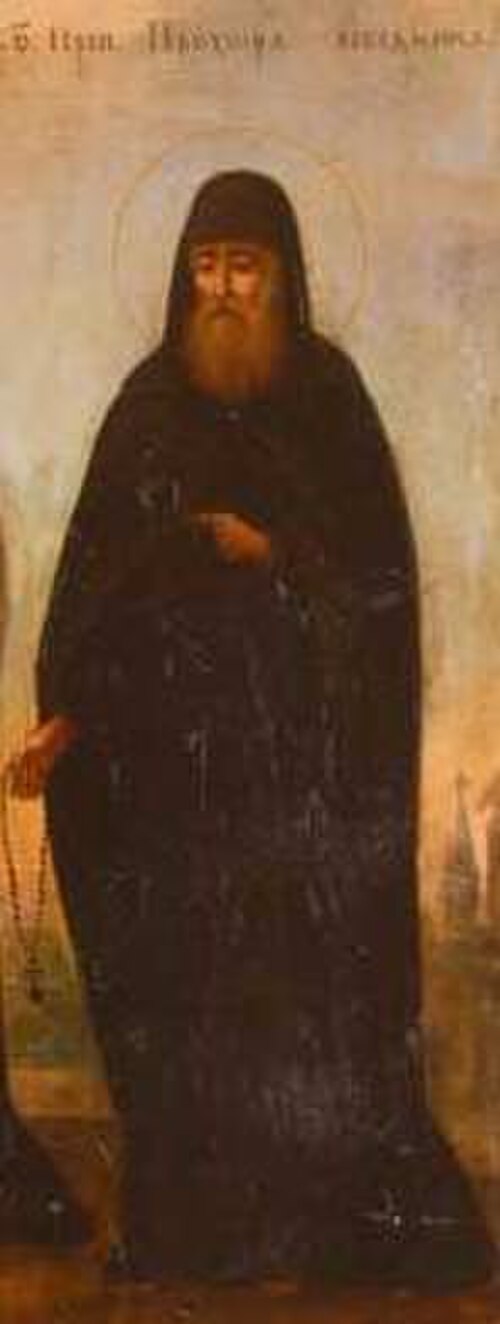
Venerable
Prochorus of the Kiev Caves
Monk of the Kiev Caves
Monk of the Kiev Caves Monastery, died 1107, who made his bread from goosefoot; a wonderworker.
- Feast
- February 10old style February 23
- Reposed
- 110712th century
- Place
- Kyiv
- Order
- Venerables
Life
Saint Prochorus Lobodnik (“the goosefoot eater”) the venerable was a monk of the Kiev Caves Lavra, who died on 10 February 1107, a wonderworker. He is commemorated on 10 February (23 February in the new style), and some sources give also 11 October or 28 September; he is also commemorated in the synaxis of the saints of Smolensk, on the Sunday before 10 August.
His life
According to the Ukrainian source he was a native of Smolensk. He was tonsured at the Caves Lavra in the time of Abbot John (1088-1103). He led a strict life: he did not eat ordinary bread, but gathered goosefoot (a weed) and made flour of it by rubbing it with his hands, and from this he made bread and fed on it. In summer he prepared such bread for the whole year. He ate nothing but the prosphora in church and in his cell and drank nothing but water, so he was called "Lobodnik". It is said that he reproached himself even for the grass prepared for a year, saying: "Prochorus, this night your soul will be required of you, and what you have prepared, whose will it be?"
In his time, because of unceasing wars, famine came to Rus. Prochorus began to make still more bread of goosefoot and to distribute it to the needy and to those perishing of hunger. People, to feed themselves in the famine, began to make bread of goosefoot too, but could not eat it for bitterness. Then all began to turn to the saint, and he refused no one. To the taste this bread seemed sweet, as if mixed with honey. It was given only with a blessing, and if anyone took it secretly, the bread turned black and bitter. One of the monks took bread secretly, without a blessing, and began to eat it: the bread showed in his hand as earth, and in his mouth so bitter that he could not eat it. This happened several times. He went to the abbot and told him. The abbot, unbelieving, ordered another brother to take bread secretly from the saint to see the truth. When the bread was brought, it was the same: no one could eat it for bitterness. While the bread was still in their hands, the abbot again sent to the saint to ask for bread with his blessing and to take another secretly. The bread taken secretly turned black as earth and bitter as wormwood, and the one taken from his hand seemed pure and was sweet as honey. After this miracle Prochorus became famous.
Later, because of the quarrels between Prince Sviatopolk Izyaslavich and Prince David Igorevich of Volhynia, the Carpathian salt was lacking in Kiev. The blessed Prochorus gathered in his cell the ashes from all the cells and, praying, turned them into pure salt. The more salt he gave, the more there was, so that it sufficed not only for the monastery but for other people. The merchants who could no longer sell their salt gathered and came to Prince Sviatopolk with a complaint against the blessed one: "Prochorus, a monk of the Caves monastery, has taken much money from us: he has drawn everyone to himself for salt, and we, who pay you taxes, can no longer sell our salt and have been ruined through him." The prince decided to steal the salt from the monk and settle the problem, earning money too. When the salt was brought, he came to see it himself, but saw only ashes. He kept the ashes three days, then ordered them thrown out at night. The ashes thrown out turned again into salt. Then the prince was told all that the blessed Prochorus had done, and he was ashamed, went to the Lavra and was reconciled with Abbot John. From those miracles the prince had great love for the most holy Mother of God and for the venerable Anthony and Theodosius of the Caves.
His end and relics
Prochorus lived many more years, but then fell ill. Before this he told the prince: "The hour of my departure from the body is near; if you wish to fulfil your promise and receive from God forgiveness of sins, come to receive leave and to lay me in the tomb with your own hand. I await your coming. If you delay and I depart without you, the fault will not be mine and the campaign will end otherwise than if you come to me." Receiving this message, Sviatopolk left the army, which was at war with the Polovtsians, and came soon to the sick Prochorus. The venerable one taught him much about almsgiving, the future judgment, eternal life and endless torment, gave him forgiveness and blessing and took leave of all around the prince. Then, raising his hands to heaven, he gave up his spirit into God's hands. The prince and the monks took the saint's body, carried it into the cave, and he laid it with his own hands in the coffin. Then he went on the campaign and won a great victory over the unbelieving Hagarenes, took all the Polovtsian lands and brought the prisoners to his own land; this victory, given by God to the Russian land, was won by the foretelling of the merciful Prochorus. His relics rest in the Near Caves, where maps of 1638 show them, opposite the relics of Saint John the Faster. On the map of 1703 the ascetic's name is accompanied by the word "priest".
Commemorated the same day February 10
 ScholasticaVenerable · Sister of BenedictFeb 10
 Anna of NovgorodRight-Believing · Wife of Yaroslav the WiseFeb 10
 CharalampusHieromartyr · Presbyter of MagnesiaFeb 10
 Austrebertha of PavillyVenerable · Abbess of PavillyFeb 10
 Joachim of KorsunSaint · First Bishop of NovgorodFeb 10
 German of NovgorodSaint · Bishop of NovgorodFeb 10
 Longinus of KoryazhmaVenerable · Founder of Saint Nicholas MonasteryFeb 10
- GalinaRighteousFeb 10
 Peter GrudinskyHieromartyr · PriestFeb 10
- ValentinaMartyrFeb 10
- Airennan of TamhlachtSaintFeb 10
- Amantius of RomeMartyrFeb 10