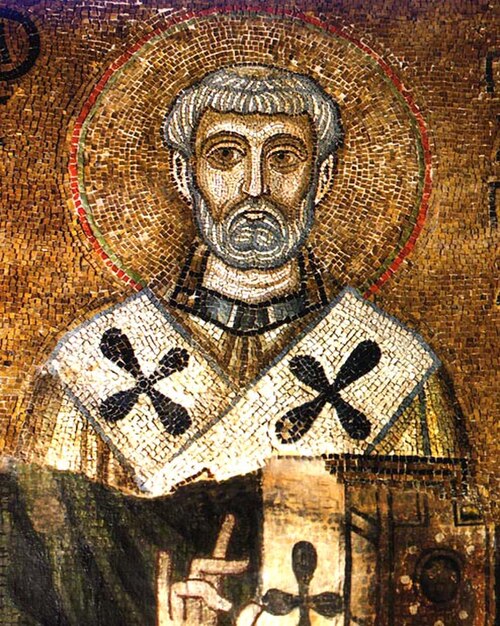
Hieromartyr
Clement of Rome
Bishop of Rome
Bishop of Rome and disciple of the apostles, author of an epistle to the Corinthians.
- Feast
- November 24old style December 7
- Reposed
- 991st century
- Place
- Chersonesus
- Order
- Martyrs
Life
The holy Hieromartyr Clement of Rome was bishop of Rome at the end of the first century and a disciple of the holy Apostles Peter and Paul. The Church honours him as one of the Apostolic Fathers, author of an epistle to the Church of Corinth, and as a witness of Christ who died for the faith. Few certain facts are preserved about his life, and tradition has added many details. He is also called Pope Clement I.
Disciple of the apostles
According to tradition, he was born at Rome into a rich and well-known family, the son of Faustus and Matidia, and received a fine education in the sciences of the day. Unmoved by the luxury around him, he searched for the meaning of life, and when he heard of Christ he left his home and fortune and set out for the lands where the apostles were preaching. At Alexandria he met the Apostle Barnabas, and in Palestine he was baptized by the Apostle Peter and became his disciple and companion in labours.
Saint Irenaeus of Lyons writes that Clement saw the apostles and heard their preaching. Tertullian says that Peter ordained him bishop. The Church of Rome counts him as the third bishop after Linus and Anacletus, or the fourth, depending on how the first bishops are reckoned. The OCA gives the years 92 to 101 for his ministry, and the Greek synaxarion says he succeeded Anacletus around the year 92. According to tradition, at Pascha he once baptized 424 persons of every rank, among them relatives of the emperor. An ancient tradition identifies him with the Clement whom Saint Paul calls a fellow worker in the epistle to the Philippians.
The epistle to the Corinthians
Around the year 96 a disturbance broke out in the community of Corinth, where some of the faithful had removed their presbyters from office. The Church of Rome wrote to them through Clement an epistle urging repentance, humility and peace and reminding them that the order of the Church comes from the apostles. This First Epistle of Clement is the only writing certainly his and is one of the oldest Christian documents outside the New Testament. The second epistle that bears his name is a later homily, and the writings called the Clementine literature are not his.
Martyrdom
According to tradition, pagans denounced him to the Emperor Trajan, who exiled him to the Crimea to labour in a stone quarry near Chersonesus with other Christians. Many of his disciples followed him of their own will. Finding that the condemned suffered from lack of water, he prayed to the Lord, and the Lord appeared to him in the form of a lamb and showed him the place where a spring gushed forth. The miracle brought crowds of pagans to the faith, and a church was built in the quarry. For this the emperor ordered him to be thrown into the sea with an anchor tied to his neck, around the year 101 according to the OCA, or around 100 according to other sources.
His disciples Cornelius and Fibius asked the faithful to pray that they might see the martyr's body, and the sea drew back, and they found a tomb in the shape of a church, in which the body was incorrupt. Each year on the anniversary of his death the sea receded for seven days, so that the relics could be venerated.
Relics and veneration
In the time of Emperor Nikephoros (802 to 811) the sea ceased to recede, and the relics remained hidden for fifty years. In the time of Emperor Michael and his mother Theodora, Saints Cyril and Methodius came to Cherson and, after their prayers and those of the clergy, the relics rose to the surface of the sea at midnight. They were taken to the Church of the Holy Apostles in Constantinople. A portion was brought to Rome by Cyril and Methodius, where it is kept in the Basilica of San Clemente, and a large part came to Kiev, brought by Saint Vladimir. The Inkerman cave monastery in the Crimea is held to mark the place of his burial.
The Orthodox Church commemorates him on 24 November, together with Saint Peter, bishop of Alexandria. In the West his commemoration falls on 23 November. The anchor is his emblem in icons.
Commemorated the same day November 24
 Mercurius of CaesareaGreat Martyr · Soldier of CappadociaNov 24
 FirminaMartyr · Virgin and martyrNov 24
- Eanflaed of WhitbyVenerable · Abbess of Whitby AbbeyNov 24
 Protasius of MilanSaint · Archbishop of MilanNov 24
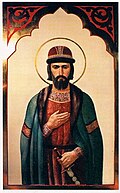 Mercurius of SmolenskMartyr · Martyr of SmolenskNov 24
 Mercurius of BrygyntsiVenerable · Monk in the Chernihiv regionNov 24
- Simon of SoigaVenerable · Founder of the Soiga River monasteryNov 24
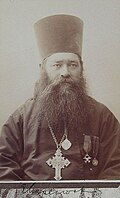 Evgraf EvarestovHieromartyr · PriestNov 24
- Theodore the MartyrMartyrNov 24
- Alexander LevitskyHieromartyrNov 24
- Alexander of CorinthMartyrNov 24
- Alexis TyutyunovHieromartyrNov 24