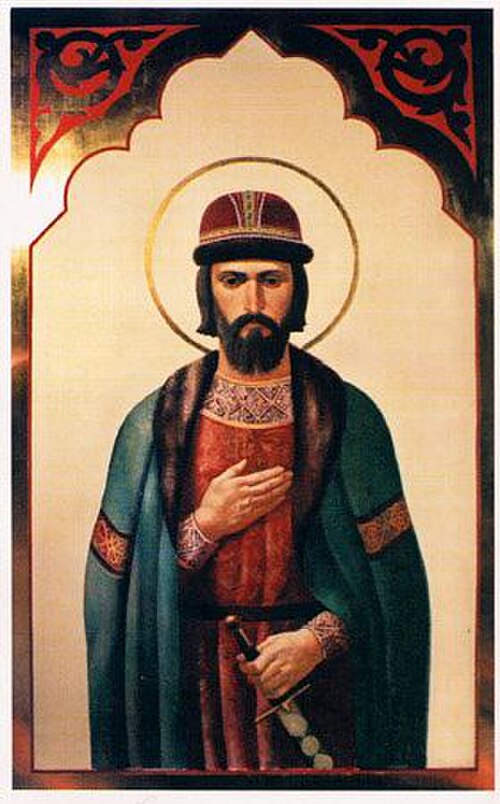
Martyr
Mercurius of Smolensk
Martyr of Smolensk
Venerated as a martyr at Smolensk, who died in 1239 during the Mongol invasion.
- Feast
- November 24old style December 7
- Reposed
- 123913th century
- Order
- Martyrs
Life
Holy Martyr Mercurius of Smolensk (died 1239) is venerated as a martyr and as protector of the city of Smolensk, which, according to his Life, was saved when the Tatars of Batu stood before the town. He is commemorated on 24 November, Old Style (7 December New Style), with a service of six stichera. Our record gives birth in 1150, but the Russian source does not say the year of birth.
His life according to tradition
Mercurius was a Slav from Moravia, of princely stock. As a young man he came to Smolensk and entered the service of the prince there. According to his Life, a monument of old Russian writing, "The Tale of Mercurius of Smolensk", he was distinguished by his faith and a pious life: he struggled in fasting and chastity. He received martyrdom in 1239, at the time of the invasion of Khan Batu against Smolensk. According to tradition, when the Tatar armies stood twenty-five versts from the city, at Dolgomostye, the sacristan of the cathedral, praying at night before the icon of the Mother of God, saw the Mother of God, who ordered him to call Mercurius.
The saint went with the sacristan to the church of the Most Holy Mother of God. In the church they found a candle burning before the icon. Mercurius, falling before the icon, prayed with tears, asking the help and protection of the Most Holy Lady. Then a voice was heard from the icon: My servant Mercurius, I send you to drive the enemies from this city and to defend this church; in this battle you will conquer the enemies and receive from the Lord the crown of victory and eternal blessedness. Mercurius obeyed the command of the Mother of God and by night went to the enemy camp, where, according to the Life, he destroyed a multitude of foes, among them a giant who struck fear into all by his strength. In the fight the son of the slain giant cut off Mercurius's head, but the Tatars, seized by terror, fled, leaving their weapons, driven by an unknown power, and left the borders of Smolensk. The inhabitants buried the body of Mercurius in the Dormition cathedral at Smolensk.
Veneration and sources
The church feast in his memory was set at the end of the sixteenth century, but already from 1509 the people of Smolensk venerated him as defender of the city. Several scholars (among them F. Buslaev, Sergius Spassky, Arseny Kadlubovsky, Leonid Beletsky and Theodosius Spassky) have seen in his veneration a form, on Russian soil, of the Greek and European cult of the Byzantine saint Mercurius of Caesarea, of the third century. The composition of the first surviving version of the Life answered the ideological glorification of the shrines of Smolensk after the capture of the city by Grand Prince Vasily III of Moscow (1514), at the time when the feast of the Smolensk icon of the Mother of God was being established and the cathedral at the Novodevichy monastery was being built (1524). The Life as we have it is therefore not a witness from the time of Batu. In the memory of the people, as we find it in Ivan Bunin's "Sukhodol" (1912), there remained the image of a headless man, with his helmeted head in one hand and the icon of the Guide in the other.
Commemorated the same day November 24
 Clement of RomeHieromartyr · Bishop of RomeNov 24
 Mercurius of CaesareaGreat Martyr · Soldier of CappadociaNov 24
 FirminaMartyr · Virgin and martyrNov 24
- Eanflaed of WhitbyVenerable · Abbess of Whitby AbbeyNov 24
 Protasius of MilanSaint · Archbishop of MilanNov 24
 Mercurius of BrygyntsiVenerable · Monk in the Chernihiv regionNov 24
- Simon of SoigaVenerable · Founder of the Soiga River monasteryNov 24
 Evgraf EvarestovHieromartyr · PriestNov 24
- Theodore the MartyrMartyrNov 24
- Alexander LevitskyHieromartyrNov 24
- Alexander of CorinthMartyrNov 24
- Alexis TyutyunovHieromartyrNov 24