Venerable
Eanflaed of Whitby
Abbess of Whitby Abbey
Daughter of King Edwin of Northumbria, queen of Northumbria and later abbess of Whitby.
- Feast
- November 24old style December 7
- Reposed
- 7048th century
- Place
- Whitby Abbey
- Order
- Venerables
Life
Saint Eanflæd (Eanflaed, Enfleda) was a Deiran princess, queen of Northumbria and later abbess of Whitby Abbey, an important Christian monastery in England. She was born on 19 April 626 and died after 685 (the exact year is not known). She is commemorated on 24 November, according to later sources.
Birth, baptism, exile
She was the daughter of King Edwin of Northumbria and Æthelburg, in turn the daughter of King Æthelberht of Kent. Her mother had grown up a Christian, but her father was an Anglo-Saxon pagan and had not committed himself to the new faith when she was born, on the evening before Easter of 626, at a royal residence on the river Derwent. Bede recounts that earlier that day an assassin sent by Cwichelm of Wessex tried to kill Edwin. Afterward Edwin, urged by Paulinus, Æthelburg's bishop, agreed to Eanflæd's baptism and promised to become a Christian if he were granted victory over Cwichelm. According to Bede she was baptized on the feast of Pentecost (8 June 626), with eleven others of the royal household. Edwin campaigned against Cwichelm, was victorious and adopted the new faith in 627. His reign ended in 633 with defeat and death at Hatfield Chase. Because of the unsettled times after Edwin's death, Æthelburg returned with Bishop Paulinus to Kent, and Eanflæd grew up under the protection of her uncle, King Eadbald of Kent.
Return, marriage
In 642 Oswiu, king of Bernicia, of the rival Northumbrian royal family, sent a priest named Utta to Kent, then ruled by Eanflæd's cousin Eorcenberht, to ask for her hand. Oswiu had been married to a British princess, Rieinmellt, and had recently become king on the death of his brother Oswald at the battle of Maserfield. King Penda of Mercia, victor of Maserfield, dominated central Britain, and Oswiu needed support. Marriage with Eanflæd would give him Kentish and perhaps Frankish support, and their children would have strong claims on all of Northumbria. The date of the marriage is not known. It succeeded only in part in bringing peaceful acceptance of his rule in Deira. By 644 Oswine, Eanflæd's second cousin, was ruling in Deira. In 651 Oswine was killed by one of Oswiu's generals. To expiate the killing of his wife's kinsman, Oswiu founded Gilling Abbey, where prayers were said for both kings.
Children, patron of Wilfrid, supporter of Rome
Her children with Oswiu, with varying degrees of certainty, are Ecgfrith, Ælfwine, Osthryth and Ælfflæd. Oswiu's tangled marriages and liaisons make it hard to identify the mother of each child; Kirby states that Aldfrith, Ealhfrith and Ealhflæd were not born to Eanflæd. She was the early patroness of Wilfrid, who played a large part in Northumbrian politics in the time of Ecgfrith, Aldfrith and Osred. When Wilfrid wished to go on pilgrimage to Rome, the queen recommended him to her cousin, King Eorcenberht of Kent.
Widow, abbess, saint
Perhaps several years after Oswiu's death, in 670, Eanflæd retired to the monastery at Whitby, founded by Hilda. The monastery was closely tied to her royal family and many of them are buried there. Divisions within the Northumbrian church led to the Synod of Whitby, held in 664, where Oswiu settled the controversy over the date of Easter by adopting the Roman reckoning. Whitby was a double monastery, with nuns and monks in separate quarters but sharing the church and services. After the death of her kinswoman Hilda, the founding abbess, in 680, Eanflæd became abbess jointly with her daughter Ælfflæd and remained there until her death, in the reign of her stepson Aldfrith (685 to 704). In this time the remains of King Edwin were reburied at Whitby. With Edwin, Oswiu, Hilda and later Ælfflæd she was buried at Whitby. William of Malmesbury believed that her remains were later moved to Glastonbury Abbey, where a monument to her was said in the twelfth century to exist.
Commemorated the same day November 24
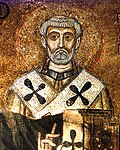 Clement of RomeHieromartyr · Bishop of RomeNov 24
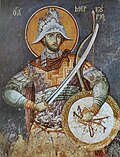 Mercurius of CaesareaGreat Martyr · Soldier of CappadociaNov 24
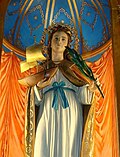 FirminaMartyr · Virgin and martyrNov 24
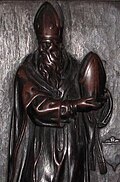 Protasius of MilanSaint · Archbishop of MilanNov 24
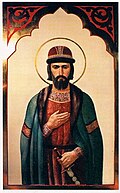 Mercurius of SmolenskMartyr · Martyr of SmolenskNov 24
 Mercurius of BrygyntsiVenerable · Monk in the Chernihiv regionNov 24
- Simon of SoigaVenerable · Founder of the Soiga River monasteryNov 24
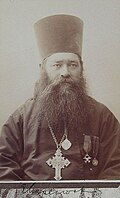 Evgraf EvarestovHieromartyr · PriestNov 24
- Theodore the MartyrMartyrNov 24
- Alexander LevitskyHieromartyrNov 24
- Alexander of CorinthMartyrNov 24
- Alexis TyutyunovHieromartyrNov 24