Saint
Colmán of Lindisfarne
Bishop of Lindisfarne
Irish-born Bishop of Lindisfarne from 661 to 664, who left his see after the Synod of Whitby.
- Feast
- February 18old style March 3
- Reposed
- 6767th century
- Place
- County Mayo
- Order
- Hierarchs
Life
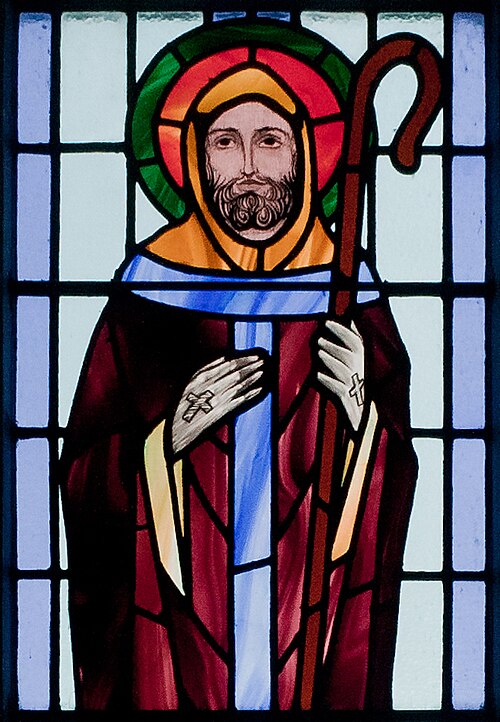
Saint Colmán was Bishop of Lindisfarne from 661 to 664, Irish by birth and educated on Iona. He is remembered for leaving his see after the Synod of Whitby, which decided that Easter should be calculated by the method of the First Ecumenical Council rather than the Celtic custom he preferred. He is commemorated in the Synaxis of the Saints of Britain and Ireland.
He was born around 605 in the west of Ireland, probably of a prominent family, and was educated on the island of Iona. In 661 he succeeded Aidan and Finan as bishop of Lindisfarne. In 664 King Oswiu of Northumbria called the Synod of Whitby, which decided to calculate Easter by the method of the First Ecumenical Council. Colmán could not accept the change, so he resigned his see and went to Scotland, and then back to Iona. A later tradition says that between 665 and 667 he founded several churches in Scotland, but no seventh-century records of this survive.
From Iona he sailed to Ireland and in 668 settled on the island of Inishbofin, where he founded a monastery, later known as the School of Mayo. He took with him half the relics of Lindisfarne, including the bones of Saint Aidan and a portion of the True Cross, which are said to have remained at Mayo Abbey until its dissolution in 1537, in the Reformation. He came to a land ravaged by the plague of 664 and 665.
In the community on Inishbofin a rift arose between the Irish and the English monks, because in summer the Irish wandered off to places they knew instead of helping with the harvest, then returned in winter and wanted to share what the English had gathered. Colmán brought the Anglo-Saxon monks to the mainland and founded a monastery for them at Mayo, afterwards called "Mayo of the Saxons". He spent his last days on Inishbofin, where he fell asleep in 674.
Commemorated the same day February 18
 Leo the GreatSaint · Bishop of RomeFeb 18
 Flavian of ConstantinopleConfessor · Patriarch of ConstantinopleFeb 18
 Kosma of YakhromaVenerable · Abbot of Yakhroma MonasteryFeb 18
 Agapitus of SynadaConfessor · Bishop of SynadaFeb 18
 Nicholas V of GeorgiaSaint · Catholicos-Patriarch of GeorgiaFeb 18
- Leo and ParegoriusHoly MartyrsFeb 18
- Aenghas of Drum RathaSaintFeb 18
- AgrippaMartyrFeb 18
- AngilbertVenerableFeb 18
- Anna ChetverikovaMartyrFeb 18
- ClassicusMartyrFeb 18
- Daniel of Cenn GaradhSaintFeb 18