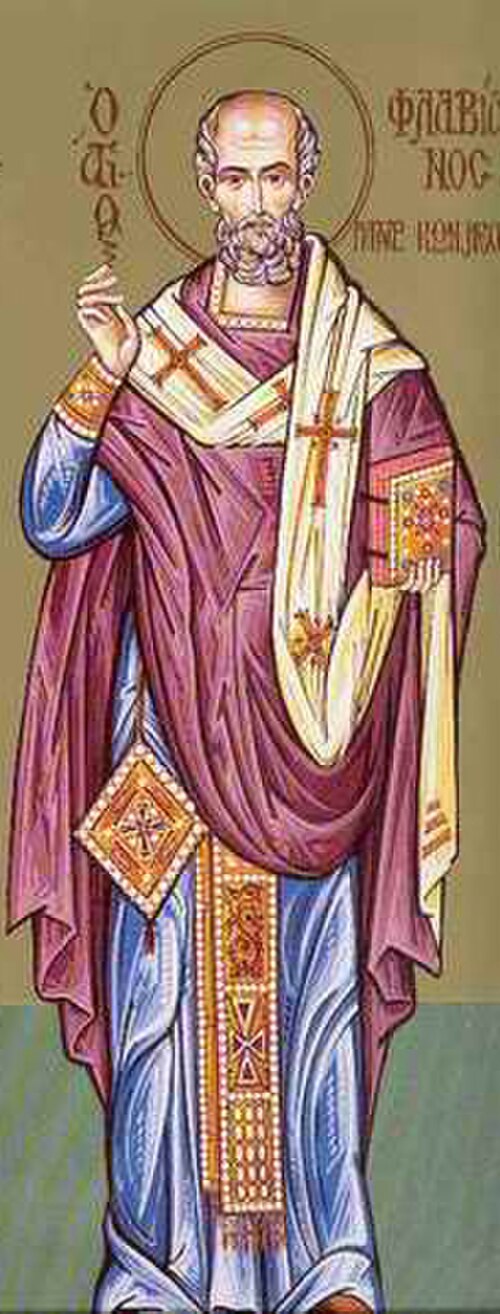
Confessor
Flavian of Constantinople
Patriarch of Constantinople
Patriarch of Constantinople from 446 to 449, who died after the Robber Council of Ephesus.
- Feast
- February 18old style March 3
- Reposed
- 4495th century
- Place
- Lydia
- Order
- Confessors
Life
Saint Flavian, hierarch and confessor, was archbishop of Constantinople from 446 to 449 and died as a result of the beatings he endured at the robber council of Ephesus. He is commemorated on 18 February.
The election
Flavian was a priest and keeper of the sacred vessels of the Great Church of Constantinople, with a reputation for a saintly life, when he was chosen to succeed Proclus. At the time of his consecration the emperor Theodosius II was at Chalcedon, and his eunuch Chrysaphius tried to extort from him a gift of gold for the emperor. Failing, Chrysaphius began to plot against the new archbishop, supporting the archimandrite Eutyches in his dispute with Flavian.
The synod of Constantinople
On 8 November 448 Flavian presided over a synod of forty bishops at Constantinople. Bishop Eusebius of Dorylaeum brought there an accusation against Eutyches, who taught that in Christ there is only the divine nature, that is, the monophysite heresy. Flavian first asked Eusebius to visit him and discuss the true faith with him; if he should be found in error, then he should be called before the assembly. In the end the synod deposed and excommunicated Eutyches. Flavian sent the result to Pope Leo, and Leo answered with the Tome to Flavian.
The robber council of Ephesus
Eutyches protested and was supported by Patriarch Dioscorus of Alexandria. Chrysaphius persuaded the emperor to gather a new council at Ephesus, which met on 8 August 449. There Eutyches was declared orthodox and reinstated, while Flavian was anathematized, deposed and sent into exile. The council remained known as an “assembly of robbers”. At the council the pope’s delegate, the deacon Hilarus, was not allowed to read Leo’s letter, and soldiers and a noisy mob entered the church. When the condemnation of Flavian was read, some of the bishops who supported him rushed toward Dioscorus; soldiers and a crowd came in. Flavian feared for his life and fled to the sacristy, where he was guarded. From there he wrote a letter to Pope Leo, which Hilarus carried to Rome after escaping from Ephesus with difficulty.
His death
According to the sources, Flavian was struck and trampled by unruly monks led by a certain Barsauma. He died three days later, on 11 August 449, at Epipus in Lydia, on the road to exile, and was buried without honour. The circumstances of his death and the part Dioscorus had in it are not clear: the testimonies at Chalcedon differ, and some scholars regard them as partial. In 451 the Fourth Ecumenical Council at Chalcedon rehabilitated him, and according to tradition his relics were brought with honour from Ephesus to Constantinople, to the church of the Holy Apostles, through the efforts of the empress Pulcheria.
Commemorated the same day February 18
 Leo the GreatSaint · Bishop of RomeFeb 18
 Colmán of LindisfarneSaint · Bishop of LindisfarneFeb 18
 Kosma of YakhromaVenerable · Abbot of Yakhroma MonasteryFeb 18
 Agapitus of SynadaConfessor · Bishop of SynadaFeb 18
 Nicholas V of GeorgiaSaint · Catholicos-Patriarch of GeorgiaFeb 18
- Leo and ParegoriusHoly MartyrsFeb 18
- Aenghas of Drum RathaSaintFeb 18
- AgrippaMartyrFeb 18
- AngilbertVenerableFeb 18
- Anna ChetverikovaMartyrFeb 18
- ClassicusMartyrFeb 18
- Daniel of Cenn GaradhSaintFeb 18