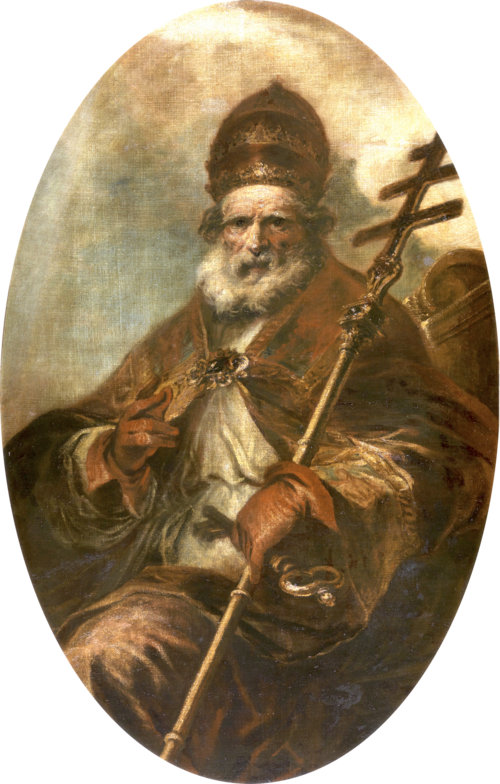
Saint
Leo the Great
Bishop of Rome
Bishop of Rome from 440 to 461, whose Tome to Flavian was received at the Fourth Ecumenical Council.
- Feast
- February 18old style March 3
- Reposed
- 4615th century
- Place
- Rome
- Order
- Hierarchs
Life
Saint Leo the Great was bishop of Rome from the year 440 until his repose in 461. The Church honours him as a great defender of the right faith concerning the Person of Christ: his dogmatic letter, called the Tome of Leo, was received with joy by the Fourth Ecumenical Council at Chalcedon. The Orthodox Church commemorates him on 18 February.
Deacon of Rome
He was born toward the end of the fourth century, about the year 391, into a noble family. The Liber Pontificalis calls him a native of Tuscany. He received a fine education that could have opened a worldly career, but he chose the service of the Church and became archdeacon under Pope Sixtus III. He was already known beyond Rome: John Cassian dedicated to him a treatise against Nestorius, written at his urging. Near the end of Sixtus's time the Emperor Valentinian III sent him to Gaul to reconcile the general Aetius with an official. While he was away Sixtus died, and on 29 September 440 the clergy and people elected Leo bishop of Rome.
The Tome to Flavian
As a pastor, Leo joined fatherly care with an unshakable firmness in confessing the faith. He rebuked the wrong customs of certain bishops, preached against the Manichaeans in Rome, and fought the teaching of Nestorius. Then he rose against the heresy of Eutyches and Dioscorus, who taught that there is only one nature in Christ.
Eutyches, an archimandrite at Constantinople, was condemned by Saint Flavian, patriarch of Constantinople. In 449 a synod at Ephesus, afterwards called the "Robber Council", pronounced the condemnation of Flavian, who suffered for the right faith. Pope Leo had written Flavian a letter setting out clearly the teaching on the two natures of Christ, divine and human, without confusion and without division, in one Person. At Ephesus his legates could not get it read, and Leo asked for an ecumenical council. His letters to the Emperor Theodosius II and to Marcian, his successor, hastened its gathering.
At Chalcedon, in 451, 630 bishops were present. The Greek Synaxarion says that the pope sent four representatives and the letter. When it was read, the Fathers cried out that this was the faith of the apostles and that Peter had spoken through Leo. Dioscorus and Eutyches were excommunicated, and the teaching on the two natures was confirmed in the Council's definition.
Protector of Rome
Leo was also the defender of his country against invasion. In 452, when Attila, king of the Huns, was advancing on Rome, Leo went with two officials to his camp near Lake Garda, and Attila withdrew from Italy. Historians debate how much the pope's words weighed with the Hun, but the embassy itself is not in doubt. In 455, when the Vandals of Genseric entered Rome, Leo went out to meet them with his clergy and held them back from burning the city and shedding blood, though it was plundered. The basilicas of Saint Peter, Saint Paul and Saint John were spared.
Writings and repose
Nearly a hundred sermons survive, on the feasts of the Lord, fasting and almsgiving, and about a hundred and fifty letters; the Synaxarion speaks of 96 sermons and 143 letters. He knew the hour of his death beforehand and prepared for it with forty days of fasting and prayer. He reposed in the year 461, on 10 November, and was buried in the portico of old Saint Peter's, the first pope buried there. In 688 his relics were moved to the south transept.
The Greek Synaxarion gives the year of his death as 460 and says that his synaxis was held in the Great Church of Constantinople. The Orthodox Church celebrates him on 18 February, the Church of Rome on 10 November, the day of his repose. In the West he was named a Doctor of the Church in 1754.
Commemorated the same day February 18
 Flavian of ConstantinopleConfessor · Patriarch of ConstantinopleFeb 18
 Colmán of LindisfarneSaint · Bishop of LindisfarneFeb 18
 Kosma of YakhromaVenerable · Abbot of Yakhroma MonasteryFeb 18
 Agapitus of SynadaConfessor · Bishop of SynadaFeb 18
 Nicholas V of GeorgiaSaint · Catholicos-Patriarch of GeorgiaFeb 18
- Leo and ParegoriusHoly MartyrsFeb 18
- Aenghas of Drum RathaSaintFeb 18
- AgrippaMartyrFeb 18
- AngilbertVenerableFeb 18
- Anna ChetverikovaMartyrFeb 18
- ClassicusMartyrFeb 18
- Daniel of Cenn GaradhSaintFeb 18