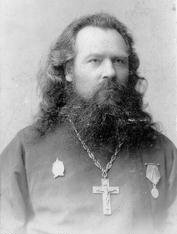
Hieromartyr
Constantine Golubev
Archpriest at Bogorodsk
Archpriest of the Epiphany Cathedral at Bogorodsk, born in 1852, who died a martyr in the autumn of 1918.
- Feast
- September 19old style October 2
- Reposed
- 191820th century
- Place
- Noginsk
- Order
- Martyrs
Life
Saint Constantine Golubev, the Hieromartyr, also called Constantine of Bogorodsk, was archpriest of the Epiphany Cathedral in the town of Bogorodsk (today Noginsk, near Moscow). He was born in 1852 in a village of Saratov province and was killed by the Soviet authorities in the autumn of 1918. The Russian Church glorified him among the saints in 2000. He is honoured for a lifetime of missionary and pastoral labour, and for his death, met with the words of the Saviour, "They know not what they do".
Family and training
Constantine Alekseevich Golubev was born in the village of Baranovka, in Saratov province, to the family of a church psalm-reader. He was orphaned at the age of nine. He graduated from the Saratov Theological Seminary. His wife, Maria Nikitina, born Anisimova, from a townsman's family in Volsk, died in 1913.
They had several children. Two daughters, Maria and Alexandra, married priests. Their son Constantine (1898 to 1970) became an archpriest and served at the Holy Trinity church in Natashino. Leonid graduated from the Moscow Theological Academy and was a school director. There were also Anna, Boris and Mariamna.
The missionary
From 1874 Constantine worked as a missionary of the Brotherhood of the Holy Cross of Saratov in his native village, where many Old Believers lived. He opened a missionary school there and taught in it both as a schoolteacher and as a teacher of religion. In only a year and a half the whole parish of the village, 1,500 people, joined the synodal Orthodox Church.
From 1876 he taught Russian and Church Slavonic at the theological school in Volsk. From 1879 he was a missionary of the Saratov diocese against sects and schism. He took part in disputes with Old Believers and with the Molokans.
Priest at Bogorodsk
On 12 March 1895 he was ordained priest. He served as rector of the Epiphany Cathedral in Bogorodsk and as dean of 16 parishes, where the Old Belief had also spread. Here too he worked as a missionary against the schism.
From 1897 he also directed the parish school at the Shibaev family's factory in Istomkino, where from 1901 he was also teacher of religion. In 1900 he opened a parish school for girls at the cathedral, which he directed and where he taught. He was chairman of the district branch of the Cyril and Methodius Brotherhood, director of the local branch of the committee for the care of prisons, where he helped the inmates greatly, and a member of the committee for the people's temperance. In 1903 he received the rank of archpriest.
The governor of Moscow, Vladimir Dzhunkovsky, wrote in his memoirs that Father Constantine held extreme right-wing views and was sharp and immoderate in his judgments. The priest was indeed involved in political life: he presided over the Monarchist Society of Bogorodsk and the local branch of the Union of the Russian People.
Martyrdom
On 12 and 13 May 1918, on the initiative of the parish council of the Epiphany Cathedral, church celebrations took place at Bogorodsk with the participation of several bishops headed by Patriarch Tikhon. They ended with a great procession around the town, in which, according to contemporaries, about a hundred thousand people took part. Representatives of the Soviet authorities took the procession as a challenge from the Church.
Some time later, in the autumn of 1918, Father Constantine was arrested and, after several days in prison, shot. On the way to the place of execution he kept repeating "They know not what they do". According to the report of Vasily Shein to the Local Council of 1917 and 1918, the priest was only gravely wounded and was buried alive, although he and his daughter begged the executioners to finish him and so shorten his suffering.
The place of his burial, at the edge of a pine wood, was honoured by the faithful of the town in all the years that followed. They brought candles and lamps there and served memorial services. Tradition says that two other people were shot with the priest: a soldier who had refused to carry out the order, whom some sources say Father Constantine had himself baptized in childhood, and a woman who tried to defend the pastor.
Relics and glorification
The saint's relics were found on 20 November 1995 and taken to the church of the Tikhvin Icon of the Mother of God in Noginsk. On 2 October 2004 they were moved to the Epiphany Cathedral. Since 2007 the Synaxis of the New Martyrs of Bogorodsk has been kept on the day the relics were found.
On 18 April 1996 Archpriest Constantine Golubev and the two martyrs killed with him were numbered among the locally venerated saints of the Moscow diocese. At the Bishops' Council of the Russian Church in August 2000 they were canonized for veneration throughout the Church. In 2020 the Holy Synod approved for general liturgical use the service to the Hieromartyr Constantine of Bogorodsk.
His troparion calls him the adornment of priests, who took up the cross as a weapon and by his preaching drove away schism and heresy, and who now, rejoicing with the choirs of angels, prays to Christ for the Russian Church.
Veneration today
A church in Noginsk and a hospital church in Reutov have been consecrated in his honour, and in his native village of Baranovka there is a church dedicated to Saint Constantine of Bogorodsk. An Orthodox gymnasium bears his name. Every year on 2 October the Divine Liturgy and a procession are held in the Epiphany Cathedral at Bogorodsk. The saint is commemorated on 19 September by the old calendar (2 October by the new), and in the Synaxis of the New Martyrs of Bogorodsk on 7 (20) November. His figure also appears in the historical novel "Crimson Robes" by Natalia Irtenina (2021), about relations between the Russian Church and the Soviet authorities in 1918.
Commemorated the same day September 19
 Theodore of CanterburySaint · Archbishop of CanterburySep 19
 Theodore the BlackRight-Believing · Prince of Smolensk and YaroslavlSep 19
 Goeric of MetzSaint · Bishop of MetzSep 19
 Prochorus of PčinjaVenerable · Monk of PčinjaSep 19
 The 156 Martyrs of PalestineMartyrSep 19
 Trophimus, Sabbatius and DorymedonHoly Martyrs · Martyrs of SynnadaSep 19
 Lantpert of FreisingSaint · Bishop of FreisingSep 19
 Alexis of Zosima HermitageVenerable · Elder of Zosima HermitageSep 19
- Konstantin UlemetsRight-Believing · Prince of YaroslavlSep 19
 David FyodorovichRight-Believing · Prince of YaroslavlSep 19
- Nicholas of IskrivkaHieromartyrSep 19
- Christopher VarfolomeyevHieromartyr · PriestSep 19