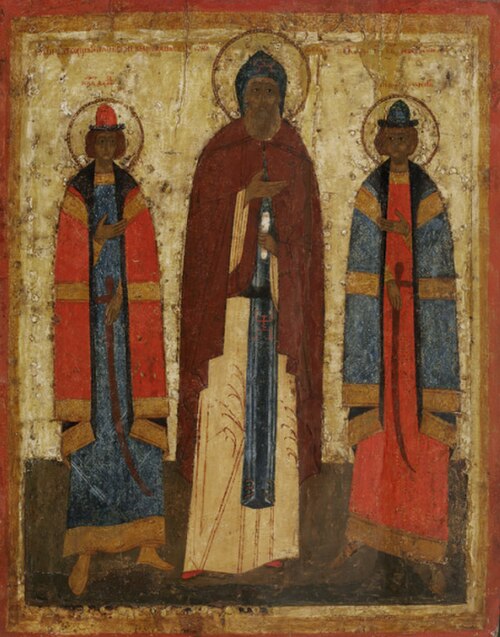
Right-Believing
Theodore the Black
Prince of Smolensk and Yaroslavl
Prince of Smolensk and Yaroslavl, called the Black, who died in 1298 and is venerated as a saint by the Russian Church.
- Feast
- September 19old style October 2
- Reposed
- 129813th century
- Place
- Yaroslavl
Life
Saint Theodore the Black (Chermny), the Right-believing Prince of Yaroslavl and Smolensk, fell asleep in 1299 at Yaroslavl, having taken the schema. He is regarded, together with his sons David and Constantine, as the first saint of Yaroslavl. The Russian Church remembers him on 19 September. The nickname “Chermny” means both “red-haired” and “beautiful.”
Youth and marriage
He was born in Smolensk around 1240 (in other sources, on 1 September 1233), the third son of Prince Rostislav Mstislavich of Smolensk, who died in 1240. His elder brothers, Gleb and Michael, wronged him by giving him only Mozhaisk. Theodore set things right by a good marriage: around 1260 he married Anastasia (called Maria in the later sources), daughter of Vasily Vsevolodovich of Yaroslavl. Through the marriage he became prince of Yaroslavl, but the actual power was in the hands of her mother, Princess Xenia. They had two daughters and a son, Michael.
In the Golden Horde
Bored with his status, around 1266 Theodore left his family and on his own will went to Sarai, the capital of the Golden Horde. He became a loyal servant and military commander of Khan Mengu-Timur, took part in a campaign against the Ossetians (Yasy) and, in 1277-1278, led a punitive campaign in Volga Bulgaria, in which, according to the sources, his troops sacked forty cities and six hundred villages. After the victory the khan made him his butler and offered him one of his daughters in marriage; Theodore refused, because he still had a wife in Yaroslavl. Anastasia soon died, and Theodore tried to return to Yaroslavl, but Princess Xenia and the boyars would not let him into the city and set up the young Michael as prince. Remaining in the Horde, he married a second time the daughter of the khan, who was baptized and received the name Anna, and received as dowry thirty-six towns and great honour. They had two sons, David and Constantine. The eldest son, Michael, died at Yaroslavl in 1290, and Theodore returned to the city with the khan's yarlyk and ruled there.
Prince of Smolensk
After the death of his brothers in 1278-1279 he inherited Smolensk. He resided there, historians think, in 1279-1281, then again in the Horde. He took part in the war between the sons of Alexander Nevsky, which ended with the devastation of many Russian towns by the Tatars and by the Russians. In 1285 Roman the Old of Bryansk besieged Smolensk in vain. In 1293 he took part, with Andrey Alexandrovich of Gorodets, in the campaign of the Tatar army of Dyuden in north-eastern Rus', in which fourteen towns were sacked, among them Vladimir, Suzdal, Moscow and Kolomna. In 1294 he received Pereslavl-Zalessky from Andrey, but when Dmitry gave up the grand principality, Theodore left and burned the city. In 1297 a nephew of his, Alexander Glebovich, took Smolensk, and in 1298, perhaps also in 1299, Theodore tried in vain to regain it by force.
Repentance and death
In his last years Theodore became a monk and died at Yaroslavl, in 1299, having taken the schema. The depth of his public repentance before death was, together with the incorruption of his relics and the miracles after death, one of the grounds of his canonization. The principality of Yaroslavl passed to his son David.
In 1463, on the eve of the annexation of Yaroslavl to the Muscovite state, Archimandrite Christopher found in the Spassky monastery at Yaroslavl the relics of the prince and of his sons David and Constantine, and they were placed in the Transfiguration cathedral of the monastery. In 1467 all three were canonized, the first saints of Yaroslavl. From 1989 to 2011 the relics were in the church of Saint Theodore at Yaroslavl, where now only particles remain; today they rest in a shrine in the new Dormition cathedral of Yaroslavl. His memory is also kept on the day of the finding of the relics, in the Synaxis of the saints of Rostov, on the Sunday before the Synaxis of the saints of Smolensk, and in the Synaxis of the saints of Kazan.
Commemorated the same day September 19
 Theodore of CanterburySaint · Archbishop of CanterburySep 19
 Goeric of MetzSaint · Bishop of MetzSep 19
 Prochorus of PčinjaVenerable · Monk of PčinjaSep 19
 The 156 Martyrs of PalestineMartyrSep 19
 Trophimus, Sabbatius and DorymedonHoly Martyrs · Martyrs of SynnadaSep 19
 Lantpert of FreisingSaint · Bishop of FreisingSep 19
 Alexis of Zosima HermitageVenerable · Elder of Zosima HermitageSep 19
 Constantine GolubevHieromartyr · Archpriest at BogorodskSep 19
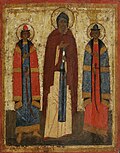 Konstantin UlemetsRight-Believing · Prince of YaroslavlSep 19
 David FyodorovichRight-Believing · Prince of YaroslavlSep 19
- Nicholas of IskrivkaHieromartyrSep 19
- Christopher VarfolomeyevHieromartyr · PriestSep 19