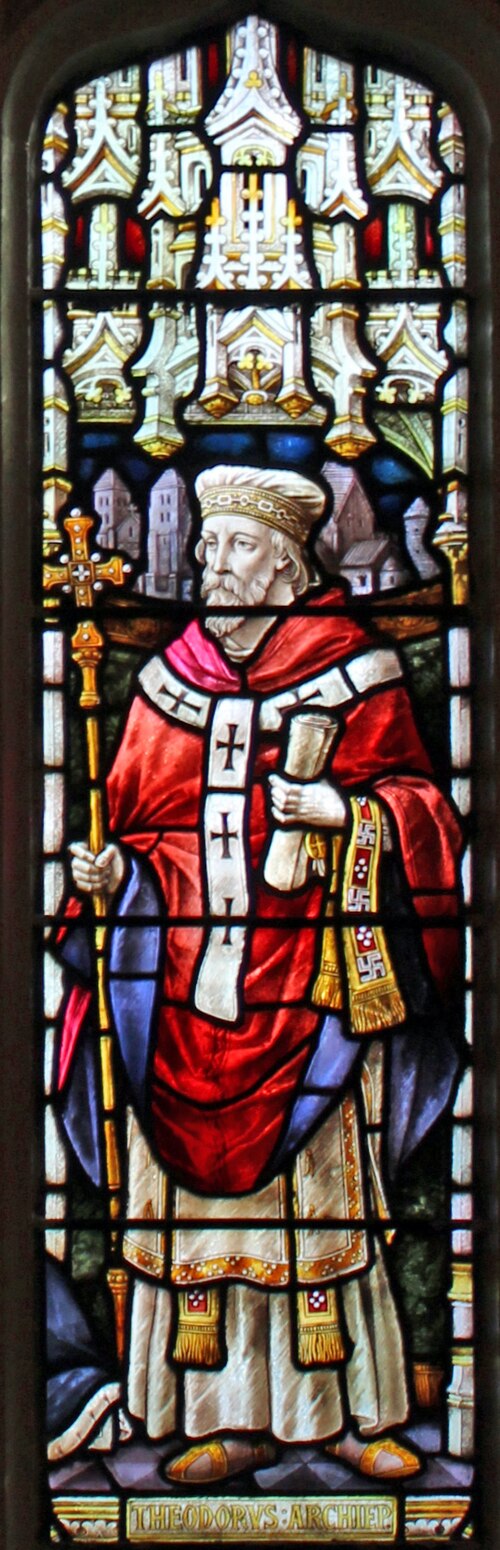
Saint
Theodore of Canterbury
Archbishop of Canterbury
Raised in Tarsus, archbishop of Canterbury from 668 until his death in 690.
- Feast
- September 19old style October 2
- Reposed
- 6907th century
- Place
- Canterbury
- Order
- Hierarchs
Life
Saint Theodore of Tarsus, hierarch, was archbishop of Canterbury from 668 until his death in 690, known for his reform of the Church in England and for the school he founded at Canterbury. He is commemorated on 19 September.
Youth
Theodore was of Greek descent and was born around 602, at Tarsus, in Cilicia, in a Greek-speaking diocese of the Byzantine Empire. In his childhood there were devastating wars between Byzantium and Persia, which led to the capture of Antioch, Damascus and Jerusalem in 613-614. The Persians took Tarsus when Theodore was eleven or twelve. He is thought to have studied at Antioch, the old home of a school of scriptural interpretation, which he upheld. He knew Syriac language and literature. The Muslim conquests reached Tarsus in 637 and drove him out; he returned to the Eastern Roman Empire and studied at Constantinople astronomy, the calculation of the date of Easter, medicine, Roman law, Greek rhetoric and philosophy. Before the 660s he went to Rome, where he lived in a community of Eastern monks, probably at the monastery of Saint Anastasius, and learned Latin literature, sacred and secular.
Archbishop of Canterbury
After the Synod of Whitby (664), in 667, the see of Canterbury fell vacant when Wighard, chosen to be consecrated archbishop, died unexpectedly at Rome. Pope Vitalian chose Theodore, on the advice of Hadrian, later abbot of the monastery of Saint Peter at Canterbury. Theodore, aged sixty-six, was consecrated archbishop at Rome on 26 March 668 and sent to England with Hadrian, arriving there on 27 May 669. He surveyed the state of the English Church, set bishops in sees long vacant and in 673 called the Synod of Hertford, which regulated the date of Easter, the authority of bishops, wandering monks, the regular meeting of synods, marriage and other matters. He wished to divide the large diocese of Northumbria, which brought him into conflict with Wilfrid, bishop of York, whom he deposed in 678; the dispute was settled only in 686-687. In 679, when Aelfwine, brother of King Ecgfrith of Northumbria, fell in battle against the Mercians, his intervention halted the war and brought peace.
The school of Canterbury
Theodore and Hadrian founded at Canterbury a school teaching in Greek and Latin, from which came a true “golden age” of Anglo-Saxon scholarship. Theodore also taught sacred music and brought texts and knowledge of the Eastern saints. From his teaching biblical commentaries survive, compiled by his students.
Commemorated the same day September 19
 Theodore the BlackRight-Believing · Prince of Smolensk and YaroslavlSep 19
 Goeric of MetzSaint · Bishop of MetzSep 19
 Prochorus of PčinjaVenerable · Monk of PčinjaSep 19
 The 156 Martyrs of PalestineMartyrSep 19
 Trophimus, Sabbatius and DorymedonHoly Martyrs · Martyrs of SynnadaSep 19
 Lantpert of FreisingSaint · Bishop of FreisingSep 19
 Alexis of Zosima HermitageVenerable · Elder of Zosima HermitageSep 19
 Constantine GolubevHieromartyr · Archpriest at BogorodskSep 19
- Konstantin UlemetsRight-Believing · Prince of YaroslavlSep 19
 David FyodorovichRight-Believing · Prince of YaroslavlSep 19
- Nicholas of IskrivkaHieromartyrSep 19
- Christopher VarfolomeyevHieromartyr · PriestSep 19