Hieromartyr
Constantine Sukhov
A hieromartyr of the Russian Church, who died in 1937.
Life
Holy Hieromartyr Constantine Sukhov, a priest, was born on 7 May 1867 in the family of the priest John Petrovich Sukhov, in the village of Zhemkovka, Syzran district, then in the Simbirsk province. For many years he was rector of the cathedral in Buguruslan, and he was shot on 22 October 1918, the old-style 9 October. He was glorified among the saints in 2001.
First years of ministry
He studied at the theological seminary in Simbirsk, which he finished on 18 July 1887. At the request of Bishop Barsanuphius of Simbirsk he was appointed psalm-reader in the village of Yasashnaya Tashla. On 17 September 1888 Bishop Barsanuphius ordained him deacon, at the church of the village of Mikhailovka, and then on 25 September priest, for the village of Opaliha. On 17 May 1890, at his own request, he was received into the clergy of the Samara diocese and assigned to the church in the village of Staro-Dvoryanovka, where he was also teacher of religion at the church school. On 1 February 1896 he was transferred to the village of Tsarevshchina, where he served more than seven years and enjoyed the love and respect of the parishioners. There he received the second church award of his life, the skufia. The chronicle of the village says: "Father Constantine Sukhov was loved by all for his simplicity of manner and cheerful nature: with the small he was small, with the great he was great". In days of sorrow he comforted the sorrowing.
The climate there did not favour the Sukhov family, and illness came. On 12 December 1896 the priest's four-year-old son Vitaly died of diphtheria, and two months later his daughter Nina. On 1 December 1899, at his own request, Father Constantine was transferred to the village of Uzmorye, in the drier climate of the steppes beyond the Volga, but in the parish he had left the people were disturbed, and a delegation of peasants went to Bishop Gurias, who, understanding that a father so loved by his flock could not easily be replaced, returned him to Tsarevshchina on 26 March 1900. The priest accepted the decision with humility. After four months little Vera, in whom her parents had found comfort, also died. Thus the Lord prepared the righteous man for the crown of martyrdom, leading him along the way of sorrows and humility.
At Buguruslan
In the autumn of 1903 Bishop Gurias, mindful of Father Constantine's long desire to change his place and needing to strengthen the clergy of a remote parish, proposed that he move to Buguruslan, and the decree was issued on 12 October 1903. There he became a cleric and then rector of the Saviour-Ascension cathedral, the largest in the district. He represented the clergy in the town zemstvo assembly, and in 1910 he was already a deputy of the Buguruslan Duma. As a zemstvo man he did much for the inhabitants of the district, especially the peasants. Local archives show that in his time the district zemstvo held first place in the province in the growth of funds for medicine; the sums for the protection of public health, including the fight against children's diseases, grew forty-three times. He himself, having lost three children to epidemics, used all the power of a shepherd's influence to explain the true state of things to the other zemstvo members. Another field in which the Buguruslan zemstvo succeeded was the building of grain stores; the district was the best in the province in this. He was also director and teacher of religion at the church school of the cathedral and those of the villages of Vasilyevka and Klyuchevka, and in 1908 he opened one more school in the town. For his zeal he received the kamilavka, the last award of his life. The cathedral in the centre of the town was full not only on feasts, and he explained to the people, with a rare gift of persuasion, the danger that falling away from the Orthodox faith brings to the country.
The enemies of the Church could not bear this, and once the body of his young son Boris was found on the bank of the river Kinel, at the place where his father was soon to suffer a martyr's death. On 25 February 1918, the feast of Saint Alexis, metropolitan of Moscow, heavenly protector of the Samara land, Father Constantine led a procession which, after the usual walk round the church, went straight to the building of the Revolutionary Council where the Bolshevik leaders sat. The faithful thus plainly expressed their protest against the crimes of the lawless power.
Martyrdom
In late autumn 1918, after the defeat of the Czechoslovak corps, the Samara territory was taken by the Red Army. On 22 October, a Sunday, units of Gai's division entered Buguruslan, and mass shootings of "enemies of the revolution" began. Father Constantine's name was on the black lists. According to the Sukhov family tradition, carefully kept by his descendants, the priest was taken from the altar of the cathedral while at the Divine Liturgy he was offering prayers for the repose of the Tsar and his family, recently shot at Yekaterinburg, and was commemorating the Orthodox army resisting the godless. The church was full, as usual. All the people followed the punishers who led Father Constantine out, begging them not to touch the priest. Heedless of the pleas, they took him in full vestments to the bank of the river Kinel, along the way he himself used to take at the head of the procession on the feast of the Baptism of the Lord.
He was shot at the very place where the Epiphany service was held. The martyr's body was left at the place of the killing and the faithful took it. The snow fell that year unusually early, and as the priest was carried on a cart, his long hair hung down on the snow and seemed suddenly grey with frost. He was buried secretly, for fear the grave would be defiled, and its place has remained unknown. It is thought that his remains lie not far from the Dormition church on the old cemetery of Buguruslan. On 17 July 2001 the Holy Synod glorified him among the New Martyrs and Confessors of Russia, for veneration throughout the Church. Now, at the place of his martyrdom by the Kinel, a large church is being built. He is commemorated on 9 (22) October, the day of his death, on 30 July (12 August), with the Synaxis of the Saints of Samara, appointed in 2004 by Patriarch Alexy II, and on 7 February, with the Synaxis of the New Martyrs and Confessors of Russia.
Commemorated the same day October 9
 AbrahamRighteous · The PatriarchOct 9
 LotRighteous · The RighteousOct 9
 James, son of AlphaeusApostle · The ApostleOct 9
 Denis of ParisHieromartyr · Bishop of ParisOct 9
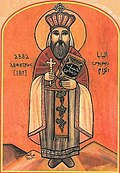 Demetrius of AlexandriaSaint · Patriarch of AlexandriaOct 9
 Gunther of BohemiaVenerable · Bavarian hermit and envoyOct 9
 Theodofrid of CorbieVenerable · Abbot of Corbie AbbeyOct 9
 Eleutherius of ParisHieromartyr · Deacon of ParisOct 9
 Gemine of CasventumVenerable · Hermit of SpoletoOct 9
- AedhanSaintOct 9
- Andronicus of AntiochVenerableOct 9
- Athanasia of TabennisiVenerableOct 9