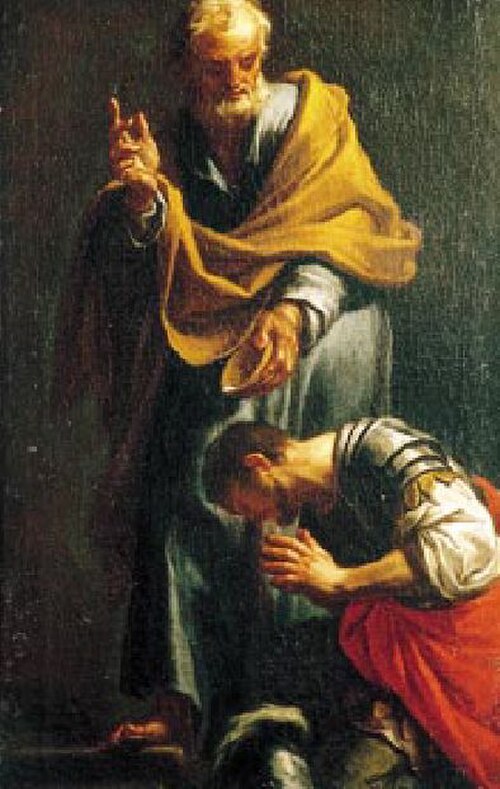
Hieromartyr
Cornelius the Centurion
Centurion of Caesarea
Roman officer of Caesarea, the first Gentile baptized by the Apostle Peter, as told in the Acts of the Apostles.
- Feast
- September 13old style September 26
- Reposed
- 1001st century
- Order
- Martyrs
Life
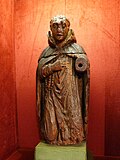
Saint Cornelius the Centurion was a Roman officer stationed at Caesarea in Palestine, and the first Gentile to be baptized by the Apostle Peter, according to chapter 10 of the Acts of the Apostles. The Orthodox Church remembers him as a hieromartyr and bishop, and keeps his feast on 13 September.
In the Acts of the Apostles
Cornelius was a centurion of the cohort called Italian, and he lived at Caesarea, the Roman capital of Judea. Acts describes him as a devout man who feared God with all his household, gave generously to the people and prayed to God continually. He belonged to the group often called God-fearers: pagans who honoured the God of Israel without having joined the Jewish community.
One afternoon, about the ninth hour, an angel of God appeared to him and said that his prayers and alms had risen as a memorial before God. He was told to send men to Joppa and bring a man named Simon, who is called Peter.
Meanwhile Peter, praying at Joppa, saw a great sheet let down from heaven, full of animals, and heard a voice telling him to rise, kill and eat. He refused, because he had never eaten anything unclean. The voice answered that what God has made clean he must not call common. When the messengers of Cornelius arrived, Peter understood that he was being sent to the Gentiles, and he went with them to Caesarea.
Cornelius had gathered his relatives and close friends. He fell at Peter's feet, and Peter raised him up. Peter said that God shows no partiality, and that in every nation the one who fears him and does what is right is acceptable to him. He spoke of Jesus Christ, of His deeds, His death and His Resurrection. While he was still speaking, the Holy Spirit fell on all who heard, and the believers of the circumcision who had come with Peter were astonished that the gift was poured out on the Gentiles also. Peter then ordered that they be baptized in the name of Jesus Christ.
The event was a turning point. Peter had to explain it to the believers in Jerusalem (Acts 11), and at the apostolic council (Acts 15) the Church decided that Gentiles may be received without circumcision.
According to tradition
The New Testament says nothing more about Cornelius. The synaxarion tradition, as given by the Orthodox Church in America, says that he left the world, followed Peter in preaching and was made a bishop by him, at Caesarea according to some accounts. When Peter was at Ephesus with his helpers, lots were cast to decide who should go to the city of Scepsis, where idol worship was strong, and the lot fell on Cornelius.
There the local prince, Demetrius, a lover of Greek philosophy who honoured Apollo and Zeus, demanded that he sacrifice. Cornelius asked to be shown the gods, entered the temple, turned to the east and prayed, and an earthquake destroyed the temple of Zeus with its idols. The prince's wife and son were thought to have died in the ruins, and Cornelius was imprisoned. Then a pagan priest heard their voices praising the God of the Christians, the saint was set free, and by his prayer they were brought out alive. Demetrius and his household were baptized.
Cornelius remained in Scepsis for a long time and brought its people to Christ. He made Eunomius a presbyter, and died in old age, in peace, and was buried near the ruined temple. Because the Church calls him a hieromartyr, some texts speak of suffering endured for the faith, but the sources describe a peaceful death.
The Catholic Church remembers him on 20 October, and also on 2 February.
Commemorated the same day September 13
 Cyprian of CarthageHieromartyr · Bishop of CarthageSep 13
 Ketevan the MartyrGreat Martyr · Queen of KakhetiSep 13
 Venerius the HermitVenerable · Hermit of the Gulf of La SpeziaSep 13
- Marcellinus of CarthageMartyr · Roman officialSep 13
- Wulfthryth of WiltonVenerable · Abbess of Wilton AbbeySep 13
- Litorius of ToursSaint · Bishop of ToursSep 13
- Peter of AtroaVenerableSep 13
- Armand of VannesSaint · Bishop of VannesSep 13
- AemilianusSaint · Bishop of ValenceSep 13
- Alexander AksenovHieromartyrSep 13
 AmatusVenerableSep 13
- Amatus of SionSaint · Bishop of SionSep 13