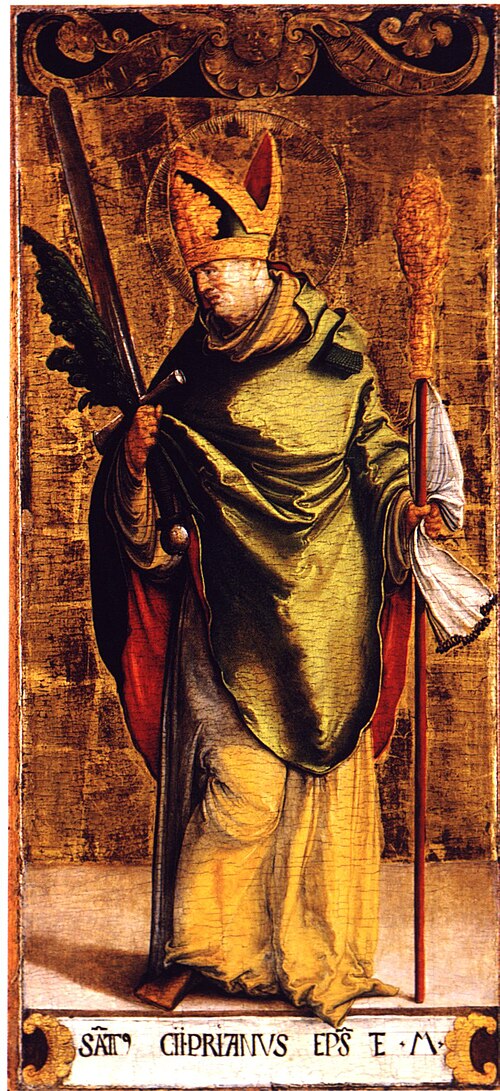
Hieromartyr
Cyprian of Carthage
Bishop of Carthage
Bishop of Carthage and church writer, killed for his faith in 258.
- Feast
- September 13old style September 26
- Reposed
- 2583rd century
- Place
- Carthage
- Order
- Martyrs
Life
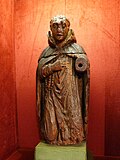
The Holy Hieromartyr Cyprian was bishop of Carthage and one of the most important Latin Christian writers of the early centuries. He led the Church of Africa in times of persecution, plague and dispute, and received the crown of martyrdom in the year 258. His writings on the unity of the Church have remained famous. The Romanian Orthodox Church commemorates him on 13 September, and the Church of Rome on 16 September.
Youth and conversion
He was born around 200 at Carthage into a rich, pagan family of Roman African descent. His name was Thascius, to which he added Caecilius, in memory of the priest to whom he owed his conversion. Before becoming a Christian he was a rhetorician, advocate and teacher of rhetoric, and after a dissipated youth he was baptized, around 246, at the age of thirty-five. Immediately after baptism he gave part of his wealth to the poor of Carthage and devoted himself to the study of Scripture and the Christian writers, above all Tertullian, whose influence shows in his style and thought. Among his first works are the Letter to Donatus on the grace of God and the Testimonies.
Bishop of Carthage
Soon after baptism he was ordained deacon and then priest. Between July 248 and April 249 he was elected bishop, chosen by the people, especially the poor, who remembered his generosity. The election was contested, however, because he was new in the Church. After a few months a fierce persecution began under the emperor Decius, and he had to hide in order to shepherd his flock, which also drew criticism. After the persecution the Church was shaken by the question of how those who had fallen should be received, and by the schism of Novatian. Cyprian held several councils at Carthage and defended a path of moderation.
In 252 a plague broke out, which later received his name, from his description of it. Cyprian urged Christians to care for the sick, Christians and pagans alike. He wrote much, among other things On the Unity of the Church, in which he taught that one cannot have God for Father who does not have the Church for mother, and that the unity of the Church is shown in the conciliar agreement of bishops. His rhetorical skill made him regarded as the foremost Latin writer of Western Christianity until Jerome and Augustine.
In 254 he entered into dispute with Pope Stephen I over baptism performed by heretics. In Africa it was the custom that heretics received into the Church be baptized again, while Rome and most of the Church held their baptism valid. Cyprian defended his view, and the later Fathers did not accept it.
Martyrdom
In the time of Emperor Valerian he was at first exiled, then tried before the proconsul and condemned. He was beheaded at Carthage on 14 September 258. Three churches were built in his honour at Carthage, one on the very place of his martyrdom. A part of his holy relics, the right hand, is kept in the Zlătari church in Bucharest.
Commemorated the same day September 13
 Cornelius the CenturionHieromartyr · Centurion of CaesareaSep 13
 Ketevan the MartyrGreat Martyr · Queen of KakhetiSep 13
 Venerius the HermitVenerable · Hermit of the Gulf of La SpeziaSep 13
- Marcellinus of CarthageMartyr · Roman officialSep 13
- Wulfthryth of WiltonVenerable · Abbess of Wilton AbbeySep 13
- Litorius of ToursSaint · Bishop of ToursSep 13
- Peter of AtroaVenerableSep 13
- Armand of VannesSaint · Bishop of VannesSep 13
- AemilianusSaint · Bishop of ValenceSep 13
- Alexander AksenovHieromartyrSep 13
 AmatusVenerableSep 13
- Amatus of SionSaint · Bishop of SionSep 13