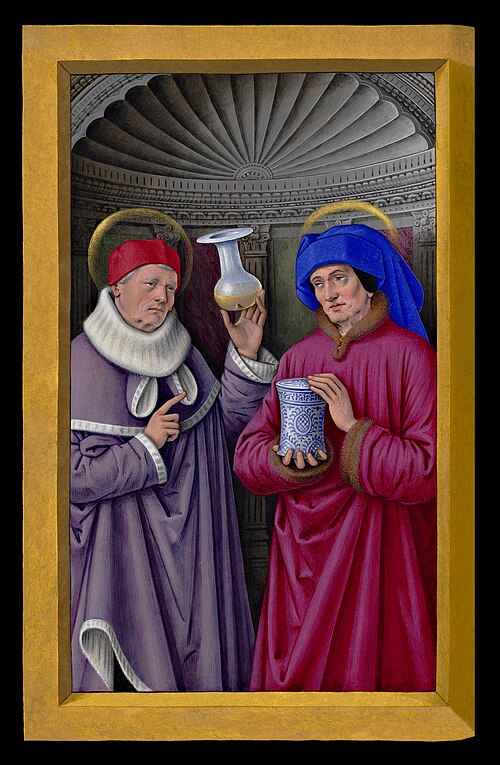
Holy Unmercenary Healers
Cosmas and Damian
Unmercenary physicians
Twin brothers and physicians who healed without payment and were put to death for Christ around 287.
- Feast
- July 1old style July 14
- Era
- unknown
- Order
- Unmercenary Healers
Life
Saints Cosmas and Damian are brothers and unmercenary physicians, who healed the sick in the name of Christ without taking any payment, and they are among the most beloved saints of all Christendom. The Orthodox Church honours three pairs of saints of these names, who according to tradition lived in different times and places: Saints Cosmas and Damian of Asia, celebrated on 1 November, those of Rome, on 1 July, and those of Arabia, the martyrs of Cilicia, on 17 October. The Roman Catholic Church celebrates those of Arabia on 26 September.
Their title “anargyroi”, “without silver”, comes from Greek and shows that they fulfilled the Saviour's command: freely you have received, freely give. Through this selfless love they brought many to the faith.
The saints of Asia
The first pair were born in Asia, in Asia Minor, and lived no later than the fourth century. Their father, a Greek and a pagan, died when they were small, and their mother, Saint Theodotia, raised them in the Christian faith. They then learned the art of medicine, and God granted them the gift of healing, so that crowds of sick people came to them. They took payment from no one, and their fame spread through the whole region.
Their life tells that once they were called to a gravely ill woman named Palladia, whom all the physicians had given up. Through her faith and the brothers' prayer she was healed. Full of gratitude, she came to Damian and brought him three eggs, begging him to accept them in the name of the Holy Trinity. Hearing the name of the Trinity, Damian did not dare refuse. Cosmas was grieved, thinking that his brother had broken their vow, and asked, when his end came, that Damian not be buried beside him.
Some time later Damian also died, and the people did not know where to bury him. Then, the life says, a camel that the saints had once healed of madness came and spoke with a human voice, asking that Damian be laid beside Cosmas, for he had not accepted the woman's gift for the sake of reward but for God's sake. So they were laid together at Pheremon in Mesopotamia. These two died in peace, and after their death they worked many miracles.
The saints of Rome
The second pair were brothers from Rome, physicians, raised by Christian parents in piety, who led pure lives and had the gift of healing. Because they treated the sick without payment they were called “unmercenary physicians”, and they brought many to Christ.
According to their life, this drew the attention of the Roman authorities in the reign of Emperor Carinus (283-285). When they learned that soldiers were coming, the Christians begged them to hide for the sake of the sick who needed them. Not finding them, the soldiers seized other Christians from their village. Then the brothers came out of hiding and gave themselves up, asking that those taken in their place be released.
In Rome they were imprisoned and then brought to trial. They openly confessed faith in Christ, refused to sacrifice to the idols and said that they had harmed no one, that they were not sorcerers, but healed diseases by the power of Jesus Christ without taking payment. The emperor insisted, but, according to the life, at their prayer he was struck by a sudden illness, and those present cried out that great is the God of the Christians. The emperor himself begged them to heal him, promising to believe, and they healed him and were set free.
But the old physician from whom they had learned their art envied their fame. He called them, as if to gather healing herbs, led them far into the mountains, stoned them to death and threw their bodies into a river.
The saints of Arabia
The third pair were brothers from Arabia, almost contemporaries of those of Rome, who practised medicine in the seaport of Aegeae in Cilicia and then in the Roman province of Syria. They cured blindness, fever and paralysis and, according to tradition, drove a serpent out of a man. During Diocletian's persecution Lysias, governor of Cilicia, ordered their arrest. Questioned about their faith, names and homeland, they confessed that they were Christians and refused to sacrifice to the idols.
Their life says that Lysias had them beaten and thrown bound into the sea, but an angel loosed them and brought them ashore unharmed. They were thrown into fire, but the fire did not touch them. Hung up, they were pelted with stones and arrows, but the stones and arrows turned back and wounded the torturers. At last they were beheaded, together with three other Christians, Leontius, Anthimus and Eutropius (in Western tradition, their younger brothers Anthimus, Leontius and Euprepius). All five were buried together, at the end of the third or beginning of the fourth century.
A Western tradition widespread in the Middle Ages tells that the saints appeared in a dream to a man with a gangrenous leg and replaced it with the leg of an Ethiopian who had recently died, and the man woke healed. The scene was painted by many medieval artists.
Three pairs or one
The old Slavonic lives and the Menaion Reader of Saint Dimitry of Rostov state clearly that there are three distinct pairs: the first, the sons of Theodotia, died in peace and were buried at Pheremon; the second, of Rome, were killed by their envious teacher; the third, of Arabia, were martyrs. The old painters' manuals also depict them differently: those of Asia with middle-length beards, holding pens and boxes of medicines, those of Rome as young men with crosses and medicine jars, those of Arabia like Saints Florus and Laurus. Their services also differ, that of 1 November being the most solemn.
In their lives and icons, however, the stories of the pairs are often mingled. In Fra Angelico's fresco “The Burial of Saints Cosmas and Damian” (1438-1440) in San Marco in Florence, five men are buried, as in the life of those of Arabia, but the camel from the burial of Damian of Asia also appears.
Relics and churches
As early as the fourth century churches were built in their honour in Jerusalem, Egypt and Mesopotamia. Their relics, held to be wonderworking, were at Cyrrhus in Syria. Patriarch Proclus of Constantinople built a church to them, and Emperor Justinian I (527-565), healed through their prayers according to tradition, restored the city of Cyrrhus and built them a church in Constantinople that became a place of pilgrimage. In Rome Pope Felix IV (526-530) turned a building on the Forum of Vespasian into the Basilica of Saints Cosmas and Damian, where relics of theirs were brought, still kept in the crypt, and where a sixth-century mosaic depicting them is preserved.
Their heads are venerated at the convent of the Poor Clares in Madrid, given in 1581 to Empress Maria, daughter of Charles V, after having been taken from Rome to Bremen in the tenth century; the church of Saint Michael in Munich also keeps a reliquary with heads of theirs, made in Bremen around 1400 and brought there in 1649 by Elector Maximilian I of Bavaria. Other relics are in the treasury of Essen Cathedral, brought from Rome by Bishop Altfrid of Hildesheim (died 874), and they are patrons of Essen.
Popular veneration
Saints Cosmas and Damian are patrons of physicians and surgeons and sometimes appear on medical emblems. In Brazil they are regarded as patrons of children, who receive sweets with their image on 27 September. Among the Eastern Slavs their names merged very early into one, “Kuzmodemyan”, already used in an eleventh-century birch-bark letter from Novgorod. The people regarded them as protectors of livestock and especially of poultry, and 1 November was called the “hens' day”: in Moscow housewives came with hens to the saints' church and then sent them as gifts to their acquaintances. Children prayed to them to open their minds to learning to read.
The Orthodox Church celebrates the Holy Unmercenaries Cosmas and Damian of Asia on 1 November, those of Rome on 1 July, and those of Arabia on 17 October.
Commemorated the same day July 1
 EstherSaint · Queen of PersiaJul 1
 Angelina of SerbiaVenerable · Despotess of SerbiaJul 1
 Cybard of AngoulêmeVenerable · Hermit of AngoulêmeJul 1
 Serf of CulrossSaintJul 1
 Galina of CorinthMartyrJul 1
- Julius and AaronHoly MartyrsJul 1
 Castus and SecundinusMartyr · Martyrs of SinuessaJul 1
- Arcadius GaryaevHieromartyr · PriestJul 1
- Peter the PatricianVenerable · Byzantine commander turned monkJul 1
- 25 Martyrs of NicomediaHoly MartyrsJul 1
- Ailill IISaint · Bishop of ArmaghJul 1
- Alexis DrozdovHieromartyrJul 1