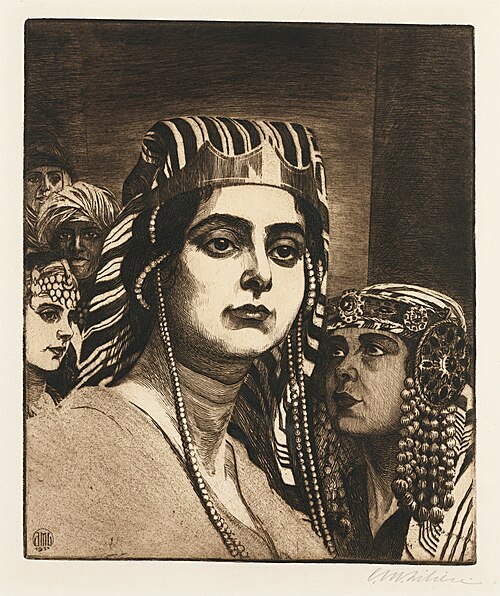
Saint
Esther
Queen of Persia
Jewish queen of Persia who saved her people from destruction planned by Haman.
- Feast
- July 1old style July 14
- Reposed
- 500 BC5th century BC
- Place
- Achaemenid Empire
Life
The righteous Esther is the heroine of the Book of Esther in the Old Testament, the Jewish woman who became queen of Persia and saved her people from the destruction planned by Haman. Her Hebrew name was Hadassah, meaning myrtle. The Orthodox Church counts her among the righteous of the Old Testament and commemorates her on the Sunday of the Holy Forefathers, two Sundays before the Nativity of the Lord.
Mordecai's ward
The story takes place at Susa, the seat of the Persian kingdom. Esther was a relative and adopted daughter of Mordecai, a Jew of the tribe of Benjamin, carried off in the captivity and living at Susa. Orphaned of her parents, she grew up in his house. She was beautiful in appearance, but also gentle, modest and, at the same time, full of zeal for her people and her faith.
The king, called Ahasuerus in the Hebrew text, Artaxerxes in the Septuagint, and identified by some with Xerxes I, banished Queen Vashti, who did not appear at his command. Beautiful maidens were gathered in the citadel, and the king chose Esther. At Mordecai's command she did not say what people she belonged to. He came daily to learn how she fared, and he reported the plot of Bigthan and Teresh against the king, which was recorded in the annals.
Haman's plan
The king then exalted Haman, of the line of Agag, to whom all were to bow. Mordecai refused, and Haman, enraged, resolved to destroy not only him but the whole people of the Jews in the kingdom. He cast lots (purim) to find the right day and obtained from the king a decree: on the thirteenth day of the month of Adar the Jews were to be killed.
When Mordecai learned of it, he asked Esther to intercede with the king. She knew that anyone entering uncalled before the king could be put to death, so she asked all the Jews of Susa to fast for three days. Then she went to the king without being summoned, and he held out the golden sceptre and offered her whatever she wished, up to half of the kingdom. Esther invited the king and Haman to a banquet, and to another on the following day.
The salvation of the people
In the night between the two banquets the king could not sleep and ordered the annals to be read to him. They came upon Mordecai's deed, and it was found that he had not been rewarded. Haman, who had come to ask for Mordecai to be hanged, had to lead him on horseback through the streets of the city, in royal robes, proclaiming that this is done for the man whom the king wishes to honour.
At the second banquet Esther said that she and her people had been sold to destruction, and she named Haman as the enemy. The king was enraged, and Haman was hanged on the gallows he had prepared for Mordecai. Mordecai became the king's counsellor. A new decree allowed the Jews to defend themselves with arms on the day Haman had set. They defended themselves throughout the kingdom and overcame those who wished to destroy them, and in memory of those days the feast of Purim was appointed.
The book and veneration
In the Orthodox Bible the Book of Esther is in a longer form than in the Jewish Bible, with the prayers of Mordecai and of Esther and other additions, in the Greek text of the Septuagint. In the Hebrew text the name of God never appears. Some scholars doubt that the narrative is history and regard it as a parable; the Church receives it as sacred history. Some consider the name Esther a form of Ishtar or a Persian word for star.
The tomb of Esther and Mordecai, with a place of prayer, is shown in the city of Hamadan (ancient Ecbatana) in Iran. Orthodox interpretation and hymnography see in her an image of intercessory prayer for the people.
Commemorated the same day July 1
 Cosmas and DamianHoly Unmercenary Healers · Unmercenary physiciansJul 1
 Angelina of SerbiaVenerable · Despotess of SerbiaJul 1
 Cybard of AngoulêmeVenerable · Hermit of AngoulêmeJul 1
 Serf of CulrossSaintJul 1
 Galina of CorinthMartyrJul 1
- Julius and AaronHoly MartyrsJul 1
 Castus and SecundinusMartyr · Martyrs of SinuessaJul 1
- Arcadius GaryaevHieromartyr · PriestJul 1
- Peter the PatricianVenerable · Byzantine commander turned monkJul 1
- 25 Martyrs of NicomediaHoly MartyrsJul 1
- Ailill IISaint · Bishop of ArmaghJul 1
- Alexis DrozdovHieromartyrJul 1