Saint
Serf of Culross
Sixth-century Scottish saint venerated in western Fife; tradition calls him the apostle of Orkney.
- Feast
- July 1old style July 14
- Reposed
- 5836th century
Life
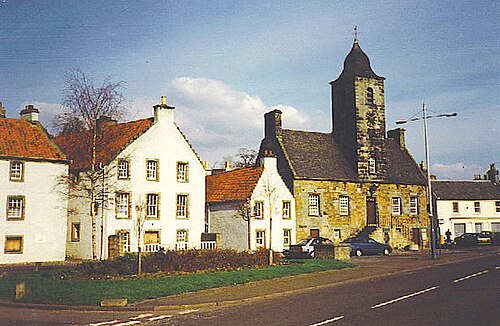
Saint Serf (Serbán, Servanus) was a Scottish saint of the sixth century (about 500 to about 583), venerated in western Fife, called, with less historical plausibility, the "apostle of Orkney", and regarded as the founder of the town of Culross. He is commemorated on 1 July. Our sources show no formal Orthodox veneration: he is a Scottish saint of the undivided Church, known chiefly from legends.
The legend
David Hugh Farmer called his story "a farrago of wild impossibilities": he was said to be the son of Eliud, king of Canaan, and his wife Alphia, daughter of a king of Arabia. Childless for a long time, they at last had two sons, the second being Serf. He came to Rome, with a reputation for sanctity so great that he was elected pope and served seven years. After leaving the see, he travelled through Gaul and Britain and returned to Scotland, where he met Adomnán, abbot of Iona, who showed him an island in Loch Leven, later called St Serf's Inch, then part of the Pictish kingdom of Fib (Fife). He raised a hermitage there, the priory of St Serf's Inch, where he remained seven years. The priory was later a community of Augustinian canons, founded from the cathedral of Saint Andrews at the initiative of King David I, in 1150; after more than four centuries it was given to St Leonard's College at Saint Andrews, and today only a few remains are left.
The centre of his ministry, and possibly of his deeds, was Culross, which, according to tradition, was founded by him. At Dunning, in Strathearn, he is said to have killed a dragon with his pastoral staff. A text says that, after many miracles, after divine virtues, after founding many churches, he gave peace to the brethren and yielded up his spirit in his cell at Dunning, on the first day before the Kalends of July, and his disciples and the people of the province took his body to Culross, where they buried it with honour, with psalms, hymns and canticles.
Serf and Mungo
Serf is said to have been a contemporary of Saint Mungo (Kentigern), though he could not have lived at the same time as both Adomnán and Mungo. According to one legend, the British princess Theneva (Thenaw), pregnant before marriage, was thrown from a cliff by her family, but survived unharmed and found an unmanned boat, which carried her across the Firth of Forth to Culross, where she was cared for by Serf, who became foster-father of her son, Kentigern (Mungo). Another legend says that Mungo restored to life a pet robin of Serf's, killed by classmates who planned to blame him. His name is attached to many churches in Fife, Edinburgh and central Scotland and to schools in the area.
Commemorated the same day July 1
 EstherSaint · Queen of PersiaJul 1
 Cosmas and DamianHoly Unmercenary Healers · Unmercenary physiciansJul 1
 Angelina of SerbiaVenerable · Despotess of SerbiaJul 1
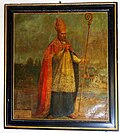 Cybard of AngoulêmeVenerable · Hermit of AngoulêmeJul 1
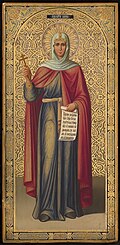 Galina of CorinthMartyrJul 1
- Julius and AaronHoly MartyrsJul 1
 Castus and SecundinusMartyr · Martyrs of SinuessaJul 1
- Arcadius GaryaevHieromartyr · PriestJul 1
- Peter the PatricianVenerable · Byzantine commander turned monkJul 1
- 25 Martyrs of NicomediaHoly MartyrsJul 1
- Ailill IISaint · Bishop of ArmaghJul 1
- Alexis DrozdovHieromartyrJul 1