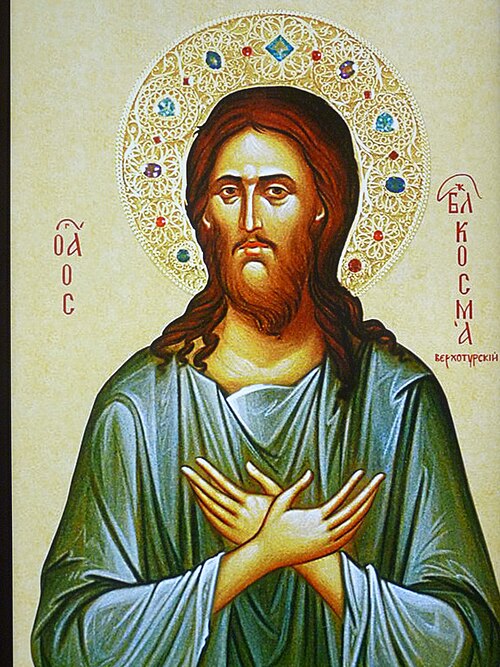
Fool-for-Christ
Cosmas of Verkhoturye
Fool for Christ of Verkhoturye, who died in 1679.
- Feast
- December 8old style December 21
- Reposed
- 167917th century
- Place
- Verkhoturye
- Order
- Fools-for-Christ
Life
Blessed Cosmas of Verkhoturye (1652 to 1679) was a fool for Christ in the city of Verkhoturye in Siberia, honoured by the Russian Church as a saint. He was glorified in 1984 only as a local saint, in the Synaxis of Siberian Saints, and not by a canonization for the whole Church. He is commemorated on 8 December (the day of his repose), on 10 June (the Synaxis of Siberian Saints), on 1 July (the Synaxis of the Saints of Yekaterinburg) and on 29 January, the feast of the holy unmercenary physicians Cosmas and Damian of Rome, in whose name the chapel over his tomb was consecrated.
Family and childhood
He was born in the city of Verkhoturye, in the Tobolsk district. According to a recollection kept by a relative, Fyodor Nemtinov, his father was a merchant from Velikiy Ustyug who lived across the river, and his mother was a priest's daughter. These reports cannot be confirmed by documents, since the Nemtinov family can be traced at Verkhoturye only from the 1720s. Yet the census of 1666 names a boy, Kuzka or Kozemka, son of Ivashko Abakumov, aged fourteen, and the father's name resembles one in a list from Velikiy Ustyug of 1630, which supports the tradition of his Ustyug origin. A register of 1682 gives the family name, Sapozhnikov. The last time Kuzka's name appears is in the census of 1679, which fits the year of his repose.
From childhood he suffered from a disease of the legs and walked on crutches. At an early age he began his folly for Christ: at night he left the house to pray, and he did not miss the services of the Trinity Cathedral. He was a contemporary of Blessed John of Verkhoturye.
Repose
He reposed on 8 December in the year 7188 from the creation of the world, that is, 1679, as the memorial book of Archpriest John Mikhailov records. Some sources give 1680, but this is an error in converting the dates. He was buried in the grounds of the Trinity Cathedral.
Tradition places his death later and gives him a part in the translation of the relics of Saint Simeon of Verkhoturye from the village of Merkushino to the monastery of Saint Nicholas. The story says that Cosmas, exhausted by walking because of his diseased legs, prayed to the saint: "Brother Simeon, let us rest". While the lame man rested, no one could move the shrine from its place. Chapels were built on the sites of the three stops. This is a tradition, not a date from history.
The tomb and veneration
In the eighteenth century a box for gifts was placed on the gravestone. In 1825 a canopy was set over it. In 1845 to 1848 a pious widow built a chapel over the grave in honour of Saints Cosmas and Damian, after a man of middle height, about twenty-five to thirty years old, barefoot and in a shirt, appeared to her in a dream, called himself Cosmas and asked her to cover the grave, which was being trampled by cattle. Later a new chapel was built with the grave in its middle, under the floor; the faithful could go down and take earth from the grave. As pilgrims multiplied, in 1902 it was decided to rebuild again, and in 1903 Saint John of Kronstadt gave a hundred roubles for a stone church. In 1912 the foundation was laid of a stone church in honour of Cosmas and Damian. Near the grave a spring appeared, which the people called "the Tears of Cosmas the Fool".
In 1920, when the relics of Saint Simeon were opened, the nuns of the Protection convent, with the blessing of Abbess Taisia (Sychova), secretly dug up the remains of Cosmas and buried them near the altar of the cemetery church. On 8 February 1993 his relics were found and placed in a shrine in the Transfiguration church of the monastery of Saint Nicholas at Verkhoturye. In 1995 they were moved to the chapel of the convent, and in 1996 to its Protection church. In 2006 a new shrine and canopy were made. In 2003, in the village of Kostyleva, a church in his honour was consecrated, and in 2006 a men's monastery, the Saint Cosmas Hermitage, was founded there, following the Athonite rule.
Commemorated the same day December 8
 Eutychian of RomeSaint · Bishop of RomeDec 8
 TychicusApostle · Companion of the Apostle PaulDec 8
 OnesiphorusHieromartyr · Disciple of the Apostle PaulDec 8
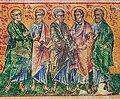 Caesar of DyrrhachiumApostle · Apostle of the Seventy and bishopDec 8
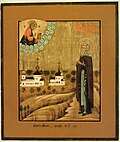 Cyril of ChelmogorskVenerableDec 8
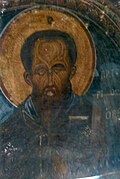 Patapios of ThebesVenerable · Patron of those with dropsyDec 8
- Ambicus, Victor and JuliusHoly Martyrs · Martyrs of NicomediaDec 8
- Anthusa of AfricaSaintDec 8
- Anthusa of RomeMartyrDec 8
- Brenainn of TethbaithSaintDec 8
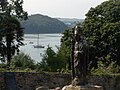 Budoc of DolSaint · Bishop of DolDec 8
- Fionan CuaeSaintDec 8