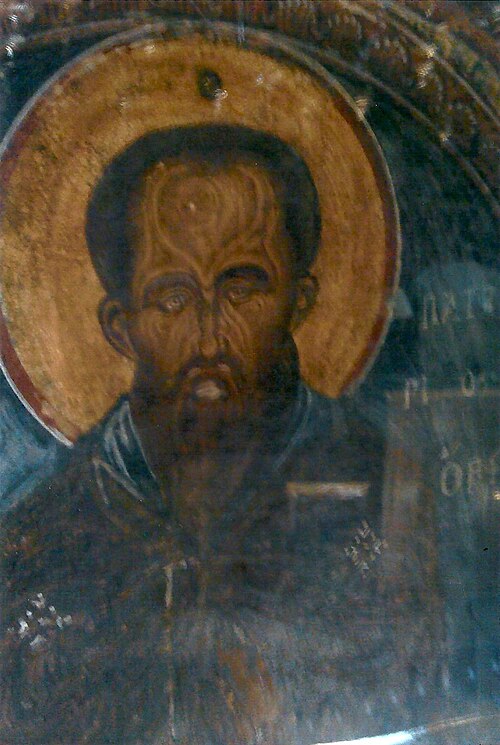
Venerable
Patapios of Thebes
Patron of those with dropsy
Fourth-century hermit of Thebes in Egypt, honored as patron of those suffering from dropsy.
- Feast
- December 8old style December 21
- Born
- 3504th century
- Place
- Egypt
- Order
- Venerables
Life
Saint Patapios of Thebes was a hermit of Egypt who came to live in Constantinople, the patron of those suffering from dropsy, honoured especially in Greece, at the convent near Loutraki where his relics are kept. According to the Greek sources he lived in the fourth century; some Serbian sources place him in the seventh. The Church commemorates him on 8 December and on the Tuesday after Easter Sunday, in memory of the finding of his relics.
Life
Patapios was born in Thebes in Egypt to wealthy Christian parents, who brought him up in the true faith. In youth he withdrew into the Egyptian desert, where he gave himself to prayer, and many came to him to ask advice and hear his word. Fearing human glory, he fled from the desert to Constantinople, thinking he could hide more easily in the bustle of the city. There he met two other ascetics, Varas and Ravoulas, who also became saints. Ravoulas struggled by the Gate of Romanos, and Varas founded the monastery of Saint John the Baptist at Petra.
Patapios made himself a hut near the church at Blachernae, at the Dry Mountain, where he founded a monastery, the Monastery of the Egyptians, in which he taught and guided many and where he passed to the Lord in deep old age. According to the Serbian source, a boy blind from birth came to him, led by God's providence, and asked him to pray that he might see. The saint took pity, prayed, and the boy saw. The miracle spread through the whole city, and crowds rushed to him, and through Saint Patapios many wonders of God were shown.
The relics
After the destruction of the Monastery of the Egyptians in 536, Saint Varas moved the relics to the monastery of Saint John at Petra, which in the last centuries of Byzantium was under the protection of the imperial Palaiologos family and especially of the Augusta Helena Dragaš, mother of the last emperor, Constantine XI Palaiologos, who became a nun with the name Hypomone, "Patience", and was numbered among the saints. After the Ottoman conquest of Constantinople in 1453, a relative of the Palaiologoi and nephew of Helena, Angelis Notaras, to protect the relics from the Ottomans, took them to Mount Gerania in southern Greece, near Loutraki, and hid them in a cave. A hermitage was established there, but it was abandoned after some centuries; the cave had been inhabited by hermits since the eleventh century, at a height of 650 metres.
The cave with the relics was discovered in 1904 by people of Loutraki. The skull of Helena Dragaš, Saint Hypomone, was found in it too. Some visitors took pieces of the relics as amulets, and the priest Constantine Sousanis of Loutraki took the relics and kept them at home, with the Church's permission, to keep them from desecration. In the cave were found a plundered wooden cross, a parchment and coins, handed over to the authorities.
The monastery
In 1952 Fr Nektarios (in the world Kyriakos) Marmarinos, a priest from the settlement of Corinth, later protosyncellus of the metropolis of Corinth, a native of Aegina and disciple of Saint Jerome, founded the monastery, and the relics returned to the cave where they had been found. The official founding took place on 1 August 1952 by Metropolitan Prokopios Tzavaras of Corinth. The first abbess was Gerontissa Synkletike, and Gerontissa Patapia helped greatly in the building; she was abbess from 1963 to 1968, then resigned for reasons of health. From 1968 to 2014 the abbess was Isidora, and today the nun Chrysovalanti leads it. At first there were only a few tiny cells, there was no road for cars, and the nuns carried building materials on a donkey, and even on their backs, together with water from a spring kilometres away and food from Loutraki.
Fr Nektarios also founded the men's monastery of the Three Hierarchs near Perachora, a summer camp for children called Bethlehem and a home for elderly women at Loutraki, where nuns care for the aged. Today the monastery has guest quarters, cells for forty nuns, the church of the Dormition of the Mother of God, consecrated on 1 August 1968 by Metropolitan Panteleimon of Corinth, a cemetery with the chapel of Saint Mary of Egypt, the katholikon of the Holy Trinity, an exhibition space and the Cave of Saint Patapios beside the church. There the saint's relics are kept, vested in a robe changed every year on the day of his feast, together with Byzantine icons of Saint Patapios and Saint Hypomone, probably of the fifteenth century. Pilgrims take from the cave a piece of cotton soaked in oil from the lamp burning there, and holy water from a spring nearby. The skull of Saint Hypomone is also kept at the monastery. The miracles of Saint Patapios, from the past and to this day, are recorded in the monastery archive, which has a large library.
Commemorated the same day December 8
 Eutychian of RomeSaint · Bishop of RomeDec 8
 TychicusApostle · Companion of the Apostle PaulDec 8
 OnesiphorusHieromartyr · Disciple of the Apostle PaulDec 8
 Caesar of DyrrhachiumApostle · Apostle of the Seventy and bishopDec 8
 Cyril of ChelmogorskVenerableDec 8
 Cosmas of VerkhoturyeFool-for-ChristDec 8
- Ambicus, Victor and JuliusHoly Martyrs · Martyrs of NicomediaDec 8
- Anthusa of AfricaSaintDec 8
- Anthusa of RomeMartyrDec 8
- Brenainn of TethbaithSaintDec 8
 Budoc of DolSaint · Bishop of DolDec 8
- Fionan CuaeSaintDec 8