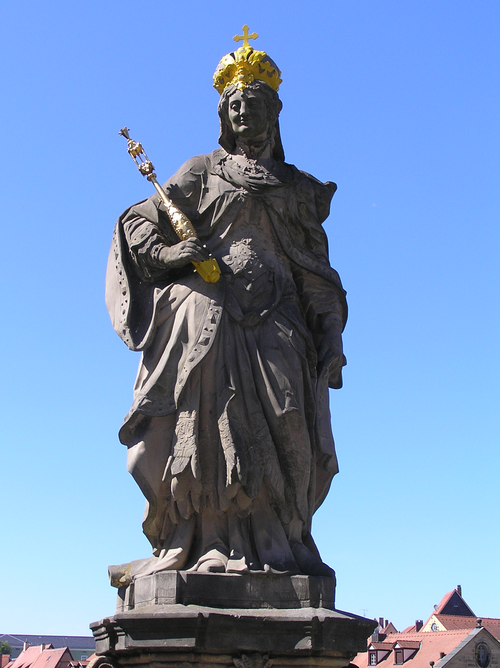
Venerable
Cunigunde
Holy Roman Empress
Wife of Emperor Henry II, who after his death entered the Kaufungen convent that she had founded.
- Feast
- March 3old style March 16
- Reposed
- 103911th century
- Place
- Kaufungen Abbey
- Order
- Venerables
Life
Cunigunde of Luxembourg was the wife of Emperor Henry II of the Holy Roman Empire and, after his death, a nun in a convent she had founded. She lived from about 975 to about 1040 and is honoured as a saint, above all in Bamberg and in Luxembourg, of which she is patroness. Her feast is on 3 March, and in Germany also on 13 July.
Family and marriage
She was born around 975-980, one of eleven children of Count Siegfried I of Luxembourg and Hedwig. She was a descendant, in the seventh generation, of Charlemagne. Around 999 she married Henry, then Duke of Bavaria, who became king of Germany in 1002 and emperor in 1014. Their marriage was without children. Tradition says that she had wished to become a nun and that the two lived in virginity by agreement; some scholars think, however, that later hagiographers misread the lack of children, and others that they were bound by steady affection.
Queen and empress
In 1002 Archbishop Willigis of Mainz crowned her queen at Paderborn, on 10 August. She was the first German queen crowned on her own; before her, the wives of kings who were already crowned received the empress’s crown directly, in Rome. On 14 February 1014 she was crowned empress together with Henry in Saint Peter’s Basilica, by the hand of Pope Benedict VIII.
Cunigunde had great influence in affairs of state. In charters her husband called her partner in the rule, and she took part in imperial councils and, in 1007, in the synod of Frankfurt. When Henry was away at war she governed the country (in 1012 and 1016). According to the sources, in 1018 she persuaded her husband to give back the duchy of Bavaria to her brother Henry, who had lost it through rebellion. In 1021 she presided over the royal court at Regensburg. She supported gifts to the Church, among them the founding of the diocese of Bamberg (1007-1008), for which she gave from her own dowry. The wealth that she and Henry gave away in charity later left her poor.
During a grave illness Cunigunde vowed that, if she recovered, she would found a convent of Benedictine nuns near Kassel. She kept her word, and the convent of Kaufungen was built in 1017. When Henry died in 1024, before the work was finished, she was regent of the Empire, with her brothers, Bishop Dietrich of Metz and Duke Henry of Bavaria, until the election of Conrad II on 8 September 1024, to whom she handed over the imperial insignia without resistance.
The nun of Kaufungen
A year later, in 1025, Cunigunde retired to Kaufungen. At the dedication of the convent she offered a relic of the True Cross, put off her imperial robes and took the nun’s habit; according to some sources she was tonsured on 13 July 1025 by Archbishop Aribo. She lived there in prayer, tending the sick and giving alms. She reposed on 3 March, in 1040 according to most sources (others say 1033 or 1039), and was buried in Bamberg Cathedral beside her husband.
In the legend that has come down, accused of unfaithfulness to her husband, she had to walk barefoot on red-hot ploughshares and came to no harm. Pope Innocent III canonized her on 29 March 1200, and in 1201 her relics were placed next to those of Henry in Bamberg Cathedral. An asteroid discovered in 1920 bears her name.
Commemorated the same day March 3
 Anselm of NonantolaVenerable · Abbot of NonantolaMar 3
 Basiliscus of ComanaMartyr · Martyr of Comana in PontusMar 3
 Cleonicus of AmasiaMartyr · Martyr of Amasia in PontusMar 3
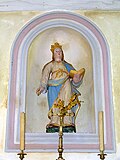 Camilla of AuxerreVenerableMar 3
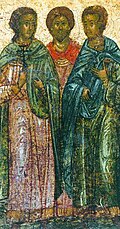 Eutropius of AmaseaMartyrMar 3
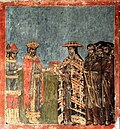 John I of MtskhetaSaint · First Archbishop of GeorgiaMar 3
- Asterius of CaesareaMartyr · Roman senatorMar 3
- Titian of BresciaSaint · Bishop of BresciaMar 3
- ArthelaisSaintMar 3
- CalupanVenerableMar 3
- Cele-ChristVenerableMar 3
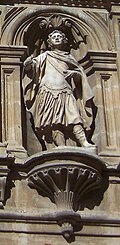 CeledoniusMartyrMar 3