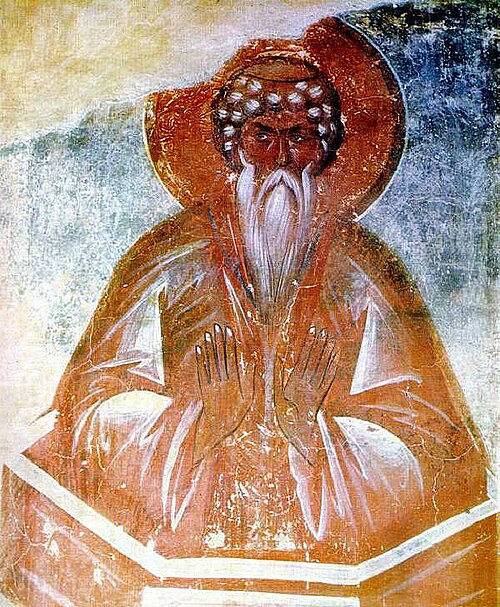
Stylite
Daniel the Stylite
Stylite near Constantinople
Stylite of the fifth century near Constantinople, venerated in East and West, who died around 493.
- Feast
- December 11old style December 24
- Reposed
- 4905th century
- Place
- Constantinople
- Order
- Stylites
Life
Saint Daniel the Stylite was a monk and stylite of the fifth century, a disciple of Simeon the Stylite the Elder, who lived thirty-three years on a pillar near Constantinople. He departed to the Lord about the year 490 (according to some sources 493) and is commemorated on 11 December, both in the Orthodox and in the Roman Catholic Church.
Childhood and calling He was born about 409 or 410 in the village of Maratha, in Upper Mesopotamia near Samosata, to Christian parents, Elias and Martha. For a long time the Lord had given them no child, and Martha prayed much and promised to dedicate to God the child who would be born. The prayer was heard. Until the age of five the boy had no name, since his parents wished him, born by God's favour, to receive his name from God. The abbot of the monastery to which they brought him opened a service book at the words of the prophet Daniel, and so he received his name.
At twelve he entered a monastery, where he remained until about thirty-eight. On a journey to Antioch with his abbot he passed the pillar of Saint Simeon, received his blessing and encouragement and was seized with the desire to struggle in the same way. According to the Serbian sources, when the abbot died the brothers wished to choose him in his place, but he went again to Simeon, then to Constantinople. He visited various holy places and stayed in several monasteries, and in 451 he retired into the ruins of a pagan temple in the region of Constantinople, in Thrace, where he had to face many demonic temptations.
On the pillar Daniel set up his pillar north of Constantinople. The owner of the land had not been consulted and complained to the Emperor Leo I and to Patriarch Gennadius. The emperor wished to remove him, but, by means unknown, held back. Gennadius ordained Daniel priest. When the service was over, the patriarch gave him Communion by means of a ladder which Daniel had ordered brought, and then himself received the Holy Eucharist from Daniel's hand. People came from all parts to see him and touch the pillar, and the faithful were healed. Daniel stood on the pillar in rain, snow and frost, his feet covered with sores, and the winds of Thrace sometimes stripped him of his scanty clothing.
Through his gift of healing and foresight Daniel became a counsellor to many. He was visited by the Emperor Leo I, accompanied by Gubazes, king of Lazica, and by the Emperor Zeno. The Life says that Leo ordered a roof to be built on the pillar, to shelter him from the cold, and that Daniel at first resisted, then accepted. When the Emperor Basiliscus wished to spread Monophysitism and came into conflict with Patriarch Acacius, the patriarch asked Daniel's help. The saint came down from the pillar and set out toward the emperor, carried by the faithful because his feet were no longer used to walking. The emperor avoided the meeting, but when the saint foretold his approaching death he sought reconciliation. Afterwards Basiliscus was replaced by the aged Zeno, who honoured Daniel. As a theologian, Daniel stood against Monophysitism.
His prayer and counsel Tradition has preserved his prayer at the start of his life on the pillar, in which he thanks Jesus Christ for all his blessings and for the grace to embrace this way of life, confessing that he leans on Him alone. Before his death he counselled his disciples to keep humility, obedience, hospitality, the fasts and the vigils, to love poverty and above all charity, to avoid the snares of heretics, and never to separate from the Church, their mother.
Death and veneration He fell asleep on 11 December, in 489 or 490 according to some sources, in 493 according to others. He was buried with splendour in a great sarcophagus of costly stone. The Life also speaks of an icon of him made of silver, weighing more than thirty kilograms. In the ninth century Joseph the Hymnographer and Theodore the Studite composed hymns for his day, which are still sung. In Moscow the oldest monastery, the Danilov, bears his name, founded by Prince Daniel Alexandrovich at the end of the thirteenth century. His likeness is found, among other places, on the iconostasis of the Holy Trinity Cathedral in Blaj.
Commemorated the same day December 11
 Damasus ISaint · Bishop of RomeDec 11
 ReubenRighteous · The PatriarchDec 11
 Acepsimas and AithalasHoly Martyrs · Martyrs of PersiaDec 11
 Leontius of MonemvasiaVenerableDec 11
 Theophan IlminskyHieromartyr · Bishop of SolikamskDec 11
 Luke the StyliteStyliteDec 11
- Mirax of EgyptMartyrDec 11
- Benjamin of JerusalemSaint · Bishop of JerusalemDec 11
- Nikon the DryVenerable · Monk of the Caves LavraDec 11
- AemilianMartyrDec 11
- Aithalas of ArbelaMartyrDec 11
- Akepsius of ArbelaMartyrDec 11