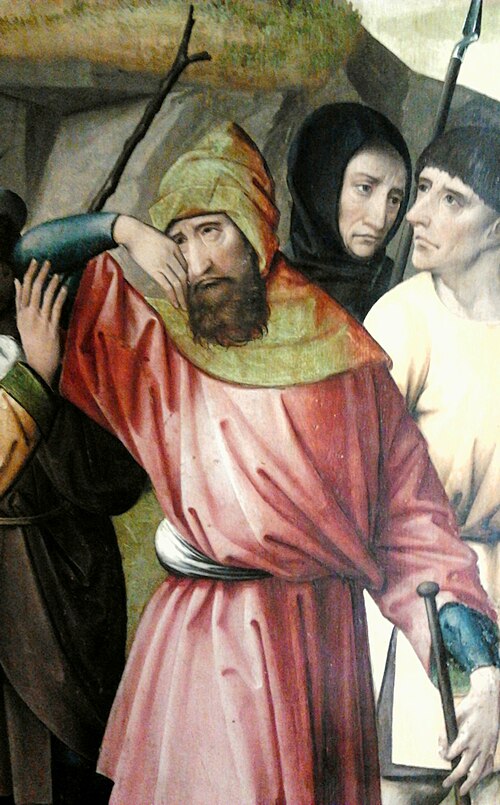
Righteous
Reuben
The Patriarch
First son of Jacob and Leah, ancestor of the tribe of Reuben.
- Feast
- December 11old style December 24
- Reposed
- 1445 BC15th century BC
- Place
- Paddan Aram
- Order
- The Righteous
Life
Reuben was the first son of Jacob and Leah and the ancestor of the tribe of Reuben. The Orthodox Church remembers him among the righteous of the Old Testament, on the Sundays before the Nativity of the Lord, when the Holy Forefathers and the Holy Fathers of the Lord according to the flesh are honoured. Scripture shows him as a man of good heart but weak in self-command, who lost the right of the firstborn through a grave fault.
Name and birth
Leah, the less loved wife of Jacob, bore Reuben at Paddan-Aram. The book of Genesis gives two interpretations of the name: Leah said that the Lord had seen her affliction, and, in the second explanation, that now her husband would love her (Genesis 29:32). Hebrew also brings the name close to the words behold, a son. Reuben is the first of Leah's six sons and of the twelve sons of Jacob.
Genesis tells that in the days of the wheat harvest Reuben found mandrakes in the field and brought them to his mother Leah. Rachel asked for some of them, which led to an arrangement between the two women (Genesis 30:14 and following).
The fault and the blessing
Reuben did not master his passions. Genesis says that he lay with Bilhah, his father's maidservant and concubine, and Jacob heard of it (Genesis 35:22). For this, at the end of his life, Jacob told him: Unstable as water, you shall not excel, because you went up to your father's bed and defiled it (Genesis 49:4). The birthright passed to Joseph (1 Chronicles 5:1). The father's word was fulfilled: Reuben's descendants became known neither for their number nor for their strength.
Reuben and Joseph
Yet Reuben had a good nature and a noble soul. Of Joseph's brothers, he alone stood in the way of those who wished to kill him. He advised them not to stain their hands with innocent blood and to cast Joseph into a pit, intending to lift him out and bring him back to their father. But Reuben was not present when Joseph was sold to the merchants. Returning to the pit and finding it empty, he tore his clothes.
Later, when the brothers fell into trouble in Egypt, Reuben said: Did I not tell you not to sin against the boy? Now his blood is required. When Jacob would not let Benjamin go to Egypt, Reuben offered his own two sons as surety for his life. When Jacob moved to Egypt at Joseph's invitation, Reuben had four sons: Hanoch, Phallu, Hezron and Carmi (Genesis 46:9). After that Scripture says nothing more of his life.
The tribe of Reuben
In the time of Moses the tribe of Reuben settled east of the Jordan, in a land good for herding. Its warriors helped in the conquest of the land and, on their return, raised an altar of witness (Joshua 22). Moses blessed the tribe: Let Reuben live, and not die (Deuteronomy 33:6). The Song of Deborah speaks of the great searchings of heart among the clans of Reuben (Judges 5:15).
Traditions about his end
Rabbinic tradition calls him the first penitent, for his repentance after the sin with Bilhah, and says that he died at the age of one hundred and twenty-five. According to a local tradition his tomb is in the former village of Nabi Rubin, on the Mediterranean coast, where an annual pilgrimage was once held. Scripture itself, however, says nothing of his death or burial.
Commemorated the same day December 11
 Damasus ISaint · Bishop of RomeDec 11
 Daniel the StyliteStylite · Stylite near ConstantinopleDec 11
 Acepsimas and AithalasHoly Martyrs · Martyrs of PersiaDec 11
 Leontius of MonemvasiaVenerableDec 11
 Theophan IlminskyHieromartyr · Bishop of SolikamskDec 11
 Luke the StyliteStyliteDec 11
- Mirax of EgyptMartyrDec 11
- Benjamin of JerusalemSaint · Bishop of JerusalemDec 11
- Nikon the DryVenerable · Monk of the Caves LavraDec 11
- AemilianMartyrDec 11
- Aithalas of ArbelaMartyrDec 11
- Akepsius of ArbelaMartyrDec 11