Saint
Desiderius of Cahors
Bishop of Cahors
Merovingian royal official who succeeded his brother Rusticus as bishop of Cahors, died in 655.
- Feast
- November 15old style November 28
- Reposed
- 6557th century
- Place
- Cahors
- Order
- Hierarchs
Life
Saint Desiderius (in French Didier) of Cahors was a high official of the Merovingian court, of an aristocratic Gallo-Roman family, and then bishop of Cahors, successor to his brother Rusticus. He was born about 580 at Albi and fell asleep on 15 November 655. He is a saint of the time of the undivided Church, venerated mainly in the West; his commemoration is on 15 November.
Youth and service at court
He was the son of Salvius, who bore an expressly Christian name, and of Herchenfreda, a literate woman with a Frankish name. He had two brothers, Rusticus and Syagrius. The three boys were sent to the court of the Frankish king Clotaire II (584-629, sole ruler from 613) and, with other boys of noble family, received an excellent education at the Merovingian court school. Rusticus took holy orders young, was archdeacon at Rodez and abbot of Clotaire's palatine basilica, and the king at length appointed him bishop of Cahors, in Quercy. Syagrius, after long service in the royal household and long familiarity with Clotaire, was made count of Albi and exercised judicial authority as prefect in the city of Marseille.
According to his Vita, Desiderius combined a love of letters with Gallic eloquence. While still an adolescent he received dignities of the royal household and turned his studies to Roman (that is, canon) law, with the result that a Roman gravity tempered the richness and brilliance of his Gallic speech. Before long he was appointed treasurer to the king, an office he kept under the new king, Dagobert I (629-639), whose confidant he was. After the death of Syagrius (629) he is said to have obtained also the prefecture of Marseille, but this is not certain; the Ukrainian source makes him patrician of Provence and prefect of Marseille between 629 and 634 and says that in 634 he gave up these offices to devote himself to church work. Faithful to the counsels of his pious mother, three of whose letters to him the Vita mentions, he led at court the serious, holy life of a monk and administered his office with great fidelity. At court he made the acquaintance of Saints Arnoux, Ouen and Eloi.
Bishop of Cahors
In 630 his brother Rusticus, the bishop of Cahors, was killed in a riot, and the clergy and people of the city asked the king for Desiderius as successor. By a letter of 8 April 630, Dagobert gave his consent and Desiderius was ordained bishop of Cahors by Sulpicius the Pious, bishop of Bourges. He governed the diocese, which flourished under his care, until his death (the Ukrainian source says he was bishop until 654). With the other bishops of his time, many of them educated with him at court, he kept up an active correspondence. He was a zealous promoter of monastic life and founded near Cahors a monastery, whose church was dedicated to Saint Amantius; later the monastery took the name of its founder, Saint-Géry (Dierius, from Desiderius). He also directed a convent of women, as a letter of his to the abbess Aspasia shows. With his support the monastery of Saint Peter of Moissac was also founded in the diocese.
Desiderius built three great basilicas in and near Cahors (of Saint Mary, Saint Peter and Saint Julian) and an oratory in honour of Saint Martin. His buildings were made not of wood, wattle and thatch, but, in the manner of the ancients, of squared and hewn stone, raised from the foundations to the topmost pinnacle. He also built an aqueduct for Cahors, rebuilt the walls and towers that protected the city and the Castrum Mercurio in Cahors. His acts show how much the bishop worked for the public good with the authority of a count or a patrician. He persuaded the nobles of his diocese to endow churches and monasteries.
By his testament (649-650) he endowed the cathedral, the churches and the monasteries of his episcopal city with all his estates. While living on his estates in the district of Albi he fell ill and died at his villa of Wistrilingo. His body was carried to Cahors and buried in the church of Saint Amantius.
His Vita and letters
A Vita of Desiderius was composed toward the end of the eighth century by an anonymous author, possibly a monk of Saint-Géry near Cahors, on the basis of older documents. Appended to it is a collection of letters, some written by him and others addressed to him, and an account of the miracles at his tomb. Anthyme Saint-Paul called him "the last of the Romans" because of his building work; his correspondence with the aristocrats he had befriended in youth marks the very end of ancient epistolography. His small literary circle tried to preserve the Roman heritage and traditions going back to Vergil and Homer, and the ability to speak the language of the past was valued; but he and his circle were very few in the literary society of the seventh century. Later letter collections, of the late Merovingian and Carolingian periods, have no direct connection to ancient models.
Commemorated the same day November 15
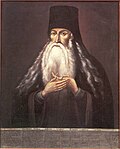 Paisius VelichkovskyVenerable · Elder of Neamț MonasteryNov 15
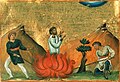 Habib of EdessaMartyr · Deacon of EdessaNov 15
- Thomas II of ConstantinopleSaint · Patriarch of ConstantinopleNov 15
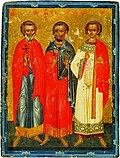 Gurias, Samonas and AbibusHoly Martyrs · Martyrs of EdessaNov 15
- Philip of RabangaVenerable · Founder of the Rabanga monasteryNov 15
- Arnulf of ToulSaint · Bishop of ToulNov 15
- Benignus of Le PuySaintNov 15
- CarteriusSaintNov 15
- Connait of LismorVenerableNov 15
- DemetriusSaintNov 15
- Demetrius of DabudMartyrNov 15
- ElpidiusMartyrNov 15