Martyr
Habib of Edessa
Deacon of Edessa
Deacon of Edessa put to death for his faith in the fourth century; he is remembered with Saints Gurias and Samonas.
- Feast
- November 15old style November 28
- Reposed
- 3224th century
- Place
- Edessa
- Order
- Martyrs
Life
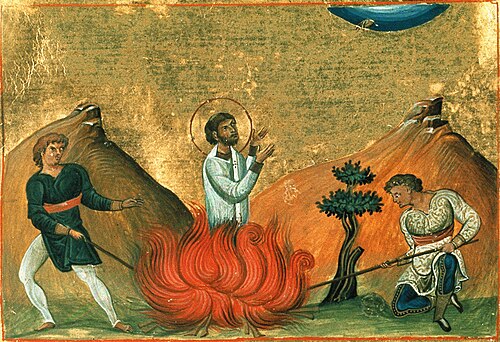
Saint Habib the Martyr, deacon of Edessa in Mesopotamia, now Urfa in Turkey, was burned alive for faith in Christ in the time of the emperor Licinius, between 307 and 322. He is venerated by the Catholic, Orthodox and Oriental Orthodox Churches. The Church remembers him on 15 November with Saints Gurias and Samonas, with whom he was buried, and separately on 2 September and 2 December.
He was born at Edessa around 307 to Christian parents and worked at first as a tradesman. He was ordained deacon at fourteen, an age regarded in antiquity as adulthood. As deacon he served in the village of Thalsei, but went around the villages reading Holy Scripture to the inhabitants. The emperor ordered his arrest for zealously spreading Christianity. He is said to have said: "If I remain in secret, others will be forced to receive the crown of martyrdom against their will, and what honour will our faith have if it is not accepted willingly? Death is before man wherever he goes, such is the fate of all the children of Adam." Not wanting any Christian or non-Christian to suffer because of the search for him, he appeared himself, saying: "I am Habib of Edessa, the one you are seeking."
In the days of torment he was scourged and combed by five men. When the governor threatened him with more grievous torture, the saint said: "As a tree that is watered bears fruit, so my spirit is strengthened by torment." The governor, frustrated at his powerlessness, asked: "Does your faith teach you to hate your own body?", and Habib answered: "We do not hate this material body, but we rejoice in the spiritual reality; the sufferings of this present time are not worthy to be compared with the glory that awaits those who embrace Christ." The governor asked mockingly: "Is this suffering glorious?", and Habib: "It is not for you to ask, for your unbelief is not worthy to hear the answers, as Scripture teaches: do not cast what is holy to dogs, nor pearls before swine."
He was sentenced to be burned at the stake. Walking to the stake, his mother was forced to walk beside him, dressed in white as for a feast. He blessed the crowd, which answered: "Pray for us before the Lord", and then entered the fire himself. After the flames were put out, his body was found undamaged by his mother and relatives. According to the Synaxarion, a group of local Christians, Jews and pagans took his relics and buried them, in the year 322, with those of the martyrs Gurias and Samonas, at a church called Beith Elaha Cucla. With Gurias and Samonas he is regarded as "avenger of unfulfilled contracts" and as patron of firefighters. His tomb is told of in the Syriac romance Euphemia and the Goth, in which a girl, Euphemia, wronged by a Goth, is saved through Habib's intercession. In the Oriental Orthodox Churches his own day is 2 September.
Commemorated the same day November 15
 Paisius VelichkovskyVenerable · Elder of Neamț MonasteryNov 15
- Thomas II of ConstantinopleSaint · Patriarch of ConstantinopleNov 15
- Desiderius of CahorsSaint · Bishop of CahorsNov 15
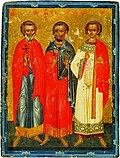 Gurias, Samonas and AbibusHoly Martyrs · Martyrs of EdessaNov 15
- Philip of RabangaVenerable · Founder of the Rabanga monasteryNov 15
- Arnulf of ToulSaint · Bishop of ToulNov 15
- Benignus of Le PuySaintNov 15
- CarteriusSaintNov 15
- Connait of LismorVenerableNov 15
- DemetriusSaintNov 15
- Demetrius of DabudMartyrNov 15
- ElpidiusMartyrNov 15