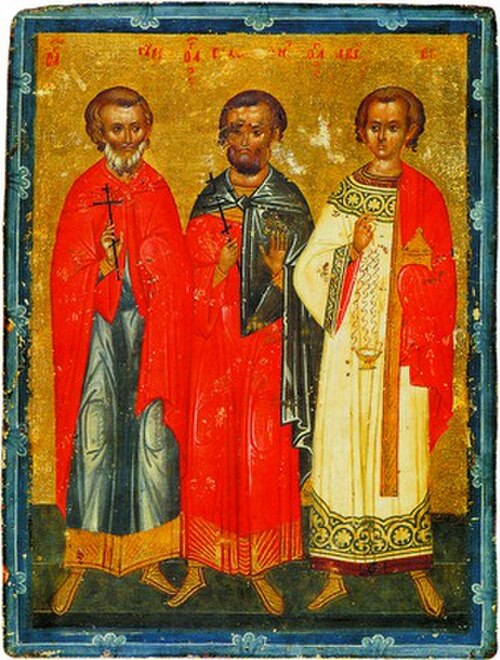
Holy Martyrs
Gurias, Samonas and Abibus
Martyrs of Edessa
Martyrs and confessors of Edessa in the late 3rd and early 4th century.
- Feast
- November 15old style November 28
- Era
- unknown
- Order
- Martyrs
Life
The holy martyrs and confessors Gurias, Samonas and Abibus suffered at Edessa in Syria at the end of the third and the beginning of the fourth century. Gurias and Samonas were laymen killed in Diocletian's great persecution, and the deacon Abibus was burned alive in the time of Licinius. They are commemorated together on 15 November and are regarded as protectors of Edessa and of those in danger.
The martyrdom
The hagiographical sources place their martyrdom between 293 and 322, because church tradition joined together the three saints, who lived at different times. The original Acts were written first in Syriac and are known from ancient Greek, Armenian and Latin translations; the Syriac text that survives is from a fifteenth-century manuscript. It names its author, Theophilus of Edessa, who says of himself that he was a pagan by birth, turned to Christianity and wrote the work on the fifth day after the martyrdom of Gurias and Samonas. The Acts of Abibus are also attributed to him.
Gurias, from Sargokitia (according to the Greek sources), and Samonas, from Ganada, suffered at the beginning of Diocletian's great persecution. They had left their native city, Edessa, but were seized by the governor Antoninus. They were urged with gentle words to sacrifice to the pagan gods and refused. At the trial they were tortured: tied to each other with a stone at their feet, they were left hanging for several hours. Then they were taken to prison, where they stayed about three months (in Arethas of Caesarea, several years, which is why he calls them confessors). When they were brought again to trial, only Samonas was tortured a second time. Seeing them unmoved, the governor condemned them to be beheaded, on Mount Vetilavikla near Edessa. Their bodies were buried by the local Christians.
The deacon Abibus, from the village of Apothelsaia near Edessa, suffered in the time of the emperor Licinius, who, parting from Constantine the Great, began a new persecution in the east of the Empire. Abibus preached the Gospel openly and brought many pagans to the faith. He was denounced, and at the trial the governor Lysanias tried to make him sacrifice to idols. Because he refused, he was hung on a post, torn with iron claws, then taken outside the city and thrown into a fire. According to the Life, his body was found unharmed by his relatives, who buried it in the same tomb with Gurias and Samonas.
The miracles
The best-known miracle of the saints is linked with the invasion of the Huns into Byzantium and is set in the time of the confessor bishop Eulogius of Edessa (379-387). During a campaign a Gothic mercenary stayed at Edessa in the house of a widow, Sophia. There he saw her daughter, Euphemia, and asked for her as wife. The mother refused, thinking from rumour that the Goth had a wife at home, but the mercenary convinced her it was not so and married the girl. Before the Goth and Euphemia left Edessa, Sophia made her son-in-law swear faithfulness to his new wife at the tomb of the saints Gurias, Samonas and Abibus.
Back home, the Goth ordered Euphemia to dress in a servant's clothes and brought her to his house, to his wife and children, saying that he had brought a Byzantine captive. But Euphemia bore a boy, and the Goth's wife understood that her husband had brought a concubine. She poisoned the newborn. Euphemia, seeing poison on the lips of her baby, wiped it with a piece of wool and later dipped it in the cup from which the mistress was to drink. The woman drank from the cup and died, and the Goth's relatives accused Euphemia of her death. By their decision she was condemned to be buried alive with the mistress of the house. Euphemia began to pray to the saints Gurias, Samonas and Abibus, and they, appearing on white horses, carried her to the church at Edessa. After a time the Goth came back to Edessa and came to Sophia's house. He told her that her daughter was well, that they lived happily and were raising their son. Then Euphemia came out, and the Goth was forced to confess what had happened in his country. After that the city authorities condemned him to death.
Another miracle is the trial by the blessed bread. Metropolitan Macarius (Bulgakov) mentions a letter of Archbishop John of Novgorod, issued on the occasion of the miraculous discovery of thieves who had stolen in 1410 the holy vessels from Saint Sophia Cathedral. He writes that "God gave us the sign of the holy confessors Gurias, Samonas and Abibus the deacon, so that by God's mercy many who are right are shown right and the guilty fall under punishment". Archbishop John wrote a "Decree on the proskomedia to the three holy confessors", which gives details of the rite: a special cross-shaped prosphora was made, from which particles were taken out with prayers, among them a petition to the confessors: "Work your wonder for those who come with faith, help those in peril, expose the guilty, shut the throats of wrongdoers", and those who were to be tried with the prosphora were commemorated by name at the proskomedia. Macarius points out that this was a private ordinance of the archbishop and that the chronicles do not show that the custom was used for long at Novgorod.
Service and icons
The commemoration of the saints is entered in the Typikon of the Great Church without an appointed service. The Jerusalem Typikon prescribes for them the daily service with the dismissal troparion or the ordinary service of the lesser fasts with "Alleluia". In present liturgical practice the service consists of a troparion in the fifth plagal tone, a kontakion in the second tone, a canon in the fourth tone with an acrostic, two samoglasna, a cycle of three stichera and an exaposteilarion. The Greek troparion calls the three equal in number to the Trinity. Their images are found in monumental painting, on icons and in illuminated manuscripts, usually together: Gurias, a grey-haired old man with a long beard, in chiton and himation; Samonas, middle-aged, with dark (sometimes grey) hair and a short beard, in the same garments; Abibus, a young beardless man in a sticharion, with a censer or cross in his hands.
Commemorated the same day November 15
 Paisius VelichkovskyVenerable · Elder of Neamț MonasteryNov 15
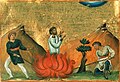 Habib of EdessaMartyr · Deacon of EdessaNov 15
- Thomas II of ConstantinopleSaint · Patriarch of ConstantinopleNov 15
- Desiderius of CahorsSaint · Bishop of CahorsNov 15
- Philip of RabangaVenerable · Founder of the Rabanga monasteryNov 15
- Arnulf of ToulSaint · Bishop of ToulNov 15
- Benignus of Le PuySaintNov 15
- CarteriusSaintNov 15
- Connait of LismorVenerableNov 15
- DemetriusSaintNov 15
- Demetrius of DabudMartyrNov 15
- ElpidiusMartyrNov 15