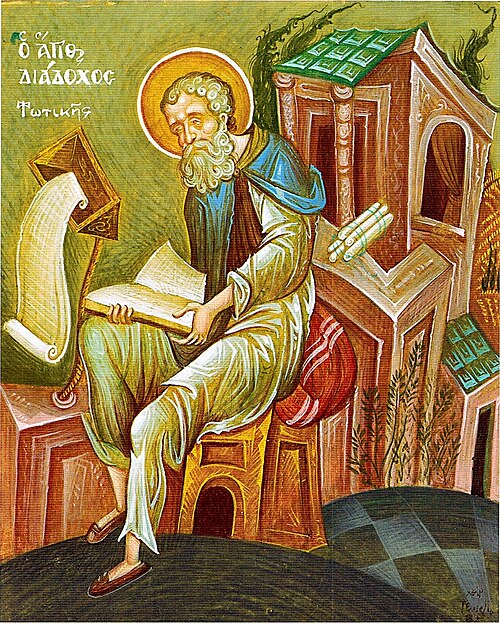
Saint
Diadochos of Photiki
Bishop of Photiki
Ascetic and bishop of Photiki in the fifth century, whose works are included in the Philokalia.
Life
Blessed Diadochos of Photiki was bishop of Photiki, a small town of Old Epirus (modern Paramythia, in north-western Greece), in the fifth century. His ascetic writings, among them the Hundred Chapters on Spiritual Knowledge, are included in the Philokalia and had a great influence on later Byzantine writers and on Hesychasm.
Little is known of his life. He was born around 400 and passed away before 486. He was bishop of Photiki and in 451 took part in the Fourth Ecumenical Council at Chalcedon. From the writings of Patriarch Photius we know that he is called bishop of Photiki in Old Epirus. With the other bishops of Epirus he signed a letter to the emperor Leo, defending the supporters of Chalcedon and condemning Monophysitism, after the murder of Patriarch Proterius of Alexandria by the Monophysites in 458. He also fought the Messalians. He was probably part of a group of Epirote notables captured in a Vandal raid between 467 and 474 and taken to Carthage, where his trace is lost; the place and day of his death are not known.
His best-known work, On Spiritual Knowledge and Discrimination, called the Hundred Chapters, was written for his monks in reaction to the strange doctrines of the Messalians (Euchites) of Mesopotamia. In it Diadochos appears as a bishop concerned for the faith of his flock, but also as a man of prayer, united to God, who has found life in Christ and wants to share its good with his readers. He was especially influenced by Evagrius Ponticus and Saint Macarius of Egypt, taking from them the idea of stillness (hesychia), spiritual sensation and the fierce struggle against the demons. A homily on the Ascension, one against the Arians, a Vision and a Catechism are also ascribed to him, but some scholars doubt the last three. His writings hold an early witness to the use of the Jesus Prayer. He also influenced the West, from Caesarius of Arles to Ignatius of Loyola and Teresa of Avila, through Julianus Pomerius. Saint Maximus the Confessor, John Climacus and Symeon the New Theologian inherited his thought. Modern translations in Russia were made by Paisius Velichkovsky and Theophan the Recluse. His feast is on 29 March; some Slavic manuscripts list him as a martyr on 31 August.
Commemorated the same day March 29
 GwynllywRight-Believing · King of GwynllŵgMar 29
 John the HermitVenerable · Armenian hermitMar 29
- Mark of ArethusaHieromartyr · Bishop of ArethusaMar 29
- Eustasius of NaplesSaint · Bishop of NaplesMar 29
- Hesychius of SinaiVenerable · Hieromonk of Mount SinaiMar 29
- Jonah of PskovVenerable · Founder of the Pskov Caves MonasteryMar 29
- Reduce of NaplesSaint · Bishop of NaplesMar 29
- Michael ViktorovHieromartyr · ArchpriestMar 29
- Aedhan of Doire BruchaisiSaintMar 29
- Armogastes and CompanionsHoly MartyrsMar 29
- Armogastes, Archinimus and Saturus of AfricaHoly Confessors · Confessors of AfricaMar 29
- BarachisiusMartyr · Martyr of PersiaMar 29