Venerable
Hesychius of Sinai
Hieromonk of Mount Sinai
Hieromonk of Sinai and Byzantine ascetic author, of whose works only fragments have been preserved.
- Feast
- March 29old style April 11
- Reposed
- 8008th century
- Place
- Sinai Peninsula
- Order
- Venerables
Life
Venerable Hesychius of Sinai was a Byzantine ascetic writer, a monk and, according to some manuscripts, abbot of the monastery on Mount Sinai. He is known as the author of the treatise on watchfulness and virtue, which has remained one of the major writings of Hesychasm and of the Jesus Prayer. He is commemorated on 29 March, according to the Synaxarion of the Church of Greece.
What is known of him
Very little certain is known of his life, and the sources do not agree on the time he lived. The Greek Synaxarion places him in the seventh century and says he was abbot of Saint Catherine's Monastery on Mount Sinai. Modern scholarship offers dates between the seventh and ninth centuries, and also the second half of the twelfth, because his name does not appear in manuscripts before the middle of the thirteenth century, and the oldest manuscript of his work, from 1267 (another source gives 1289), is much later. In manuscripts he is usually given the title Our Holy Father. He should not be confused with Hesychius of Jerusalem, whose writings his were mixed with in manuscripts and old editions. For that reason no separate commemoration has been established for him in the Russian tradition.
His work
His only surviving work is the Soul-profiting and Saving Discourse on Watchfulness and Virtue in Chapters, also called the Centuries or Chapters. The long text has two hundred chapters, in manuscripts between 200 and 203, while the short one has twenty-four chapters in alphabetical order. It is addressed to a Theodulus, and in some manuscripts Theodulus was wrongly taken to be the author. The author gives his name through a play on the word hesychia, stillness. He draws on the Sayings of the Fathers, Evagrius of Pontus, Diadochus of Photiki, John Climacus and Maximus the Confessor.
His theme is watchfulness, that is, attention of the mind, guarding of the mind and resistance to thoughts, joined to the invocation of the name of Jesus Christ and the purification of the heart. The work was printed in Greek in the sixteenth century, entered Migne's Patrologia Graeca and, in a better form, the Greek Philokalia. It was translated twice into Slavonic, survives in more than forty South Slavic manuscripts, the oldest from the first decades of the fourteenth century, and was cited by Gregory of Sinai, Callistus Angelicudes, Callistus and Ignatius Xanthopoulos and, in the Russian tradition, by Nil Sorsky, who calls him Hesychius of Jerusalem. A lost discourse, On the Cross, is also attributed to him.
Commemorated the same day March 29
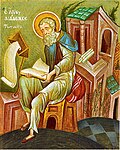 Diadochos of PhotikiSaint · Bishop of PhotikiMar 29
 GwynllywRight-Believing · King of GwynllŵgMar 29
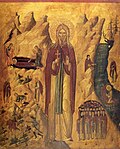 John the HermitVenerable · Armenian hermitMar 29
- Mark of ArethusaHieromartyr · Bishop of ArethusaMar 29
- Eustasius of NaplesSaint · Bishop of NaplesMar 29
- Jonah of PskovVenerable · Founder of the Pskov Caves MonasteryMar 29
- Reduce of NaplesSaint · Bishop of NaplesMar 29
- Michael ViktorovHieromartyr · ArchpriestMar 29
- Aedhan of Doire BruchaisiSaintMar 29
- Armogastes and CompanionsHoly MartyrsMar 29
- Armogastes, Archinimus and Saturus of AfricaHoly Confessors · Confessors of AfricaMar 29
- BarachisiusMartyr · Martyr of PersiaMar 29