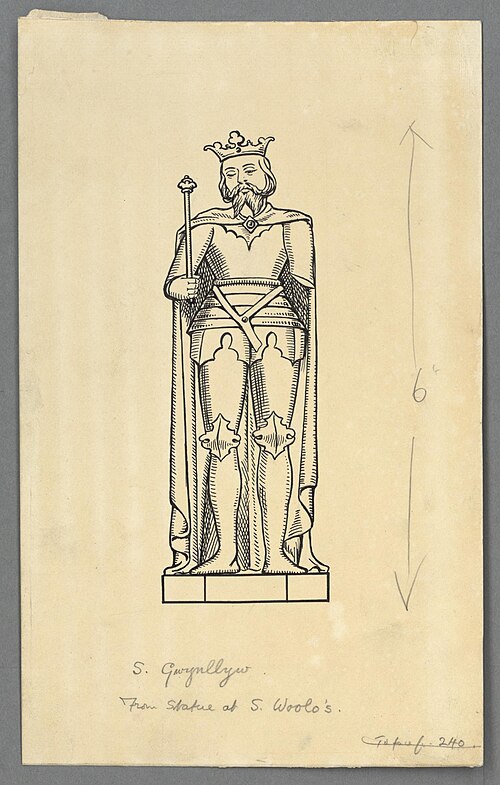
Right-Believing
Gwynllyw
King of Gwynllŵg
Welsh king of Gwynllŵg in south Wales around 500, also remembered as a religious figure.
- Feast
- March 29old style April 11
- Reposed
- 5206th century
- Place
- Gwynllwg
Life
According to the old Welsh tradition, Gwynllyw was king of Gwynllŵg in south Wales around the year 500. From a feared warlord he became a hermit, founded the place now called Saint Woolos Cathedral in Newport, and was the father of Saint Cadoc the Wise. His feast is kept on 29 March.
The Lives of Saint Cadoc (by Lifris, about 1100) and of Gwynllyw (about 1120) preserve old stories, often differing in detail. It seems likely that a king of this name really existed. His deeds were sung by Welsh bards. He was the son of King Glywys, whose realm, Glywysing, was centred on Glamorgan, and of Guaul, a granddaughter of Cunedda. At Glywys' death the kingdom was divided among his sons. Gwynllyw, the eldest and most powerful, was overlord of the others, and the centre of his domain was the cantref of Gwynllŵg, named after him. One of his brothers was Saint Petroc, honoured in Cornwall, Brittany and Devon.
The stories show him as a fierce warrior who raided neighbouring kingdoms. The Life of Cadoc says he was fond of thieves and used to urge them to robbery, but the Life of Gwynllyw insists that he was a just ruler. In one such raid, told in the Life of Cadoc, he set out with some three hundred men and carried off the beautiful Gwladys, daughter of King Brychan of Brycheiniog, who had refused to give her to him in marriage. A fierce battle followed, halted by the coming of Cai and Bedwyr, said to be his allies, with the help of the legendary King Arthur. The Life of Gwynllyw, however, says the battle never took place and the marriage was made peacefully.
Gwladys bore a son, Cadoc, who became famous as a saint. To mark his birth Gwynllyw made another raid and took cattle from Caerwent. Saint Tathyw came boldly to demand the return of a cow, and the king, impressed, decided to send his son to him to be taught and baptized. He is said to have had other holy children: Cynidr, Bugi and Egwine, while a daughter, Maches, was reportedly killed by robbers.
When Cadoc grew up he was deeply devout. According to some sources, his example and preaching led his father to abandon his life of violence and seek forgiveness for his sins. The king is said to have dreamed of an angel who bade him go to a hill, and in a vision he saw a white ox with a black spot high on its forehead. He set out, found the ox of his dream and founded a hermitage there, built of wood, on Stow Hill in Newport. Of that place he is said to have said: “There is no retreat in the world such as this place which I am destined now to inhabit. Happy is the place, and happier he who inhabits it.” Gwladys joined him in the hermit's life, and for a time they lived together in asceticism, in fasting and simple food.
Gwynllyw built a church there dedicated to the Mother of God, now Saint Woolos Cathedral, and was buried in it. From his name comes the English form Woolos. After his death he was honoured as a saint, and today he is regarded as the legendary founder and patron of the city of Newport. His son Cadoc became ruler of Gwynllŵg after him, before giving his life to God.
Commemorated the same day March 29
 Diadochos of PhotikiSaint · Bishop of PhotikiMar 29
 John the HermitVenerable · Armenian hermitMar 29
- Mark of ArethusaHieromartyr · Bishop of ArethusaMar 29
- Eustasius of NaplesSaint · Bishop of NaplesMar 29
- Hesychius of SinaiVenerable · Hieromonk of Mount SinaiMar 29
- Jonah of PskovVenerable · Founder of the Pskov Caves MonasteryMar 29
- Reduce of NaplesSaint · Bishop of NaplesMar 29
- Michael ViktorovHieromartyr · ArchpriestMar 29
- Aedhan of Doire BruchaisiSaintMar 29
- Armogastes and CompanionsHoly MartyrsMar 29
- Armogastes, Archinimus and Saturus of AfricaHoly Confessors · Confessors of AfricaMar 29
- BarachisiusMartyr · Martyr of PersiaMar 29