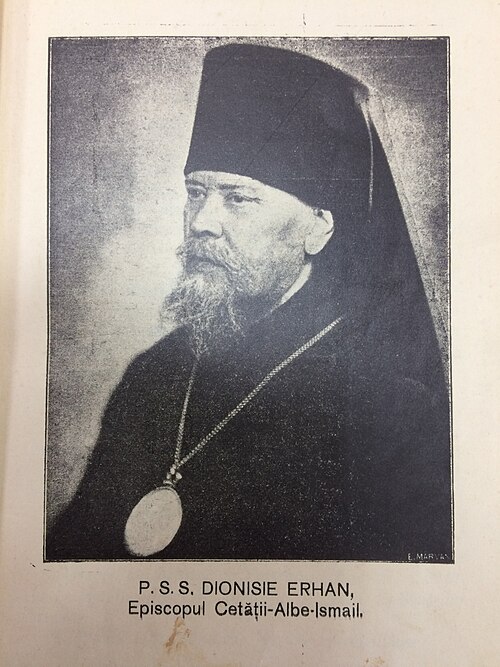
Saint
Dionisie Erhan
Bishop in Bessarabia
Romanian bishop in Bessarabia, born in 1868 and died in Chișinău in 1943; canonized by the Holy Synod in 2018.
- Feast
- September 17old style September 30
- Reposed
- 194320th century
- Place
- Chișinău
- Order
- Hierarchs
Life
Saint Dionisie (Dionysius) Erhan (1868-1943), in the world Dimitrie Erhan, was bishop of Cetatea Albă and Ismail, a Romanian hierarch of Bessarabia, a free peasant (răzeș) and monk from his youth, who spent almost all his life at Suruceni Monastery. The Holy Synod of the Romanian Orthodox Church numbered him among the saints on 25 October 2018, with his memory on 17 September.
Youth and monastic life
He was born on 2 November 1868 in the village of Bardar, now in the Ialoveni district of the Republic of Moldova, to deeply devout parents, Vasile and Andriana, Moldovan răzeși. At baptism he was given the name Dimitrie. At only fifteen, on 28 November 1883, he entered Suruceni Monastery as a brother, where he also learned to read and write. He was made a rassophore in 1890 and received monastic tonsure on 25 September 1899 with the name Dionisie. He was ordained hierodeacon in 1900, chosen steward of the monastery in 1901, ordained hieromonk in 1904, and in 1908 became abbot (according to some sources first acting abbot, from 1906). In 1911 he was given a gilded cross, in 1915 ordained hegumen, and in May 1918 raised to the rank of archimandrite. He received no systematic theological education and was self-taught.
He supported the Romanian movement in Bessarabia. For years he taught all the brothers in the monastery to read and write in Romanian and took care that the monks were instructed and knew the truth of the Orthodox faith and the history of the Church and the nation. He supported the editors of the Moldovan newspaper "Basarabia" and collaborated with the church journal "Luminătorul", where he wrote a series of articles against the Innocentist sect. In 1917-1918 he spoke for the union of Bessarabia with Romania. From June to December 1918 he was exarch of the monasteries of Bessarabia.
Bishop
On 22 July 1918 he was elected bishop of Ismail and consecrated in the cathedral of the Metropolis of Iași. In the first parliament of Greater Romania he was elected almost unanimously senator for the counties of Cetatea Albă and Ismail. On 8/21 February 1920 the diocesan congress elected him vicar of the Archdiocese of Chișinău and Hotin, and he remained abbot of Suruceni, which he renewed almost completely. After the establishment of the Diocese of Cetatea Albă and Ismail in 1923 he was given the title "of Tighina". In 1932 he was named locum tenens of this diocese, and on 20 October 1933 he was elected its titular bishop. The election was not confirmed by the Holy Synod, on the ground that he had no theological studies. On 21 March 1934 the council of the Faculty of Theology of Chișinău, together with the senate of the University of Iași, on the initiative of Dean Nicolae Popescu-Prahova and taking account of the wish of the faithful of southern Bessarabia, conferred on him the title of doctor honoris causa. On 18-19 April 1934 the Holy Synod, under Patriarch Miron, validated the election, and on 27 April 1934 he was invested by King Carol II. He was installed in the cathedral of Ismail on 15 or 20 May 1934 and shepherded there until 1940.
When Bessarabia was occupied by the Soviet army in summer 1940, he fled to Romania and, in 1940-1941, was locum tenens of the Diocese of Argeș, keeping his title. On 1 September 1941 he asked to retire from the see because of his health and age and returned to the monastery of his vows, which he found looted and devastated. In September 1943 he was admitted to the Central Hospital in Chișinău, where he reposed on 17 September 1943. On Monday 20 September he was buried with a service at the church of Saint Nicholas in Chișinău and carried in procession on a cart drawn by six oxen to Suruceni, arriving in the evening. The next day, Tuesday, after the Divine Liturgy served by Archbishop Efrem Enăchescu and Bishop Policarp Morușca, before a crowd of priests and people, he was laid in the tomb beside the church of the Holy Great Martyr George. The inscription on his gravestone says that he was a răzeș of Bardar in Lăpușna, enlightened by the learning of books, a devout monk from childhood, abbot of Suruceni Monastery from 1908 to 1934, brave in the Christian faith, unwavering in love of his people, a supporter of the young toward the light of learning, and an example of a spiritual shepherd to the end.
The finding of his relics and canonization
On 10 July 2018, during consolidation works at the church of the Holy Great Martyr George in Suruceni Monastery, workers came upon his tomb, which had a hole in it, and with the blessing of Metropolitan Vladimir they opened it. The relics were found whole. Abbess Epistimia received the metropolitan's blessing for a detailed study of the bishop's labours, and the main preparation for canonization was taken on by Bishop Veniamin of Southern Bessarabia. On 15 September 2018 the holy relics were clothed in episcopal vestments and placed in a reliquary in the church of Saint Nicholas of the monastery. On 17 September 2018 Metropolitan Vladimir of Chișinău and All Moldova, with Bishop Ioan of Soroca, served the Divine Liturgy and the commemoration for the seventy-fifth anniversary of the bishop's repose. On 25 October 2018 the Holy Synod of the Romanian Orthodox Church numbered him among the saints, with his memory on the day of his death, 17 September. On 28 October 2018, in Bucharest, in the presence of the Patriarch of Romania, the members of the Holy Synod and thousands of pilgrims, the ceremony of his glorification took place. Both representatives of the Metropolis of Chișinău of the Moscow Patriarchate and of the Metropolis of Bessarabia of the Romanian Patriarchate took part in the proclamation of the canonization.
Commemorated the same day September 17
 Lambert of MaastrichtSaint · Bishop of MaastrichtSep 17
 Sophia of RomeMartyrSep 17
 Joachim of AlexandriaSaint · Patriarch of AlexandriaSep 17
 AgathocliaMartyr · Patron of MequinenzaSep 17
 Columba of CórdobaVenerable Martyr · Nun of CórdobaSep 17
- Daniel of YelisavetgradSaint · ElderSep 17
- 100 Egyptian MartyrsHoly MartyrsSep 17
- Alexander of AxylouVenerable · Venerable of Axylou, an AlamanSep 17
- Alexandra KhvorostyannikovaVenerable MartyrSep 17
- AnastasiusSaint · the WonderworkerSep 17
- AsclepiodoteMartyrSep 17
- Broccan CloenVenerableSep 17